 |
 Home | Webstore Home | Webstore
|
|
Latest News:
OOTP 27 Buy Now
- FHM 12 Available
- OOTP Go! 27 Available
Out of the Park Baseball 27 Buy Now! |

|
|
||||
| ||||
|
|||||||
| Earlier versions of OOTP: General Discussions General chat about the game... |
 |
|
|
Thread Tools |
 07-02-2011, 02:29 PM
|
#1 |
|
All Star Starter

Join Date: Jul 2009
Posts: 1,737
|
Hall of Fame Bios
Anyone else do this? I like a nice visual hall of fame. What the game does is ok but I like having a nice setup for these guys.

|

|

|
|
07-02-2011, 02:48 PM
|
#2 |
|
Major Leagues
Join Date: Jun 2007
Posts: 405
|
That's very nice. Good work.
|
|
|
|
|
07-02-2011, 05:30 PM
|
#3 |
|
Hall Of Famer

Join Date: Feb 2006
Location: San Jose, CA USA
Posts: 3,494
|
It would be fantastic of OOTP did something like that!
|
|
|
|
|
07-02-2011, 06:02 PM
|
#4 | |
|
Hall Of Famer

Join Date: Sep 2008
Location: with my army of orangutans
Posts: 2,948
|
I'm guessing you added all of the stats manually, correct? Regardless, can you post a file of this? It's really cool and certainly something I'd like to have for use in my leagues!
__________________
Quote:
|
|
|
|
|
|
07-02-2011, 06:33 PM
|
#5 |
|
All Star Starter
Join Date: Jun 2006
Posts: 1,919
|
What he said.
|
|
|
|
|
07-02-2011, 08:53 PM
|
#6 |
|
All Star Starter

Join Date: Apr 2007
Posts: 1,140
|
Very nice! We've been doing something similar to that for awhile in the USBA - USBA Hall of Fame
__________________
Heartland Baseball League Commissioner Fictional - Stats Only - 30 years of History! HBL HOME PAGE | HBL REPORTS HOME | HBL UTILITIES HOME |
|
|
|
|
07-02-2011, 11:20 PM
|
#7 |
|
All Star Starter
Join Date: Jul 2009
Posts: 1,737
|
I just have the one guy in there (my league is only in 1920 and I don't plan on starting the HoF until 1930) as a sample for this league so I have the basic template for it when my HoF starts. It's done on a open office (microsoft word for those who have money) document. I had a great one for OOTP 10 but that league and file is long gone.
It requires minimal knowledge of word and the ability to create simple tables. If anyone is interested in my HoF voting or Homerun derby methods feel free to ask. EDIT: jhere is the file http://www.megaupload.com/?d=QND8JJHI should open with open office or micro word. |
|
|
|
|
07-03-2011, 12:08 AM
|
#8 |
|
All Star Starter
Join Date: Jun 2006
Posts: 1,919
|
Downloaded it but it won't open in Word (no option) or Excel (gave option but wouldn't open). Is it supposed to be a .odt file?
|
|
|
|
|
07-03-2011, 01:31 AM
|
#9 |
|
Minors (Single A)
Join Date: Jul 2003
Location: Texas
Posts: 63
|
Yes, .odt is the open office file extension. Word 2010 will open it. I'm guessing you don't have that though...in which case I THINK you could save it on google documents as a word file an then open in an earlier version of word.
Roger |
|
|
|
|
07-03-2011, 08:17 AM
|
#10 |
|
All Star Starter
Join Date: Jun 2006
Posts: 1,919
|
Yeah, I only have Word 2003. I can probably reproduce it myself, I was just hoping to save myself the work.
|
|
|
|
|
07-03-2011, 02:14 PM
|
#11 | ||
|
Hall Of Famer
Join Date: Sep 2008
Location: with my army of orangutans
Posts: 2,948
|
Quote:
 Can you please post them? Can you please post them?
__________________
Quote:
|
||
|
|
|
|
07-10-2011, 08:00 PM
|
#12 |
|
All Star Starter
Join Date: Jul 2009
Posts: 1,737
|
Sorry been on vacation in florida seeing my daughter I return tomorrow night at which point I will show my hof voting method and homerun derby
|
|
|
|
|
07-10-2011, 10:57 PM
|
#13 | |
|
All Star Reserve

Join Date: Dec 2005
Location: In a fictional baseball world
Posts: 843
|
Quote:
So perhaps the OP can do that for you. I don't have it here at this location or I'd help.Awesome product by the way, does about 95% of what the average office person would use Microsoft's products for -- for free! 
__________________
|
|
|
|
|
|
07-12-2011, 02:27 AM
|
#14 |
|
All Star Starter
Join Date: Jul 2009
Posts: 1,737
|
MY HALL OF FAME VOTING METHOD
HOF Voting All you need is the site random.org and to be able to set up two random integer generators on it. One that ranges 1-6 and another 2-9. Upon the five year waiting period a player is eligible for his first voting. At that time I assign them a number from 0.5 and above if they are eligible for the hall of fame (10 years of service and I usually limit it myself to those with at least one all-star appearance to get on the ballot) The number is decided as follows. Each stat on the chart gets you a certain number of points. As you can see below a career with say 1378 Runs scored will add 1.0 points and someone who say broke 1841 Runs scores would get 3.0 points. 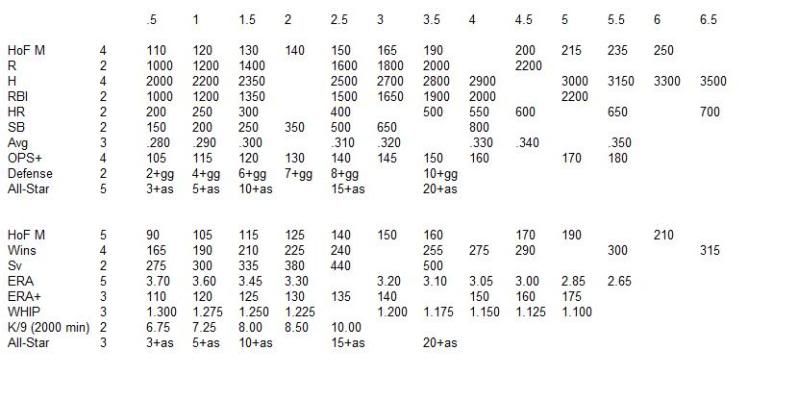 NOTE: disregard the first single digit number column as it serves no purpose now I forgot to erase that. Their hall of fame monitor is based on the Baseball-Reference formula. Now add up all of the points they may have received from their career major league totals. If your league uses pre-1930 settings you may not get accurate results for this particular chart and may use the following guide. Below are general ideas of how to distribute a number to a player and some examples with each tier. 25 is generally for those who are unquestionably first ballot HoFers (Babe Ruth, Ty Cobb, Walter Johnson). 20-24 are for those who are most likely a first ballot HoFer but not 100 percent. These are almost guaranteed to make it to the hall the first few years. (Lou Brock, Robin Yount, Carlton Fisk) 15-19 are for those who led an illustrious career and can gain at least half the vote on the first ballot. More than likely they will eventually get in. (Ryne Sandberg, Juan Marichal, Robin Roberts, Catfish Hunter) 10-14 are used for borderline Hall of famers. These have a good chance to either make it one day or just end up completely missing it. Still the hall favors this group and are more than likely to get in on a late try. But it's not a guarantee (Steve Garvey, Pee Wee Reese, Enos Slaughter, Andre Dawson) 5-9 Used for players who have a less favorable chance but still had a memorable career. Usually a multiple time all-star who has a shot at the hall someday. (Alan Trammel, Don Mattingly, Bill Mazeroski, Ken Boyer, Gil Hodges, Roger Maris) 0-4 Usually for those will make it on the ballot but either not make the 5% cut or eventually be cut, or sit between 5-20% for 15 years. Very slim shot of ever seeing the hall. (Curt Flood, Dave Concepcion, Thurman Munson) Whichever way you chose to assign the first number to a player you now are at the following step. I take these numbers and and roll that amount of times using the 1-6 number generator to get there first ballots percentage of votes. Results can be seen below. If a player has a 0.5 it is half of the number you get. TO BE CLEAR, the number you assign to a player is how many times you did the 1-6 number generator for their first ballot. If someone had 5 points based off of the charts or guide you generate 5 numbers from the 1-6 generator and add them up. Keep these percentages handy as you will use them again for those who fail to make the hall. When next season rolls around these percentages are a base for these players votes for there second season. You will generate ONE number from the 2-9 generator to see how much you will add to the percentage, then click the 1-6 generator to see how much to take off their percentage. Most players gain votes every year they are on the ballot which is why the Positive die is bigger than the negative. If the positive die is a 7 and the negative die a 2, then the player gains 5% If the positive die is a 0 and the negative a 6, then the player loses 6% of his vote. If a player drops below 5% of the vote he may not be voted on again. A player also has a maximum of fifteen years on the ballot. NOTES Anything 25 and above from the inital points is basically a guarantee the first year or second. Anyone receiving at least 10.0 points from the initial guide has a legitimate shot at making it and should splash in with around a 35% first ballot and will usually end up between 45% and making the hall of fame. Below 10.0 points for the initial ballot and likely the player will never even near 60% of the vote (And 60% would require a ton of lucky number generators.) EXAMPLE BELOW I will randomly choose 17 former all stars for a mock ballot. Also next to them I will show the initial point total they got based off of their career stats and using my guide shown above in the picture. Rod Carew - 22.0 Steve Garvey - 11.0 George Brett - 21.5 Rocky Colavito - 5.0 Ron Santo - 7.0 Steve Sax - 3.5 Don Mattingly - 10.0 Tony Gwynn - 23.5 Jeff Bagwell - 15.5 Dolph Camilli - 2.5 Luke Appling - 11.0 Whitey Ford - 17.0 Bob Lemon - 6.0 Tom Seaver - 24.0 Jim Kaat - 9.0 Greg Maddux - 23.0 Bert Blyleven - 11.0 Above you will see how many initial points each player received based on the chart guide above. Now we will take these numbers and generate that many numbers using a 1-6 random number generator. Below are the results. Tony Gwynn - 86% Greg Maddux - 81% Tom Seaver - 78% George Brett - 77.5% ------------------- Rod Carew - 72% Whitey Ford - 62% Jeff Bagwell - 55% Luke Appling - 47% Steve Garvey - 42% Bert Blyleven - 41% Don Mattingly - 32% Jim Kaat - 32% Ron Santo - 25% Bob Lemon - 20% Rocky Colavito - 17% Dolph Camilli - 12% Steve Sax - 6% As you can see 4 of the players made the hall of fame on the initial ballot. 13 others remain ranging from 6-72 percent. Below is the new ballot for the next fictional season. Rod Carew - 72% Whitey Ford - 62% Jeff Bagwell - 55% Luke Appling - 47% Steve Garvey - 42% Bert Blyleven - 41% Don Mattingly - 32% Jim Kaat - 32% Ron Santo - 25% Bob Lemon - 20% Rocky Colavito - 17% Dolph Camilli - 12% Steve Sax - 6% Using these as a base number I then use the random number generator (2-9) to see how much I add to each percentage. Then I use the other number generator (1-6) to see how much i minus from each percentage. A positive 7 results and a negative 3 result would equal a 4% increase in votes from the previous year. Below are the results of the second year's ballot. Rod Carew - 72% Whitey Ford - 65% Jeff Bagwell - 57% Luke Appling - 51% Bert Blyleven - 42% Steve Garvey - 41% Don Mattingly - 33% Ron Santo - 33% Jim Kaat - 31% Rocky Colavito - 25% Bob Lemon - 22% Dolph Camilli - 12% Steve Sax - 5% As you can see Carew's percentage stood still and no new members were added from this bunch. (75% is needed). Also you see Steve Sax is on the brink of being off the ballot having lost 1% being brought to the 5% minimum needed to stay on. Also You can see Santo and Colavito both had big 8% jumps. Below I will show the FINAL result for each player after 15 years of them on the ballot finishes. I will show their final voting percentage and what year they were inducted if they made it to the hall and the difference between their final and initial %. Rod Carew - 78%, 4th year, +6% Whitey Ford - 78%, 8th year, +16% Jeff Bagwell - 76%, 5th year, +21% Luke Appling - 78%, 11th year, +31% Bert Blyleven - 77%, 13th year, +36% Steve Garvey - 75%, 11th year, +33% Don Mattingly - 62%, NO, +30% Ron Santo - 68%, NO, +43% Jim Kaat - 35%, NO, +3% Rocky Colavito - 47%, NO, +30% Bob Lemon - 62%, NO, +42% Dolph Camilli - 55%, NO, +43% Steve Sax - 15%, NO, +9% In the end 10 of the 17 in my fictional ballot made it to the hall of fame. In real life 8 of them are, Maddux will more then likely make that 9 and Bagwell has a good chance of making it 10 which would be consistent with the real life inductees. HOMERUN DERBY: I stole it from someone else on this site but I give 10 outs to each player in it and use a 1-100 random number geenratoe. If a player (on the 1-20 ratings) has a 14 homerun power then I multiply that by 2 and anything that is a 28 or below is a homerun. 29 and above is an out. It gives very realistic results. 10 power = 20 and below homerun 20 power = 40 and below homerun. Last edited by hfield007; 07-12-2011 at 02:32 AM. |
|
|
|
|
07-12-2011, 03:03 PM
|
#15 |
|
Minors (Double A)

Join Date: Mar 2009
Location: Ribeira Brava, Portugal
Posts: 120
|
That is great and shows that you really care about your leagues! Thanks for sharing, I'll try this myself
__________________
"We only make peace with our enemies. That's why it's called making peace". |
|
|
|
|
07-12-2011, 04:00 PM
|
#16 |
|
All Star Starter
Join Date: Jun 2006
Posts: 1,919
|
I think I'm going to steal the HoF part too. My one question is how you go about assembling all the initial data without it taking forever. Do you use a filter on the retired players screen?
|
|
|
|
|
07-12-2011, 04:02 PM
|
#17 |
|
All Star Starter

Join Date: Jun 2005
Location: London, Ont. Canada
Posts: 1,106
|
Wow dude! That is too much work for me. That being said, that is a wonderful model you have set up and I think many here will use it and enjoy it.
Thanks for posting it. |
|
|
|
|
07-12-2011, 04:04 PM
|
#18 |
|
All Star Starter
Join Date: Jun 2006
Posts: 1,919
|
Come to think of it, is there any way of getting a similar process in place for OOTP 13 as an alternate option to the "milestone method" of selecting players for the hall?
Caveat being that I have no idea how difficult it would be to program in and still have it be effective for non-MLB setups. |
|
|
|
|
07-12-2011, 05:58 PM
|
#19 | |
|
All Star Starter
Join Date: Jul 2009
Posts: 1,737
|
Quote:
I keep a seperate wordpad file that keeps each retiring player who has ten years of service and at least 3000 PA or a reasonable amount of games pitched handy so I know who to add to the ballot each season (if doing this remember to check every minor league and major elague at the end of their respective seasons for retirements in the transactions and recheck each one each january 1st for the other retirements and keep an eye on career enders). After compiling the list of newly retired players at the end of each season (usually 5-12 players a year as of now) I do their initial number right then and put it in the wordpad file so that when they become eligible in 5 more seasons I know how many times to run the number generator for their first percentage. ALSO I DIDNT MENTION above that when figuring out the inital amount of times to run the generator for a relief pitcher I halve the number. It is more realistic as relievers get rare induction but it gives the very good ones a shot. You may even want to cut the number in thirds, it's up to you but I always use half the number. Last edited by hfield007; 07-12-2011 at 06:00 PM. |
|
|
|
|
|
07-12-2011, 06:40 PM
|
#20 |
|
All Star Starter
Join Date: Jun 2006
Posts: 1,919
|
Do you also set the milestone thresholds for induction to absurdly high values so that no one gets in that way?
I think this is going to turn into a league I run for the sole purpose of HoF inductions. |
|
|
|
|
| Bookmarks |
|
|


