 |
 Home | Webstore Home | Webstore
|
|
Latest News:
OOTP 27 Buy Now
- FHM 12 Available
- OOTP Go! 27 Available
Out of the Park Baseball 27 Buy Now! |

|
|
||||
| ||||
 01-16-2011, 03:23 PM
|
#21 |
|
All Star Starter

Join Date: Jun 2002
Posts: 1,166
|
Professional Base-Ball Methods
Special Dispatch to the New York Times
Cleveland, December 5, 1878 The third annual session of the National League of Professional Base-ball Players met to-day at Kennard House. Troy, Syracuse, Buffalo, and Cleveland clubs were admitted to membership. The championship pennant for the 1878 season was awarded to the Chicago club. President O'Connell tendered the resignation of the Indianapolis Club, which was accepted. The following amendment to the rules was adopted: The pitcher will not be allowed to turn his back to the batsman while in the act of delivering the ball. A resolution was adopted to give the Milwaukee Club 20 days in which to pay its indebtedness and withdraw honorably from the league, at the expiration of which time, if not paid, it will be considered expelled. It was decided to hold the special meeting next Spring to adopt the schedule, and the next annual meeting at the Grand Hotel, Cincinnati. The contract for furnishing balls for the league clubs next season was award to B.A. Osgood & Brother, Chicago. The organization of the nines for 1879:
 Shag O'Connell, president of the Indianapolis Club
__________________
FABL -- Chicago Chiefs |

|

|
|
01-16-2011, 04:43 PM
|
#22 |
|
All Star Starter
Join Date: Jun 2002
Posts: 1,166
|
1879
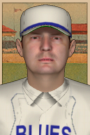
For much of the summer, the White Stockings were in a close race with Boston and the new Buffalo club. The latter two faded over the last two months, leaving Chicago at the end with a rather impressive margin of victory.
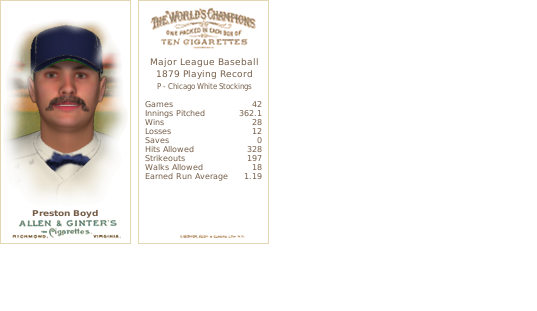
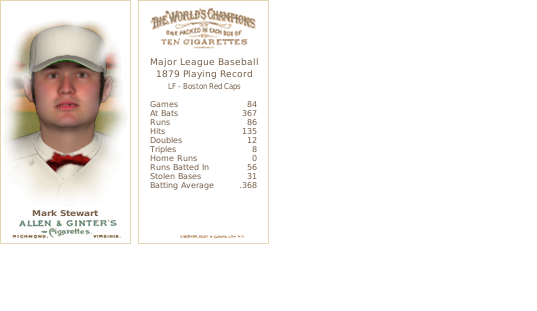
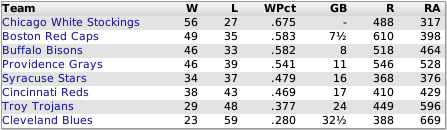 Chicago was led by newly acquired pitcher Preston Boyd (23-12, 1.19). Boyd had entered the league in 1877 as an 18 year old with Hartford. Chicago manager Osgood has extracted a promise from Boyd for his services for at least the next 3 years. Chicago could have something special on its hands. 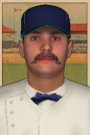 Preston Boyd As in 1877, Boston's best assets were its batsmen, with young OF Mark Stewart (.368, 86 runs, 31 stolen bases) leading the charge. Buffalo's bats were right behind the Bostons. Julius Hans (.354, 27 doubles, 63 runs) has been playing professional base ball since 1871, and he enjoyed his best season for the Buffalo club in 1879. Hans set a new league record for two-base hits. 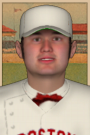 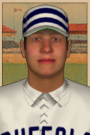 l-to-r, Mark Stewart, Julius Hans
__________________
FABL -- Chicago Chiefs |
|
|
|
|
01-16-2011, 05:13 PM
|
#23 |
|
All Star Starter
Join Date: Jun 2002
Posts: 1,166
|
1879 National League Award Winners
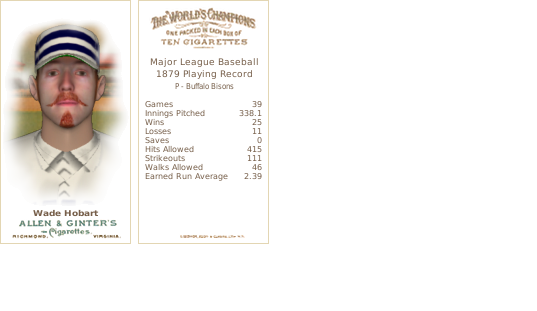
Preston Boyd of the Chicagos took home the Cartwright Award; Mark Stewart of Boston was award the Chadwick, and Wad Hobart of the Buffalo club was the top amateur.
__________________
FABL -- Chicago Chiefs |
|
|
|
|
01-16-2011, 05:41 PM
|
#24 |
|
All Star Starter
Join Date: Jun 2002
Posts: 1,166
|
The Base-Ball Season
New York Times
Buffalo, N.Y., December 2, 1879 The League Base-Ball Association met again to-day. The session was held with closed doors. The League awarded the 1879 Championship Pennant to the Chicago Club. A committee was appointed to prepare the schedule for 1880. The same ball that was used last season was adopted. It was concluded to continue the present price of admission. The playing rules were changed. Eight balls instead of ten will be called hereafter. The catcher will be compelled to catch the ball on the fly, the bound between abolished. If the side at the bat in the ninth inning secures the winning run, the game is to be called without putting out three men, as heretofore. The league nines:
The members of each of these nines are in splendid condition. It is the general opinion that the club which carries off the honors this year will be obliged to do the hardest work that has ever been done in the ball-field in a single season. The playing this year will commence May 1, at Cincinnati, between the Chicago and Cincinnati clubs.
__________________
FABL -- Chicago Chiefs |
|
|
|
|
01-16-2011, 08:55 PM
|
#25 |
|
All Star Starter
Join Date: Jun 2002
Posts: 1,166
|
1880
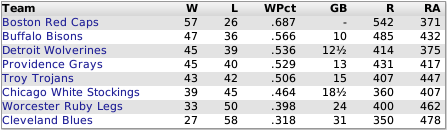
As a new decade dawned, professional base ball was entering it's tenth season. League president Roller has the league in a pretty strong position. The 50 cent admission rule was wreaking havoc in the smaller cities--Syracuse dropped out of the league after 1879 to be replaced by Worcester. But overall, interest in base ball was increasingly strong. Chicago manager Ben Osgood's sporting goods company was selling hundreds of thousands of bats and balls (including the Osgood Official National League Base Ball) each year as young boys played the sand lot version of the game. Independent teams were coalescing into various "minor leagues" (a few of which will start to make their appearance in this history in a few years). The league continued to stay out of New York and Philadelphia, but strong independent teams were popping up to fill that void. The New York Metropolitans (or "Mets" for short) started playing in September of 1880. They played over 150 games in 1881, surpassing most of the league teams in revenue.
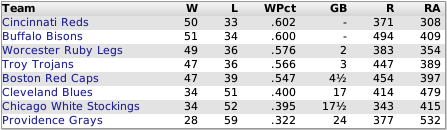 As Boston and Chicago were racked by injuries, the 1880 season turned out to be a a race between the Cincinnati and Buffalo clubs. Buffalo won the most games, but Cincinnati won the greater pecentage of its games. Over the course of the summer, Cincinnati chairman J.G. Sohn, a brewery owner, took advantage of the interest the championship run produced by starting to sell beer at Reds games. The league, of course, was not happy with Sohn. 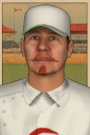 J.G. Sohn In response to league president Roller's increased pressure on Cincinnati to stop the beer sales, Sohn withdrew the club from the league. Sohn formed an alliance with St. Louis baseball interests (another German heavy immigrant city with a number of breweries). Cincinnati and the St. Louis club will play a number games against each other in 1881, greatly increasing the beer sales in both cities. Unwittingly or not, by keeping a hard line against Cincinnati, Roller had himself sowed the seeds of a second professional league.
__________________
FABL -- Chicago Chiefs Last edited by mjj55409; 01-17-2011 at 09:00 AM. |
|
|
|
|
01-16-2011, 09:33 PM
|
#26 |
|
All Star Starter
Join Date: Jun 2002
Posts: 1,166
|
1880 National League Award Winners
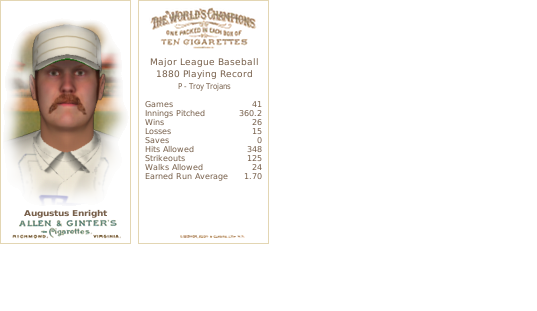
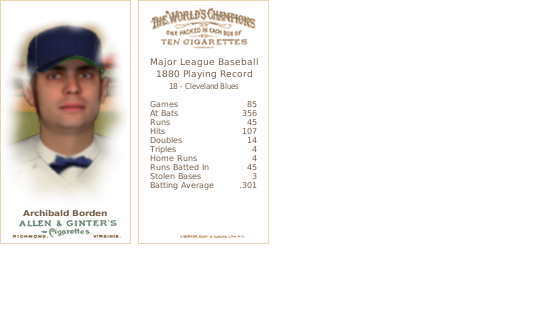
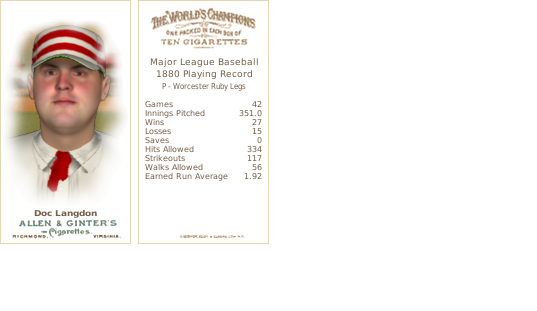
The Cartwright Award to Augustus Enright of Troy; the Chadwick Award to Archibald Borden of Cleveland; the best amateur to Doc Langdon of Worcester.
__________________
FABL -- Chicago Chiefs |
|
|
|
|
01-16-2011, 09:45 PM
|
#27 |
|
All Star Starter

Join Date: Nov 2004
Location: Safety Harbor, FL
Posts: 1,525
|
I'm going to really enjoy this. Your posts are very well laid out, nice and neat. Really like the format.
|
|
|
|
|
01-17-2011, 08:37 PM
|
#28 |
|
All Star Starter
Join Date: Jun 2002
Posts: 1,166
|
1881
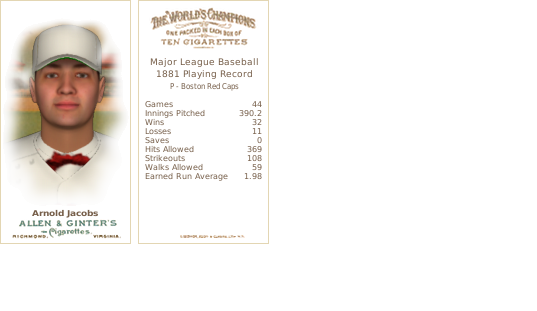
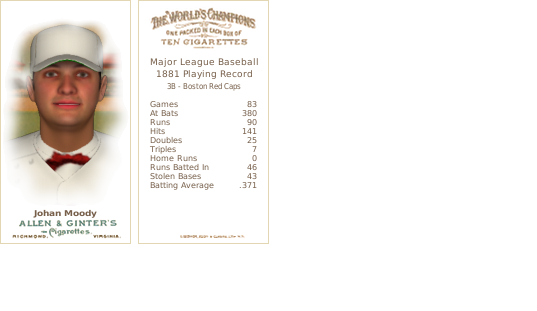
 As usual, the Boston batsmen were the class of the league. And with the pitching of newly acquired Arnold Jacobs (32-11, 1.98), the Bostons had little trouble in securing the championship pennant. 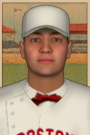 Arnold Jacobs Buffalo once again was second fiddle. Grant Franklin (.343, 15 doubles, 41 runs, 54 rbi) finished second to Boston's Johan Moody (.371) in batting average. Pitcher Duncan Hinkley (25-13, 1.71) moved from Chicago to Detroit, and he was able to keep the Wolverines in the race for a while. 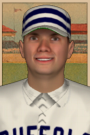 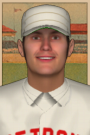 l-to-r, Grant Franklin, Duncan Hinkley
__________________
FABL -- Chicago Chiefs |
|
|
|
|
01-17-2011, 09:33 PM
|
#29 |
|
All Star Starter
Join Date: Jun 2002
Posts: 1,166
|
1881 National League Award Winners
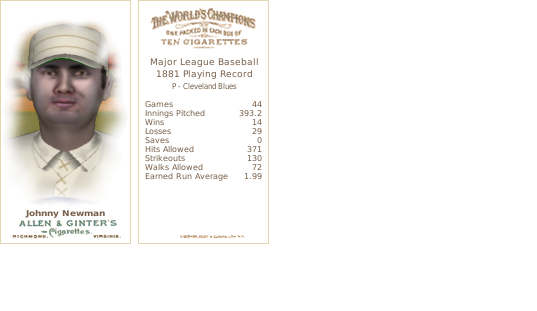
The Cartwright and the Chadwick award both went to Boston, to Arnold Jacobs and Johan Moody respectively. Johnny Newman suffered through 29 losses for Cleveland, but he was named the top amateur for his efforts.
__________________
FABL -- Chicago Chiefs |
|
|
|
|
01-17-2011, 09:51 PM
|
#30 |
|
All Star Starter
Join Date: Jun 2002
Posts: 1,166
|
New Base-Ball League Proposed
New York Times
Cincinnati, November 2, 1881 A base-ball convention to form a new league is in secret session here, Representatives are present from New-York, Boston, St Louis, Pittsburg, Cincinnati, Brooklyn, and Philadelphia. All these seek admission, and the question under discussion is how many shall be admitted. The association was organized under the name, "American Association of Base-Ball Players," and the constitution of the old league taken as a basis, but materially modified with a view of making the clubs self supporting and affording more liberal conditions to the clubs and players. It has been determined to require a fixed sum to be paid visiting clubs for every game, leaving to the home clubs the management of prices and admissions The final organization of the clubs:
The biggest question around the formation of the Association concerned the involvement of the New York Metropolitan club. John Day, who owned the New York club, had the ultimate goal of joining the National League. The League continued to rebuff Day, but he didn't want to risk alienating the League by joining the new Association. So the Metropolitans will remain on the sidelines.
__________________
FABL -- Chicago Chiefs |
|
|
|
|
01-18-2011, 10:32 AM
|
#31 |
|
All Star Starter
Join Date: Jun 2002
Posts: 1,166
|
1882
Officially, the National League ignored the American Association. The pro-league newspapers in New York and Chicago derided the new league as "The Beer and Whiskey League," which was true insofar as one of the popular features of the league was the ability to buy beer at games. Beer which was typically either brewed by the owner of the club or sold by a tavern keeper with an interest in the club. But overall the American Association brought "big league" base ball back to Cincinnati, St. Louis, and Philadelphia, and the repercussions will be felt for decades.
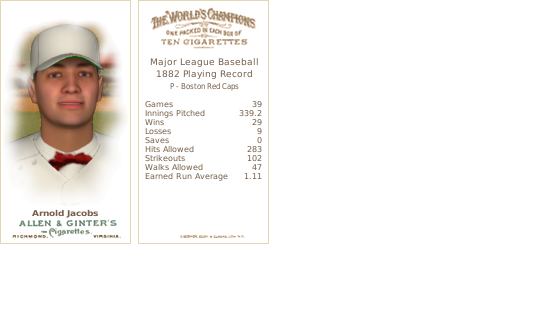
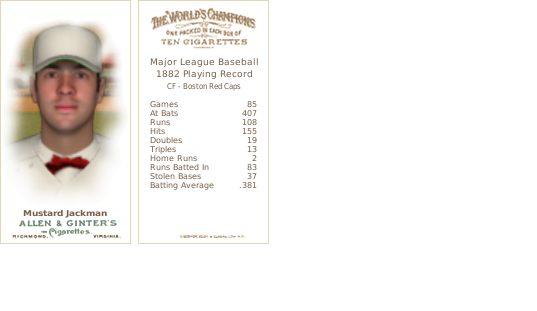
The summer of 1882 was a good one for base ball. There were close pennant races in both the League and the Association. In the League, Boston and Detroit exchanged leads all summer, with Boston ultimately finishing on top for its second consecutive pennant. 1882 National League Standings 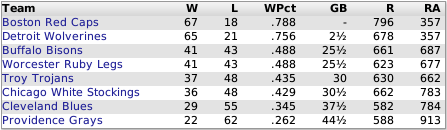 Boston's Mustard Jackman (.381) won his third batting title (and second in the last three seasons). Detroit's Max Cowley (.371) was the runner-up. Offense overall was on an upswing as rules and playing fields were adjusted to give the batters a bit more of an advantage. Buffalo's Green Stearns hit 11 home runs, while the Chicago club as a whole accounted for an astounding 45. 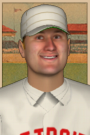 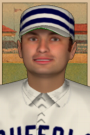 l-to-r, Max Cowley, Green Stearns Boston had the top two pitchers in the League in Arnold Jacobs (29-9, 1.11) and Gardner Cornwell (26-6, 1.57). Detroit's Phillip Jeffrey won 26 league games. 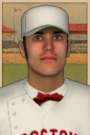 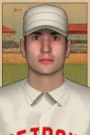 l-to-r, Gardner Cornwell, Phillip Jeffrey In the Association, Pittsburgh, Louisville, Cincinnati, and Baltimore were neck and neck all season. Cincinnati averaged over 8 runs per game. But ultimately it was Baltimore finishing on top to claim the Association's inaugural pennant. 1882 American Association Standings 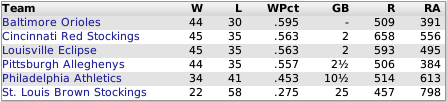 Cincinnati's Chris Parrish (.339) was the Association's batting champion, with Baltimore's tavern keeper turned base ball player Owen Rooney (.323) the runner-up. St. Louis's Mansfield Blunt matched the home run tally of Green Stearns at 11. 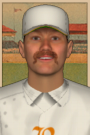 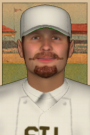 l-to-r, Owen Rooney, Mansfield Blunt For the Baltimores, pitcher Fuzzy Bradfield (22-11, 1.29) was one of the big National League stars to make the jump to the Association, and he proved instrumental in the Baltimore championship. Doc Langdon, another former league pitcher, won 27 games for Cincinnati. 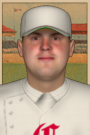 Doc Langdon
__________________
FABL -- Chicago Chiefs |
|
|
|
|
01-18-2011, 11:17 AM
|
#32 |
|
All Star Starter
Join Date: Jun 2002
Posts: 1,166
|
1882 Award Winners
For the National League, Arnold Jacobs wins his 2nd consecutive Cartwright and team mate Mustard Jackman takes home the Chadwick.
  In the Association, Cincinnati's Doc Langdon is named the Cartwright winner, and team mate Chris Parish is awarded the Chadwick. 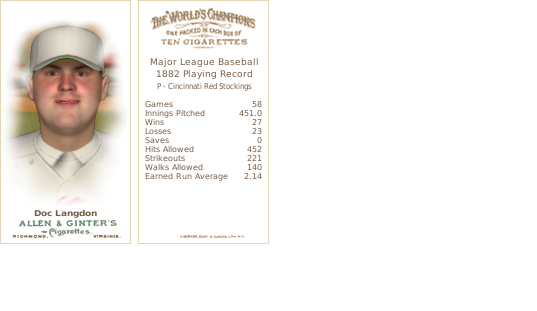 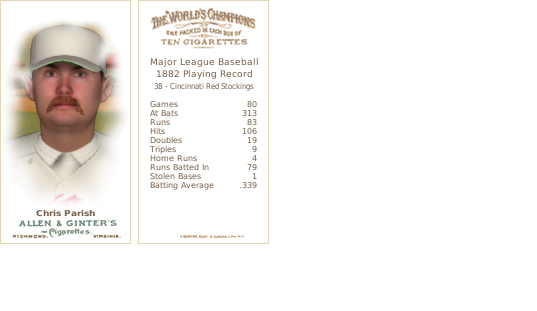
__________________
FABL -- Chicago Chiefs |
|
|
|
|
01-18-2011, 12:44 PM
|
#33 |
|
All Star Starter
Join Date: Jun 2002
Posts: 1,166
|
1883
In the Winter of 1882-1883, the National League named a new president, attorney Abraham Mills, the first league president without a tie to a club. Mills' first order of business was to establish peace with the American Association. With the help of New York Metropolitan president John Day, the "National Agreement of Baseball Clubs" is drawn up and agreed to by the National League and the American Association. The agreement states that the clubs will honor the contracts of the other clubs and that each club would have the right to "reserve" 11 players at the end of each season. This "reserve clause" means that the players are effectively under contract with a team in perpetuity (as long as their skills hold out, that is). This of course was wildly unpopular with the players.
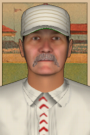 John Day With a peace brokered, John Day applied for admission to both the League and the Association, and he was accepted to both. The Metropolitan club was to join the Association, and Day created the New York Gothams club for entry into the League. For the Gothams, Day purchased the players from the defunct Worcester club, along with the best players from the folded Troy club--Blondie Clapp, Frederich Schaefer, and Clifton Workman--and transferred the contract of celebrated amateur Seamus O'Grady from the Metropolitans to the Gothams. 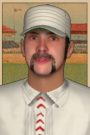 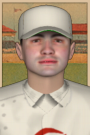 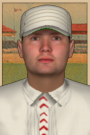 l-to-r, Blondie Clapp, Fredrich Schaefer, Clifton Workman In the National League, the championship was once again contested between the Boston and the Detroit clubs. And for the second consecutive season, Boston finished on top. 1883 National League Standings 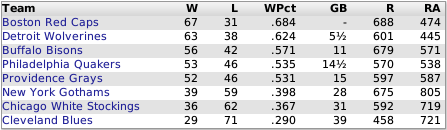 A pair of New York Gothams team mates finished atop the batting average race--Seamus O'Grady (.385) and Zeke Hammon (.366). Chicago's Edgar Haglett set a new league record with 13 home runs. 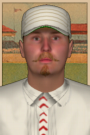 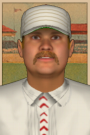 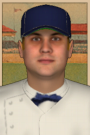 l-to-r, Seamus O'Grady, Zeke Hammon, Edgar Haglett But it was the pitching of Boston and Detroit that was too much for the rest of the league. Boston's Arnold Jacobs (30-13, 1.85) had another fine season. Detroit's Arch Hawley (28-15, 1.68) was second to Jacobs in wins. 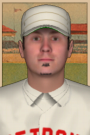 Arch Hawley In the American Association, Cincinnati, Baltimore, and Louisville all were competitive, but in the end Cincinnati won the championship by a sizable margin. 1883 American Association Standings 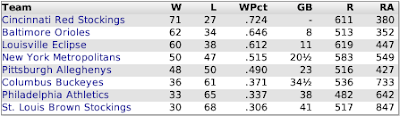 After jumping from Cincinnati to Louisville, Hawk Olds (.318) won the batting championship for the Eclipse, with with Cincinnati's Chris Parish (.315), and Cleveland's Punkin Everett (.315) finishing second. Cincinnati's Williams Easton won 34 league games, while a trio of Baltimore pitchers dominated the ERA leaderboard--Preston Boyd (14-4, .79), Phillip Jeffrey (21-12, 1.08), and Fuzzy Bradfield (14-4, 1.17). 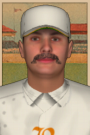 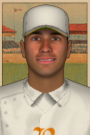 l-to-r, Preston Boyd, Fuzzy Bradfield
__________________
FABL -- Chicago Chiefs Last edited by mjj55409; 01-19-2011 at 11:12 AM. |
|
|
|
|
01-18-2011, 10:10 PM
|
#34 |
|
Hall Of Famer

Join Date: Apr 2008
Posts: 2,464
|
Nicely done. Love the old school unis.
|
|
|
|
|
01-19-2011, 11:24 AM
|
#35 |
|
All Star Starter
Join Date: Jun 2002
Posts: 1,166
|
1883 Award Winners
In the National League, Boston's Arnold Jacobs is awarded his third consecutive Cartwright. New York Gothams Seamus O'Grady is given the Chadwick Award. Tim Majors of Louisville is named the top amateur.
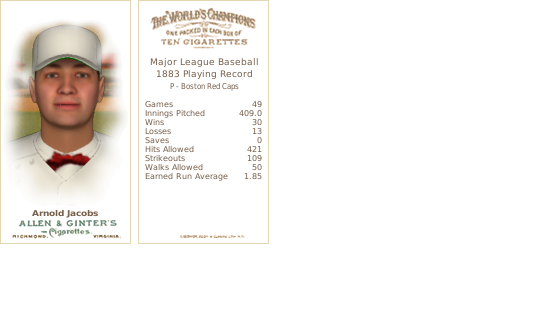 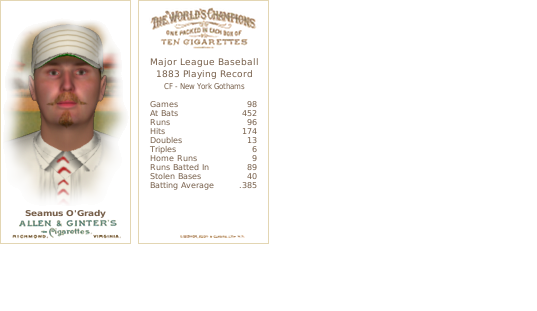 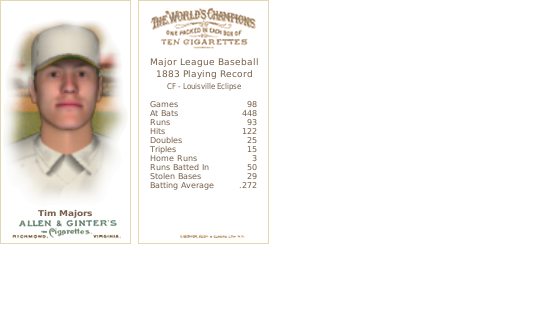 In the Association, the Cartwright and Chadwick are presented to a pair of Cincinnati team mates, Williams Easton and Chris Parish. It is the second consecutive Chadwick for Parish. The top amateur is Bernhard Gilliam of the Philadelphia Quakers. 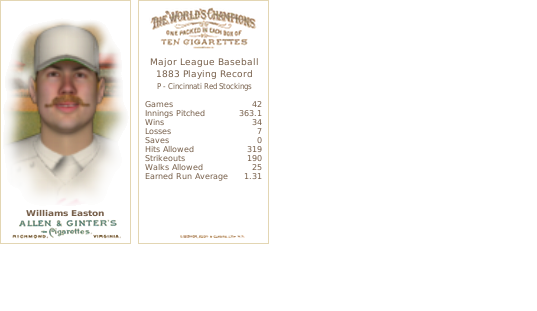 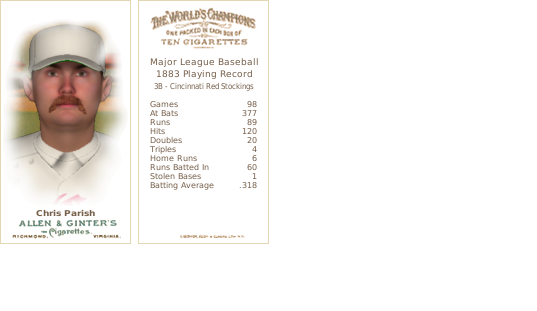 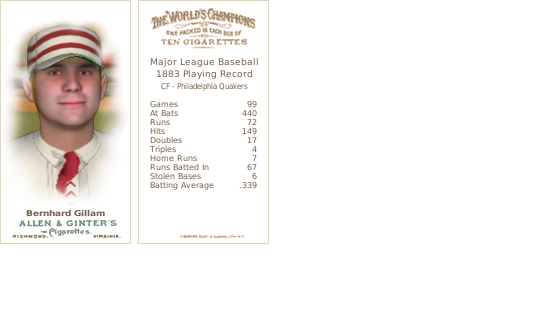
__________________
FABL -- Chicago Chiefs |
|
|
|
|
01-19-2011, 02:36 PM
|
#36 |
|
All Star Starter
Join Date: Jun 2002
Posts: 1,166
|
A New Association
New York Times
Pittsburgh, Penn., September 12, 1883 Delegates representing Chicago, Philadelphia, Pittsburgh, Baltimore, Washington, Richmond, Indianapolis, and St. Louis met at the Monongahela House to-day and organized the "Union Association of Base-ball Clubs." The constitution and by-laws of the American Association, with a few changes were adopted. The following was unanimously adopted: Resolved, That, while we recognize the validity of all contracts made by the League and American Association, we cannot recognize any agreement whereby any number of ball-players may be reserved for any club for any time beyond the terms of their contracts with such club.Secretary White is confident of the success of the new association. In an interview this evening he said: "We are certain to succeed. Our refusal to be bound by the 'eleven-men reserve rule' assures of of the good-will of every player in the country, for the stand we have taken is directly in their interest." ******* 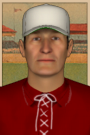 Abe Morrill One of the primary backers of the new association was St. Louis real estate magnate Abe Morrill. A scion of one of St. Louis' oldest families, Morrill had tremendous wealth and was a great fan of baseball. He had been denied membership, however, when the American Association started up, and the League refused him a franchise also, not wanting to compete with the the Association's St. Louis club. So the best idea at the time seemed to be to take advantage of baseball's burgeoning popularity and start a new league. The Union Association maintained publicly that they did not intend to "war" with either League nor the American Association, but their constitution directly attacked the reserve clause, and the Unions were planning to place clubs in six major league cities--Baltimore, Boston, Philadelphia, Chicago, Cincinnati, and St. Louis. To thwart the Unions, John Day, New York owner, introduced a resolution at the November meeting of the League to blacklist any reserved player who jumped his contract. The purpose was not only to discourage a player from going over to the Unions, but to lessen the temptation to lure him back with a higher salary, which would amount to rewarding instead of punishing him for leaving. The Day Resolution was successful. Very few League or Association players signed with the Unions, and most that did were marginal players. St. Louis managed the biggest signings, with Hardy McGowan, Levi Callaway, Pepper Perry, and Eugene Jett. 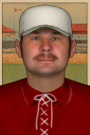 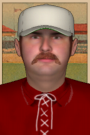 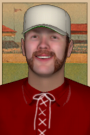 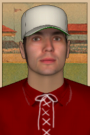 l-to-r, Hardy McGowan, Levi Callaway, Pepper Perry, Eugene Jett Beyond these kinds of signing, the Union clubs succeeded in finding a few players that were of major league quality. But overall the talent level of the Unions was quite low.
__________________
FABL -- Chicago Chiefs |
|
|
|
|
01-19-2011, 04:15 PM
|
#37 |
|
All Star Starter
Join Date: Jun 2002
Posts: 1,166
|
1884
The summer of 1884 was a chaotic time for baseball. There was the ongoing war with the Union Association. Club owners spent as much time in court in 1884 as they did at the ballpark. And the Union Association was losing badly. It suffered its first casualty after only six weeks of operation, when Altoona withdrew. Abe Morrill spent the summer industriously trying to patch up his circuit by finding replacements for clubs as they expired.
Kansas City substituted for Altoona and finished the season. The Chicago franchise was transferred to Pittsburgh in August, where it remained until mid-September, when St. Paul filled in for the balance of the season. The Keystones of Philadelphia also disbanded early in August. Wilmington was brought in from the minor Eastern League to fill the gap, but it survived only a month, after which Milwaukee was enlisted. All told, only five of the original eight Union clubs--Cincinnati, St. Louis, Baltimore, Washington, and Boston--carried on to the end. The total of thirteen Union clubs, together with the Association's thirteen and the National League's eight, made thirty-four clubs operating in 1884, a figure unsurpassed in major league history. Out of all, six clubs were concentrated in Pennsylvania, five in Ohio, and four in New York state. All three leagues competed in Philadelphia. Eight other cities contained two competing clubs. Gate receipts naturally dwindled. 1884 Final Union Association Standings 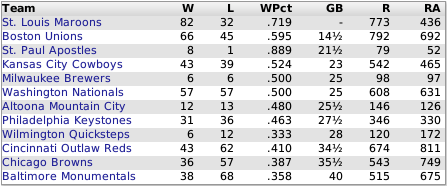 Morrill's St. Louis club outclassed the competition. There was never any doubt they would win the championship. League refuges Levi Callaway (34-14, 1.29), Pepper Perry (25-10, 1.28), and Eugene Jett (18-3, 1.86) made for a dominating pitching staff. 1884 Final National League Standings 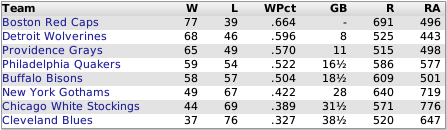 In the league, Boston maintained its lead all summer and Detroit was never a serious threat. Boston's Arnold Jacob won a league-record 44 games. Philadelphia's Bernhard Gilliam (.355, 20 home runs) not only won the batting championship, but also set a new league-record for home runs, only to be match by his Philadelphia team mate Pardon Shepard. 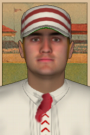 Pardon Shepard 1884 Final American Association Standings 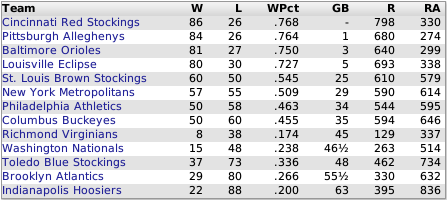 The pennant race in the Association was much more interesting. Baltimore, Pittsburgh, and Cincinnati stayed close all summer. Baltimore had spent the most time in the top position, but they faded a bit at the end, allowing Cincinnati to overtake them for the championship. Cincinnati's Chris Parish (.322, 94 runs, 83 rbi) had another fine season but finished second in the batting race to team mate Frank Strother (.329, 24 doubles, 22 triples, 48 stolen bases). Cincinnati's Doc Langdon topped Arnold Jacobs by winning an amazing 48 Association games. Baltimore's Preston Boyd (42-13, 0.63) threw two no-hitters. 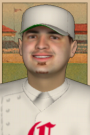 Frank Strother 1884 also saw base ball's "color barrier" broken, at least temporarily. Judson Barnhardt was a catcher for the Toledo Blue Stockings of the minor Northwestern League. Toledo was one of the new American Association clubs for 1884 and Barnhardt appeared in 110 games for Toledo (.236, 19 doubles, 49 runs). Barnhardt's team mate, pitcher J.W. Dickerson, stated Barnhardt "was the best catcher I ever worked with, but I disliked a Negro and whenever I had to pitch to him I used to pitch anything I wanted without looking at his signals." As Toledo went bankrupt and folded after the season, Barnhardt's base ball future is still up in the air. 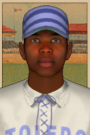 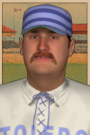 l-to-r, Judson Barnhardt, J.W. Dickerson
__________________
FABL -- Chicago Chiefs |
|
|
|
|
01-20-2011, 09:58 AM
|
#38 |
|
All Star Starter
Join Date: Jun 2002
Posts: 1,166
|
1884 Award Winners
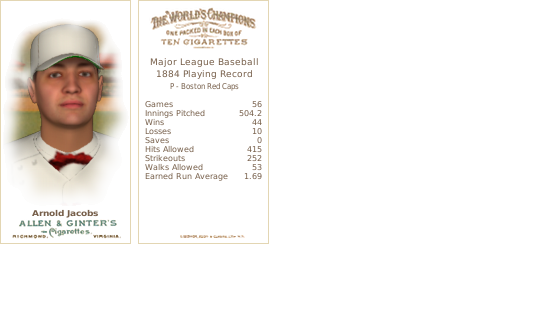
For the fourth season in a row, Boston's Arnold Jacobs is given the Cartwright Award. The League Chadwick Award goes to Harvey Hannon of Louisville. Cleveland's Tom Hindman is named the league's top amateur.
 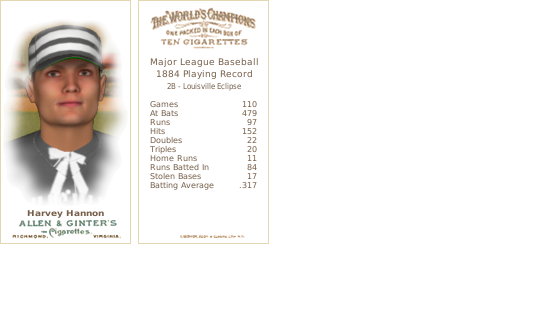 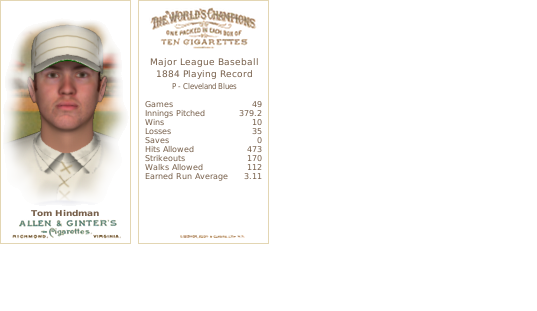 For the Association, Cincinnati's Doc Langdon takes home the Cartwright, his second win in three seasons. His team mate Bernhard Gilliam followed up his Best Amateur win last season with a Chadwick Award this season. Toledo's J.W. Dickerson is named 1884's best amateur. 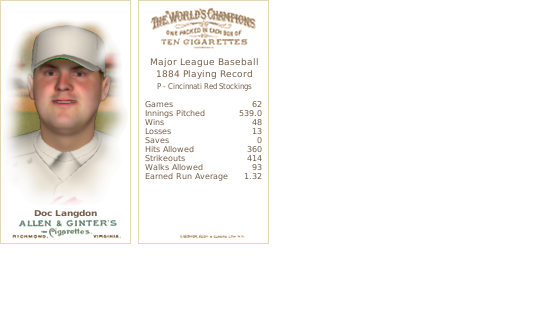 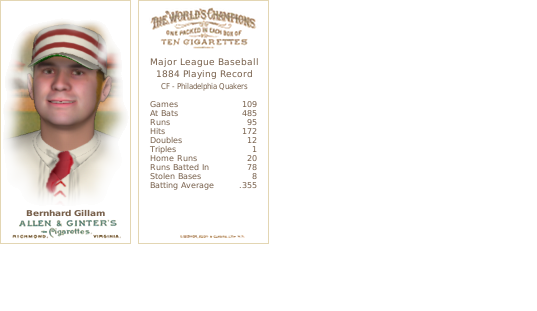 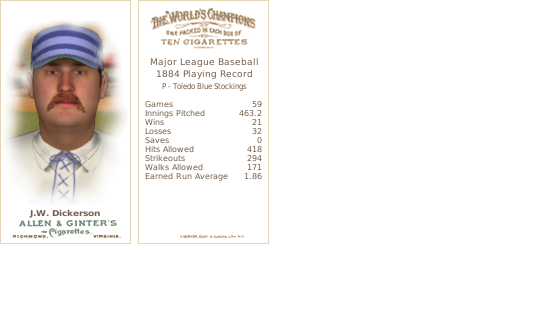
__________________
FABL -- Chicago Chiefs |
|
|
|
|
01-20-2011, 11:58 AM
|
#39 |
|
All Star Starter
Join Date: Jun 2002
Posts: 1,166
|
I made a mistake in the 1884 recap above. It was not Preston Boyd who threw two no-hitters (though he did throw one). Pittsburgh's Egbert Robin threw back to back no-hitters in July: Player Report for #29 Egbert Robin
__________________
FABL -- Chicago Chiefs |
|
|
|
|
01-20-2011, 07:19 PM
|
#40 |
|
Minors (Double A)

Join Date: Jul 2010
Location: In Red Sox Nation
Posts: 131
|
Love this. Great job.
"Blondie" Clapp is a brunette, though. Must be an imposter. |
|
|
|
 |
| Bookmarks |
|
|


