 |
 Home | Webstore Home | Webstore
|
|
Latest News:
OOTP 26 Available
- FHM 12 Available
- OOTP Go! Available
Out of the Park Baseball 26 Buy Now! |

|
|
||||
| ||||
 07-06-2006, 06:03 PM
|
#21 |
|
Minors (Double A)

Join Date: May 2003
Location: South Florida
Posts: 119
|
hoo yah!!! Thanks for the assist!!!
 I had planned on doing some census work myself to see if I could dig up some of this info! Thanks for saving me some time.
__________________
GM, Miami Sharks, IHOF Founder & President, SFL GM, Oklahoma Outlaws, GEFL Read my "Sports and History Dynasty" Last edited by sflcat; 07-06-2006 at 06:15 PM. |

|

|
|
07-07-2006, 01:13 AM
|
#22 |
|
Registered User

Join Date: Mar 2004
Location: North Carolina
Posts: 66
|
Here are a few more guys I had forgotten about:
Richard J. Godwin (b. 1828, England)--catcher, 1855 Putnams Samuel Godwin (b. 1825, England)--1856 Putnams John H. Graham (b. 1836, New York)--1856 Harmony Robert Justison Jr. (b. 1835, New York)--1856 Harmony William Julian Jr. (b. 1833, New York)--1856 Harmony Thomas E. Sutton (b. 1815, New York)--1856 Morrisania Unions Caleb Sniffin (b. 1822, New York)--1856 Atlantic Thomas Tassie (b. 1833, New York)--1856 Atlantic Horatio Holden (b. 1839, New Jersey)--pitcher, 1856 Baltic Dr. Charles W. Cooper --1856 Baltic (and later teams) So, I was wondering: what's your source for the cricket players? The New York Clipper was full of cricket box scores.
__________________
Agate Type - a baseball research blog on the negro leagues, latin america, the 19th century, and japan |
|
|
|
|
07-07-2006, 10:18 AM
|
#23 | |
|
Minors (Double A)
Join Date: May 2003
Location: South Florida
Posts: 119
|
Quote:
Again, thanks for your contribution to the dynasty!
__________________
GM, Miami Sharks, IHOF Founder & President, SFL GM, Oklahoma Outlaws, GEFL Read my "Sports and History Dynasty" Last edited by sflcat; 07-07-2006 at 10:27 AM. |
|
|
|
|
|
07-11-2006, 02:46 AM
|
#24 |
|
Minors (Double A)
Join Date: May 2003
Location: South Florida
Posts: 119
|
The Republic
May 1857 Letters to the editor Dear Republic: In this nation, we are seeing the rise of am anti-Christian spirit little if at all better in its nature or in its effects than that of the thief, the robber and the pirate, which arrogates to one portion of mankind a superior right over another portion, either as to freedom of opinion religious or political, the right to use its faculties for its own profit and advancement, or to participate in the government which all are required to support and obey. It is a spirit opposed to the great Christian rule of doing as we would be done by, of which spirit, robbery, slavery, political proscription, and religious persecution are only different manifestations. It makes a crime of that which the individual cannot avoid of possessing a particular skin, being born in a particular spot, or being convinced by the irresistible force of circumstances or of argument, of the truth or particular doctrines. It is a spirit which has covered the earth with misery and crimes. It is a spirit in which too many high professors of religious or political-purity partake, and upon which they act in one or other respect, while they are loud in their execrations of those who exhibit precisely the same spirit, only in a different form of manifestation. It is a spirit which makes the Creator a partial and grossly unjust being, and which, with the self conceit of the Pharisee that thanked God that he was not like the poor publican always assumes itself to be the favorite, and its opponents to be the proscribed of the and unjust Deity, which it has imagined. Against this wicked and absurd spirit, abolitionists have arrayed themselves as to one form of its manifestation. Against it, we as a portion of the abolitionists, are resolved to array ourselves under whatever form it may assume. Against this spirit the law and the administrators of the law should ever be arrayed. It is because those administrators have been too often either neutral or arrayed on the same side with it, that its encroachments have at length become so alarming. Ever since our national independence, the law has been enlisted in support of this spirit in reference to the colored man. They must be bad reasoners who would not carry out the principle, and apply it to other classes of men, if they believed in its justice in reference to the African descendant. Though freedom of speech has been, in general, guaranteed by law, it has not been maintained in practice. For the last ten years the abolitionists have been subject to mob violence in three-fourths of the Union for the simple expression of their opinions. This violence has been either winked at, or indirectly approved, by a large portion of the men in authority, as well as of the political and religious leaders of the people. Coming more directly to the city of Philadelphia, we find that about the year 1837 a few colored and white boys at a scene of amusement called the "flying horses," got into a quarrel in which the white boys, who were probably the aggressors, were worsted. They left and collected a mob of men and boys with whom they made an indiscriminate assault on the colored people of Southwark and Moyamensing who had given them no provocation. They tore down some houses, ransacked others, destroyed furniture, beat women and children, and killed an inoffensive man who was too ill to escape by flight. A large portion of the community sanctioned this horrible crime on the pretext that the colored people must be taught to know their places: the public authorities winked at it, and the rioters and murderers were never even brought to trial. In May, 1838, the celebrated burning of the Pennsylvania Hall (a popular meeting place for abolitionists) took place: after it had been delivered into the hands of the Mayor, under a solemn promise of protection - a promise which he did not even attempt to keep. This burning was palliated by clergymen and others in public speeches. It was applauded by a large portion of the merchants of the city. One of them went so far as to issue his card or advertisement, with a picture on it of Pennsylvania Hall in flames, thinking thereby to conciliate the slave holding merchants of the South. Although some of the rioters were known, and two or three indicted, the Attorney General never brought them to trial. In 1842, a colored procession walking peaceably along the streets was assailed and dispersed by a mob. The colored people were pursued every where with savage ferocity. The Mayor and police being called on to suppress the riot, instead of arresting the rioters arrested those who were attacked. The mob thus encouraged proceeded to the burning of Smith's Hall and the African Presbyterian Church. Although the Mayor had been alerted about the intent to burn the church, he had scarcely any portion of his force on the ground, and none of it we believe stationed within the building. This burning was followed the succeeding days and nights by indiscriminate attacks and beatings of colored people, without the pretense of any offencse on their part, and by efforts to burn the remaining churches. No efficient attempt was made to arrest any considerable portion of the rioters: and the Mayor actually refused to take measures for the arrest of some whose names were given him, together with those of the witnesses, by a highly respectable citizen. For some years past our city has been disturbed by continual riots, among the firemen and weavers, accompanied by most atrocious outrages, and our public authorities have been distinguished by a remarkable failure to arrest and try the criminals, especially the firemen. There seems to be a belief by a great portion of the people, including many of the clergy, the professional men, the politicians and the public authorities, that the rights of men are unequal, that a portion of society might be trampled on at pleasure by other portions. The doctrine that black men are by birth the rightful subjects of oppression has naturally led to the extension of the same principle to foreigners. The idea that abolitionists are entitled to no protection, because their beliefs are unpalatable, is naturally extended to Catholics, whose doctrines are equally unpalatable to sectarians. Almost every class and every sect of men, are responsible for the mischief, for almost every class and sect have encouraged mob violence, when it was directed against what they deemed the right objects. And especially guilty are public authorities, from governors down to the constables and watchmen, not only for having neglected to enforce the law, but for having given positive encouragement by word and deed to its violators. It is the duty of every man to set his face resolutely against all manner of religious, politicial and personal interference and to maintain the full that equality of rights, and of claims to benevolence, which is alike the doctrine of the New Testament and of the Declaration of Independence. P.F., Philadelphia, PA Entertainment news Herman Melville's "The Confidence-Man: His Masquerade," a narrative following a con-man in a number of disguises on board a Mississippi River steamboat, has been released to mixed reviews and sluggish sales. Although Melville enjoyed moderate success with last year's publication of "The Piazza Tales," a collection of his short stories, he hasn't produced a real winner since his second novel, "Omoo: A Narrative of Adventures in the South Seas", which was published ten years ago. His more recent novels, "Mardi," "Redburn," "Whitejacket," "Moby ****," "Pierre," and "Israel Potter" have been critical and financial disappointments. Meanwhile, Gustave Flaubert's controversial novel, "Madame Bovary," has generated brisk sales and additional outrage since its April publication in book form. The narrative, which depicts the adulterous affairs and excessive living of a doctor's wife bored with the banalities and emptiness of provincial life, was first serialized last year in the French journal "Revue de Paris". The French government brought an action against the publisher and Flaubert on immorality charges, but both were acquitted. The controversy has generated substantial curiosity and interest in the novel. International news Revolt in British India After months of unrest, violence erupts on the subcontinent It began in late January when numerous fires, believed to be arson, broke out in and around Calcuta. In March, a sepoy (an Indian soldier in the British army) named Mungal Pandy of the 34th Native Infantry "walked about the lines with a loaded musket, calling upon his comrades to rise, and threatening to shoot the first European who appeared." When a Lieutenant Baugh with a European sergeant and Muslim orderly rode up, there were shots and a fist fight. A group of twenty sepoys began to beat the Europeans' heads with their rifle butts. Regiment commander General He****y broke up the fight. Pandy and other leaders were arrested, court-martialed and hanged in April. On May 3, the Indian situation came to a boil in Lucknow. A regiment of Oudh Irregular Infantry mutinied. They were subdued by British soldiers and their regiment was disbanded. On May 6 in Meerut a native calvary refused to parade before British officers. Eighty-five sepoys were arrested and convicted by a native court-martial. On May 9, they were stripped of their uniforms, placed in irons, paraded before European and native regiments and jailed under native guard. On Sunday, May 10, at about 5:00 p.m. as the British were heading to evening Christian worship service. The remaining sepoys mutinied, let all the jail inmates out and went wild. Accompanied by a mob from the city's bazaar, the mutineers poured into the European settlement and slaughtered any Europeans or Indian Christians they found there. Whole families -- men, women, children and servants, were killed on sight. The cantonment was then burned. By the time the British soldiers regrouped, the mutineers had reportedly fled from Meerut toward Delhi, located roughly 40 miles to the west. The revolt spread to Delhi on May 11. The sepoys there killed British officers and civilians as they took control of the city. Afterwards, they proclaimed Bahadur Shah, the last of the Moguls, emperor. As the month progresses, the insurgency seems to be gaining momentum. Native mobs have rioted in a number of cities in central India and native soldiers in the region continue to defect. British intelligence believes the 38th, 54th, and 74th regiments of native infantry and native artillery under a leader named Bahkt Khan have joined the insurgents in their Delhi stronghold. With trouble also simmering in China, the British have been slow to react to the Indian crisis. Many analysts believe that a delay in decisively dealing with the insurgency will only embolden other Indian provinces to revolt. How this has come to be Many believe the Sepoy Insurgency began long before 1857. The history of the war delves deep into the colonization and conquest of India and the conflicts between British and Indian culture and religion. The British East India Company is the massive export company behind much of the colonization of India. The power of the East India Company took nearly 150 years to build. In the 18th century, the company became, in effect, the ruler of a large part of India, and a form of dual control by the company and a committee responsible to Parliament in London was introduced by the India Act of 1784. The East India Company set up factories (trading posts) in Masulipatam on the east coast of India in 1611; on the west coast in Surat in 1612; and on the east coast in Madras in 1639. Attempts to set up a factory on the Hooghly (one of the mouths of the Ganges) began in 1640, but were unsuccessful until 1690; the settlement later developed into the city of Calcutta. By 1652 there were some 23 English factories in India. Bombay came to the British crown in 1662, and was granted to the East India Company for £10 a year in 1668. The British victory in the Battle of Plassey in 1757 gave the company control of Bengal. The East India Company has been allowed to operate in overseas markets despite the fact that the cheap imports of South Asian silk, cotton, and other products have hurt domestic business. In 1767, the Company was forced into an agreement that is should pay 400,000 pounds into the National Exchequer annually. By 1848, the East India Company was experiencing financial difficulties and had reached a point where expanding revenue required expanding British territories in South Asia massively. The Government began to set aside adoption rights of native princes and began the process of annexing more than a dozen independent Indian states between 1848 and 1854. In an article published in The New York Daily Tribune, journalist Karl Marx notes that "... in 1854 the Raj of Berar, which comprise 80,000 square miles of land, a population from four to five million, and enormous treasures, was forcibly seized." In order to consolidate and control these new holdings, the East India Company established an army comprised mainly of native Indians officered by British soldiers. At the beginning of this year, that army numbered about 200,000 natives and 40,000 British. Some believe religious differences between the East and West have also played a role in the insurgency. The sepoys' hesitation to use the newly issued Lee-Enfield Rifle is a case in point. The rifle was developed at the Enfield ****nal by James P. Lee and fires .303 caliber ammunition that has to be manually loaded. Loading involves biting the end of the cartridge, which is greased in pig fat and beef tallow. This presents a problem for native soldiers, as pig fat is a haraam, or forbidden, substance to Muslims, and beef fat is, likewise, deemed inauspicious for certain Hindus sects. According to Captain Wright, a British officer who commands the Indian Rifle Instruction Depot: "Somewhere about the end of the third week in January, a khalasi, that is to say a laborer, accosted a high Brahmin sepoy and asked for a drink of water from his lotah (water-pot). The Brahmin refused because of the laborer's low caste. The khalasi then said, 'You will soon lose your caste, as ere long you will have to bite catridges covered with the fat of pigs and cows,' or, words to that effect." While British officers have denied this is the case, it quickly spread among the sepoys. Some British legislation has clashed with long-standing traditional Hindu or Muslim religious practices that are highly offensive to Western sensibilities. The prohibition of practices such as infanticide and saathi (often transliterated "sati"), or the ritual suicide of widows on their husbands' funeral pyres, has been a source of tension between many Hindus and the Colonial administration. The emperor of the insurgents The last Mughal king, Bahadur Shah, is better known as Bahadur Shah Zafar. He was born in 1775 at Delhi. He is the son of Akbar Shah from his Hindu wife Lalbai. Bahadur Shah, after the death of his father, was placed on the throne in 1837 when he was little over 60 years of age. He is last in the lineage of Mughal emperors who ruled over India for about 300 years. Bahadur Shah Zafar, like his predecessors, came to throne when the British domination over India was strengthening and the Mughal rule was nearing its end. The British have curtailed the power and privileges of the Mughal rulers to such an extent that by the time of Bahadur Shah Zafar, the Mughal rule was confined to the Red Fort in Delhi. Bahadur Shah Zafar is obliged to live on British pension, while the reins of real power lay in the hands of the East India Company. Urdu poetry has flourished under Shah's reign and he himself is a prolific poet and an accomplished calligrapher. He passes most of his time in the company of poets and writers and is the author of four diwans. Love and mysticism are his favorite subjects and often find expression in his poetry.
__________________
GM, Miami Sharks, IHOF Founder & President, SFL GM, Oklahoma Outlaws, GEFL Read my "Sports and History Dynasty" Last edited by sflcat; 01-17-2007 at 04:19 PM. |
|
|
|
|
07-11-2006, 02:25 PM
|
#25 |
|
Registered User
Join Date: Mar 2004
Location: North Carolina
Posts: 66
|
Even though I'm both a Melville fan and 19th-century baseball history buff, I never made the connection that The Confidence-Man came out in the same year that the National Association was founded.
Btw, I PM'd you a list of Massachusetts club members I've run across in the NY Clipper, in case you find it useful (didn't want to clog up your dynasty thread with more long lists of names!).
__________________
Agate Type - a baseball research blog on the negro leagues, latin america, the 19th century, and japan |
|
|
|
|
07-11-2006, 03:36 PM
|
#26 |
|
Minors (Double A)
Join Date: May 2003
Location: South Florida
Posts: 119
|
Thanks a lot DS. Because of all your valuable assistance, I need to make you the official associate contributor to the dynasty!
 It is interesting how when we study general history, we usually do so in such an isolated and linear fashion that it is often a jolt when we see how events correspond and associate with other historical events.
__________________
GM, Miami Sharks, IHOF Founder & President, SFL GM, Oklahoma Outlaws, GEFL Read my "Sports and History Dynasty" Last edited by sflcat; 07-11-2006 at 03:40 PM. |
|
|
|
|
08-17-2006, 04:59 PM
|
#27 |
|
Minors (Double A)
Join Date: May 2003
Location: South Florida
Posts: 119
|
Sorry, I recently had a massive computer meltdown. Hopefully I'll have this dynasty up and running again soon. But just to tease everyone...
The National Association's season opened with a tightly contested game between the Eagle and Knickerbocker clubs of New York. The final score was 18-17. Who won you ask? Details to come.
__________________
GM, Miami Sharks, IHOF Founder & President, SFL GM, Oklahoma Outlaws, GEFL Read my "Sports and History Dynasty" |
|
|
|
|
08-18-2006, 12:15 AM
|
#28 |
|
Registered User
Join Date: Mar 2004
Location: North Carolina
Posts: 66
|
Great. Can't wait to hear more.
__________________
Agate Type - a baseball research blog on the negro leagues, latin america, the 19th century, and japan |
|
|
|
|
09-12-2006, 11:06 AM
|
#29 |
|
Minors (Double A)
Join Date: May 2003
Location: South Florida
Posts: 119
|
The Sport
June 1857 National Association  Knicks Edge Eagles in Association Opener HOBOKEN, NJ (JUNE 6) -- In a hard-fought contest at Elysian Field, the Knickerbocker club of New York opened the inaugural National Association season with an 18-17 victory over the Eagle club. A good-sized crowd of several hundred supporters turned out to watch the historic contest. The Eagles opened by scoring a single run in the first after CF Yates led-off with a single and scored from third on a sacrifice fly by 2B Houseman. Knicks' pitcher Norman Welling ended the Eagle side of the inning when he fielded a ball hit by 3B Charles Place on the bounce. During the bottom part of the inning, the Eagles' fielding showed signs of early season rust as they misplayed the first two balls hit into play by the Knicks. SS Vrendunburgh and 3B Niebuhr each reached base on "muffs" and both men scored as the Knickerbockers plated three runs in their half of the first inning. During the top of the second inning, SS Smith and P Bixby each hit doubles and the Eagles scored four to take a 5-3 lead. The Knicks tied the game 5-5 in the bottom of the third as both Niebuhr and 1B Stephen scored. By the middle of seventh inning, the Eagles had built a 15-12 lead over the Knicks. However in the bottom half of the inning, Welling connected with a mammoth clout that sent the ball sailing past the Eagle players in the outfield and rolling almost to the opposite treeline before it was retrieved. Not only did Welling score on the hit, but 3B Niebuhr and CF Adams scored as well to knot the contest again, 15-15. Welling and the Knicks held the Eagles in check during the top of the eighth, not allowing any runs and leaving two runners stranded on the bases. The Eagle club was again vexed by poor fielding in the Knicks' half of the eighth when RF Tucker muffed a potential third-out fly ball hit by Niebuhr. The Knicks went on to score three runs and take an 18-15 lead. The Eagle club continued to battle during the top of the ninth inning. 2B Houseman doubled home LF Williams and C Gelston to make it a one-run contest. Charles Place then grounded to SS Vrendunburgh, who cleanly fielded the ball and made a perfect throw to 1B Stephen for the third out and a Knicks' victory. Code:
       123 456 789    R  H  E
EAGLES 140 432 102 - 17 23 10
KNICKS 302 610 33X - 18 26  4

EAGLE            AB  R  H  BI
Yates, CF         7  2  2   0
Williams, LF      5  4  5   1
Gelston, C        5  4  2   2
Houseman, 2B      7  2  5   4
Place, 3B         6  0  4   3
Wandell, CF       5  2  3   2
Smith, SS         5  1  1   0
Bixby, P          5  1  1   2
Winslow, 1B       4  1  0   0
                 49 17 23  14

                IP  R  ER  SO
Bixby (L,0-1)  9.0 18  11   0


KNICKERBOCKER    AB  R  H  BI
Vrendunburgh, SS  4  4  2   0
Niebuhr, 3B       4  5  4   0
Adams, CF         6  2  4   2
Stephen, 1B       6  3  4   3
Welling, P        6  2  4   4
Davis, LF         6  1  3   2
Moth, 2B          6  0  2   1
Debost, C         6  0  1   0
Tucker, RF        6  1  2   0
                 50 18 26  12

                IP  R  ER  SO
Welling (W,1-0)9.0 17  14   2
Code:
June 16 R H E EAGLE 623 052 012 - 21 23 5 ECKFORD 320 100 000 - 6 11 10 June 24 EMPIRE 005 192 520 - 24 35 4 KNICKS 030 1308 20x - 26 40 3 June 30 ECKFORD 220 035 712 - 22 32 7 EMPIRE 661 364 103x - 39 46 5 Association Standings Code:
W L PCT GB R RA KNICKERBOCKER 2 0 1.000 -- 44 41 EMPIRE 1 1 .500 1 63 48 EAGLE 1 1 .500 1 38 24 ECKFORD 0 2 .000 2 28 60 Boston's Olympic Club Defeats Bay State Club in Marathon Game BOSTON (JUNE 6) -- On the Commons, Boston's venerable Olympic club downed the newly formed Bay State club 106-94 during a 32-inning contest that lasted nearly seven hours. Curious onlookers gathered throughout the day as the initial small group of supporters grew to a large crowd of several hundred by the conclusion of the game. During the early innings, the Olympics dominated play, building a comfortable 27-10 lead by the top side of the eighth inning. During the next six innings, the Bay Staters slowly gained some ground, outscoring the Olympics 14-7 during the stretch. After allowing the Olympics nil in the 14th inning, Bay State exploded for 20 runs to take a 43-34 lead. From that point forward, the lead would change hands four times before the Olympics took the lead for good during the top side of the 29th innning. With the lead in hand, the Olympics crossed the century mark during their side of the 32nd inning. Chasing 17, Bay State was only able to plate five runs during their side. S. Fletcher and R.G. Hubbard starred for the Olympic club both with the bat and in the field. Charles Hopkins and H. Noyes were the frontliners for the Bay State club. Code:
OLYMPIC 029 0104 201 111 3 03 826 804 025 221 659 27 - 106 BAY STATE 010 6 02 159 410 4200 147 018 342 311 503 35 - 94 OLYMPIC R H C S Wadsworth 7 4 4 1 Rollins 10 2 0 0 Perkins 10 4 0 0 Forbush 10 4 1 2 Flye 6 4 2 4 Fletcher 12 3 3 6 Hubbard 12 0 3 4 Cody 11 3 0 0 Frye 11 2 1 0 Crosby 10 3 0 0 Bateman 7 3 1 0 TOTALS 106 32 15 17 BAY STATE R H C S Hopkins 11 2 3 3 Henry 7 3 4 0 Noyes 11 3 3 1 Atherton 9 5 0 4 Tyler 8 2 0 4 Hobart 9 5 2 2 Palmer 10 0 0 0 E. Spooner 9 3 0 0 Burridge 7 5 0 1 G. Spooner 8 3 0 0 Ayres 6 1 1 4 TOTALS 95 32 13 19 R - Runs Scored; H - Hands Lost (Outs); C - Balls Caught (Fielding); S - Runners Soaked Code:
June 13 TRI MOUNTAIN 213 459 995 535 845 445 96 - 105 BUNKER HILL 413 057 245 854 637 1146 83 - 96 June 16 UNION 301 014 020 130 202 420 242 - 33 GREEN MTN 1237 285 735 082 638 374 412 - 100 June 20 AMERICAN 790 101 5414 410 9 504 703 212 - 97 ELM TREE 1205 1121 171 2 9 517 040 146 0 3 - 100 Code:
W L PCT GB R RA OLYMPIC 1 0 1.000 -- 106 94 TRI MOUNTAIN 1 0 1.000 -- 105 96 GREEN MTN 1 0 1.000 -- 100 33 ELM TREE 1 0 1.000 -- 100 97 BAY STATE 0 1 .000 1 94 106 BUNKER HILL 0 1 .000 1 96 105 AMERICAN 0 1 .000 1 97 100 UNION 0 1 .000 1 33 100 Philadelphia Cricket Club captain William Wister guides team to seven wicket victory over rival Germantown in first inter-club match of season. PHILADELPHIA, PA (JUNE 15) -- Philadelphia was led by Jeremiah Johnson's 48 and superb bowling from William Wister, John McKenna and Robert Kingston as they downed long-time rival Germantown Cricket Club by seven wickets in a match played on Philadelphia's home grounds. In 27.4 overs, one of which was a maiden, Philadelphia dismissed Germantown for 119 runs. Only Robert Black, William Meeker and George Regnault showed much fight for Germantown as they combined for 81 with eight wickets taken. The bottom of Germantown's side collapsed as John Hayes and Justin Albrooth both were out for ducks and the final two wickets fell for three. Philadelphia had a scare when Germantown took the first two wickets for 26 as Wister opened with a stubborn 19 and Christopher Gadney was dismissed for seven. After this slow start, the middle of Philadelphia's side picked up the pace. During the next 13 overs, Shelly hit 21, Johnson hit 48 and Kingston hit 23 to help seal the triumph. Code:
BOXSCORE PHILADELPHIA CC VS. GERMANTOWN CC

PHILADELPHIA CC WINS THE MATCH BY 7 WICKETS

------------------------------------------

GERMANTOWN CC INNINGS

D. Adams     17(23) bowled Shelly
A. McKee      4(16) bowled Wister
H. Botsford   2 (8) caught Shelly b Wister
R. Black     31(31) lbw Kingston
W. Meeker    24(29) caught Kingston b Gadney
E. St. John   6 (6) caught Wister b Kingston
J. Nair       4(16) caught Gadney b McKenna
G. Regnault  26(18) caught Gadney b McKenna
J. Hayes      0 (7) lbw Kingston
J. Albrooth   0 (2) caught Shelly b Kingston
H. Green      3(10) not out
EXTRAS
    NB:       1
 WIDES:       0
    LB:       1
  BYES:       0

GERMANTOWN CC ALLOUT FOR 119 IN 27.4 OVERS

PHILADELPHIA CC BOWLING

	         O  M  R  W
W. Wister      5.4  1 21  2
J. McKenna       5  0 19  2
H. Hackett       5  0 17  0
E. Shelly        4  0 27  1
R. Kingston      3  0  6  4
J. Johnson       3  0 18  0
C. Gadney        2  0 10  1

------------------------------------------

PHILADELPHIA CC INNINGS

W. Wister     19(16) caught Regnault b Adams
C. Gadney      7(11) caught Black b Botsford
E. Shelly     21(25) caught Botsford b St. John
J. Johnson    48(39) not out
R. Kingston   23(18) not out
H. Hackett     0 (0)
J. McKenna     0 (0)
S. Miller      0 (0)
W. Mylon       0 (0)
C. Royston     0 (0)
B. Shakespeare 0 (0)
EXTRAS
    NB:        0
 WIDES:        0
    LB:        1
  BYES:        1

PHILADELPHIA CC 120/3 WICKETS AFTER 18.1 OVERS

GERMANTOWN CC BOWLING

	         O  M  R  W
D. Adams         5  0 28  1
A. McKee         5  1 32  0
H. Botsford    4.1  0 31  1
E. St. John      2  0 14  1
R. Black         1  0 10  0
W. Meeker        1  0  3  0
June 20 NEW YORK CC VS. CHOSEN ELEVEN (NY) Match Played at Elysian Field in Hoboken, NJ NEW YORK CC WINS THE MATCH BY 8 WICKETS June 27 CAMDEN (NJ) CC VS. ST. GEORGE (NY) CC Match Played at St. George home grounds ST. GEORGE WINS THE MATCH BY 51 RUNS Boxing Tom Sayers takes English Heavyweight Crown ISLE OF GRAIN, ENGLAND (JUNE 16) -- Looking to be in the best shape of his professional career, Tom Sayers defeated a clearly overweight William Perry in seven rounds to claim the Heavyweight Crown of England. The location of the field where the fight took place had been well guarded and no police appeared during the fight to stop it. A crowd started collecting at the spot early in the morning. The fighters arrived in separate coaches about fifteen minutes prior to the bout's scheduled 11:00 A.M. start. By this time the crowd numbered several hundred, and wagering among them was fast and furious. Removing his jacket and shirt, Sayers looked trim and fit. Perry, on the other hand, looked pauncy and haggard. Some reported that Perry had been ill in the weeks leading up to the fight and hadn't been able to strenuously train. Perry was clearly the bigger man. He looked to outweigh Sayers by at least 50 pounds. THE FIGHT Round 1.- Both trying to measure their distance. Perry ran in and closed, grasping Sayers by the neck, and put on the old-fashion hug, continuing to hold his man in such a way that the Referee entered the ring and strictly cautioned him not to repeat the operation in a similar manner. Round 2.- Sayers made fighting as soon as he came to the scratch. There was some attempt at countering by both; very wild and not particularly effective. Perry then rushed on Sayers; got the hug again, and threw him, like a sack of malt, on the grass. On the men being lifted, Perry was found to be bleeding from the mouth. First blood was claimed and allowed Sayers. (Cheers) Round 3.- After some hard exchanges, Perry again put on the hug, and threw Sayers on the ropes with an awful spank. All was going dead against Sayers but the first blood. Round 4.- During this round, Perry came up with a "mouse" rather visible under his left eye. After receiving some punishing blows from Sayers, Perry again closed in for the hug. It was obvious that he meant to use his size advantage to fight nothing but a wrestling fight, fists to be only very subordinate agents in the business. This called forth loud expressions of disapprobation. Sayers was again thrown, but his fists had taken some toll on his opponent. Round 5.- Both men came up smiling at one another, and after some initial sparring, Sayers let fly a tremendous right-handed thunderbolt against Perry's ear that was heard all over the ring. Sayers followed up his advantage and launched a fellow-blow on Perry's temple. Perry, in despair hugged again, and threw his antagonist. Round 6.- Give and take now became the order of the day. A few seconds, then more hammering, when Perry was obliged to fly to his favorite embrace. But this time he failed woefully, for Sayers turned the table and floored his antagonist. During this round Sayers gave Perry a rattling sledge-hammer on the nose with his right, and brought the blood down in a stream. Round 7.- Perry came up quite groggy, and his heart seemed to be failing him, for when Sayers once more planted a straight one on the mouth, he appeared quite perplexed and helpless. He tried to plant his left but did not reach. After some sharp in-fighting, he was again knocked heavily to mother earth, and when picked up was nearly senseless. When Perry tried to leave his corner for another round he was a helpless child, and amidst shouts of shame, shame, to allow him to come up again, his seconds gave in for him. (Actual result: Sayers defeated Perry in ten rounds)
__________________
GM, Miami Sharks, IHOF Founder & President, SFL GM, Oklahoma Outlaws, GEFL Read my "Sports and History Dynasty" Last edited by sflcat; 09-12-2006 at 01:22 PM. |
|
|
|
|
09-14-2006, 04:57 PM
|
#30 |
|
Registered User
Join Date: Mar 2004
Location: North Carolina
Posts: 66
|
Great to see this continue. That 100-97 game must have been quite a thriller! This must be the first time anyone has ever simmed a Massachusetts rules games. Love the stats ("runners soaked"). How are you doing it--I assume some variation on a baseball tabletop game?
__________________
Agate Type - a baseball research blog on the negro leagues, latin america, the 19th century, and japan |
|
|
|
|
09-22-2006, 04:07 PM
|
#31 |
|
Minors (Double A)
Join Date: May 2003
Location: South Florida
Posts: 119
|
The Republic
June 1857 National News Trouble in Utah Territory Controversial Mormon sect on collision course with Feds SALT LAKE CITY - While a tenuous peace holds for the time being between pro- and anti-slavery factions in Kansas, new trouble is simmering further west in Utah territory where Governor Brigham Young is reportedly fomenting open rebellion among his Mormon followers against the United States government. There are accounts of schools being formed to drill militia and Mormon preachers urging the faithful to take up arms. There are reports that the official news outlet for the sect denies the right of the federal government to impose its will upon the territory -- especially in regard to the sect's controversial practice of polygamy. W.W. Drummond, who served as Chief Justice of the Territory, resigned his post last year, and in a long letter addressed to the U.S. Attorney-General, made several serious accusations against the Mormons. He said that the Mormons look to Brigham Young as the sole source of law, and consider no acts of Congress binding upon them; that there is a secret organization among them, embracing all the male members of the church, who are bound by oath to acknowledge no laws except those emanating from Young; that there is a body of men, whose names he can disclose, set apart by the church to destroy the lives and property of those who question the decrees of the hierarchy; that the records of the court have been destroyed at the instigation of the rulers of the Mormons, and the Federal officers have been insulted for questioning the outrage; that the Government of the United States is openly abused, and its offices in the Territory insulted and annoyed without redress; that Young constantly interferes with the Grand Jurors, directing who shall and who shall not be indicted, and that his directions are invariably complied with; that Mormons convicted of aggravated crimes, have been summarily pardoned, while those not belonging to the Church, though guilty of no crime, have been wantonly imprisoned. He also affirms that the murder by the Indians, in 1853, of Captain John W. Gunnison and his survey party, was really committed at the instigation of the Mormon leaders; that his own predecessor, Hon. L. Shafer, was poisoned by them; and that Mr. Babbitt, late Secretary of the Territory, was killed by them, and not, as reported, by the Indians. He says that if a Governor were sent out, who is not a Mormon, and if he were supported by a sufficient military force, something might be effected; but as matters now stand, it would be madness to attempt to administer the laws in the Territory, and that no man who has once tried the experiment would be willing to risk life and property by accepting an appointment there. It is said that President Buchanan has been strongly influenced by this and other reports from former territorial officials. Reportedly, he has made finding a non-Mormon governor for Utah a high priority since his inauguration. A source close to the administration says the President and his cabinet are prepared to dispatch federal troops to the territory since they are convinced the Mormons will resist any attempt by the federal government to replace Brigham Young as governor. Political insiders believe the President has to take a hard-line against the Mormons to counter charges by the Republicans that the Democrats favor the "twin relics of barbarism--polygamy and slavery," especially after the administration has thrown its support strongly behind the Supreme Court's Dred Scott decision. The Mormons have had a turbulent history. The sect's founder was Joseph Smith (1805-1844), a resident of Palmyra NY. His family of origin were called "Seekers" - Christians who were not affiliated with a church, but who respected the teachings of all denominations. In his teens, his mother and most of the rest of the family converted to Presbyterianism. However, Smith was deeply troubled by the multiplicity of Christian sects which existed in his time and wondered which was the "true" Christian religion. He reportedly experienced a vision in 1820, at the age of 14 in Palymra, NY. God and Jesus Christ appeared to him as separate entities and told him that all of the Christian sects and denominations were in error and that he should not join any of them. In 1823, at the age of 17, he supposedly received three visitations from an angel named Moroni at the time of the Autumn Equinox. The angel is said to have revealed to Smith the location of golden tablets on which was written the history of two early American tribes. He went to the site and claimed to find: a breastplate, such as might have been worn by an ancient Israelite; golden plates upon which ancient American authors Ether, Mormon, Lehi and Nephi had recorded additions to Biblical history; the Urim and Thummim, two mystical stones mentioned in Old Testament scriptures which priests consulted to determine the will of God;and brass plates upon which another author, Laban, quoted from Hebrew Scriptures and recorded genealogies. At the time, he was not permitted to remove the plates. He was instructed to return to the spot at each Autumn Equinox. Four years later, in 1827, he was finally allowed to take possession of the material. A friend of Smith, Martin Harris, attempted to authenticate the tablets by taking copies of some of the inscriptions to Professor Charles Anton and is said to have received verbal confirmation that the tablets were written in "reformed Egyptian" hieroglyphics. Prof. Anton later denied making this statement, and wrote that the symbols that he saw were a combination of Greek, Hebrew, inverted or sideways Roman letters, and elements from a Mexican calendar. Accounts say Joseph Smith positioned himself behind a curtain and used the special stones to translate the inscriptions on the golden plates. Emma Smith (his wife), Martin Harris and Oliver Cowdery served at various times as scribes. A 116 page Book of Lehi was translated over a two month interval. Martin Harris showed the only copies to his wife, Lucy, who promptly lost them. There is speculation that Lucy Harris was a skeptic and she believed the book to be a fraud. By forcing Smith to retranslate the book, she hoped to demonstrate discrepancies between the two versions, thus proving that the book was a hoax. Smith stated that God was so angry at this loss that he temporarily took away the special stones. Smith later translated the plates of Nephi which described the same events as the Book of Lehi. Later, Smith and Cowdery claimed that John the Baptist appeared to them, investing them in the Aaronic Priesthood and showing them how to baptize each other by total immersion in water. Still later, the Apostles Peter, James and John appeared and invested Smith and Cowdery in the Melchizedec priesthood and commissioned them as the first two elders of the new church. Smith founded The Mormon Church in 1830. it attracted 1,000 members during its first 12 months. Smith and a small band of followers first moved to Kirtland (near Cleveland OH) and later to Jackson County, MO, which he called Zion. Relations between church members and Missouri citizens began a downward spiral following the arrival of Joseph Smith and church leaders from Ohio in 1838. Church members were heavily persecuted, largely because non-Mormons believed that the church was promoting the establishment of a religious dictatorship (a theocracy). They were also distressed at the Mormon's belief that the Book of Mormon was the revealed work of God, with the same status as the Hebrew Scriptures (Old Testament) and Christian Scriptures (New Testament). In spite of the opposition, much of it state-sponsored or condoned, the church increased greatly in numbers. The church was expelled from Jackson County and settled in Far West, MO, in Caldwell County. In late 1838, violence broke out, as the original settlers attacked the Mormons; they were concerned that the Mormons might become a political majority in their locality. The attack appears to have started as a method of preventing Mormons from voting. The state militia became involved. Sampson Avard, an officer in the Mormon militia, persuaded his men to become a "covert renegade band" and to avenge outrages against the Mormons. Armed encounters between disputants escalated. The violence culminated with the Massacre at Haun's Mill, where 17 Mormon settlers were murdered. Faced with diminishing supplies, the approach of winter, an aggressive militia and an anti-Mormon extermination order from the Governor of Missouri, the Mormons surrendered. The church moved again. Their destination was Commerce IL, which Smith renamed Nauvoo in 1839. It was there that polygamy was introduced - the concept of a man taking more than one wife. It has been variously called the Law of Abraham, or the Patriarchal Order of Marriage, or Celestial Plural Marriage. Associated with these was the Law of Sarah -- the belief that a man's first wife must give permission for her husband to marry again. Smith personally assigned women to some of the Mormon men. At the age of 38, Smith decided to run for the presidency of the US. He chose Sidney Rigdon, a trusted associate and a figure whose importance was second only to Smith in the fledgling church, as his vice-presidential candidate. A local newspaper (the Nauvoo Expositor) was critical of Smith's political platform, and revealed to readers that Mormons were practicing polygamy (a practice that Smith denied at the time). In order to silence the opposition, he ordered his followers to destroy the presses. In 1844, Smith and his brother Hyrum were arrested for the crime. A mob later broke into the jail and assassinated both of them. The death of the founder provoked a major crisis for the Mormons. Many in the church felt Rigdon was a logical choice as a successor. However, he fell out of favor with the church's leadership council, called the Quorum of the Twelve Apostles, and was excommunicated. Brigham Young, the President of the Quorum of the Twelve, began to act as leader of the church. At this time, several splinter groups broke away from the Mormons. These included: the Community of Christ, led by Joseph Smith III and Emma Smith (the son and wife of the founder); the Bickertonites; the Strangites and the Church of Christ. In 1846, Young led most of the church on a 1,300 mile (2100 km) trip to the Great Salt Lake in Utah, where they established Salt Lake City. Because of past persecution, Mormon anger against the Gentiles (non-Mormons) has reportedly remained high and is fueling the current tensions in Utah between the settlers and the federal government. New Orleans Gives Walker Hero's Welcome Famous American Filibuster Arrives in New Orleans After Setback in Nicarauga President of Lower California, Emperor of Nicaragua, doctor, lawyer, writer — these have been some of the titles claimed by William Walker, an American adventurer who has gained much fame for his wild-eyed military exploits south of the United States border. Arriving last week in New Orleans, he was greeted as a returning hero and has been busy delivering speeches to masses of adoring people about his exploits in Nicaragua. Born in 1824 in Tennessee, Walker graduated from the University of Nashville at the age of 14 and by 19 had earned a medical degree. He practiced medicine in Philadelphia, studied law in New Orleans, and then became co-owner of a newspaper, the Crescent. When the paper was sold, Walker moved on to California, where he worked as a reporter in San Francisco before setting up a law office in Marysville. When he was 29, his freebooting nature led him to become the leader of a group plotting to detach parts of northern Mexico. Taking the expansionist concept of Manifest Destiny to heart, Walker hired a small army of soldiers of fortune and in October, 1853 sailed to Baja California where he conquered La Paz. He then declared himself president of Lower California. He later decided to extend his empire to include Sonora, and renamed it “The Republic of Sonora.” Mexican forces finally were able to expel his army from the country in 1854, as Walker's supplies ran out and his men began to desert. Back in the United States, Walker was tried for breaking neutrality laws. Public sentiment, however, was so strongly supportive of him for pursuing the Manifest Destiny of the United States, that he was found not guilty. One result of this incursion was that Mexico sold a part of Sonora to the United States. Acquitted of criminal charges, Walker next turned his attention to Central America. Throughout this region, chaos reigned, as forces known as Democrats and Legitimists fought each other. The leader of the Democratic faction in Nicaragua invited Walker to bring an army and join the struggle against the Legitimists. In 1855, with his army of 58 Americans, later called "The Immortals" by stateside romantics, he landed in Nicaragua. Within a year Walker's forces, combined with the native rebel force, had routed the Legitimists and captured Granada, their capital. Walker obtained recognition from the United States for the new government, and then declared himself president of Nicaragua in July, 1856. His success roused concern in the other Central American countries, especially Costa Rica, which sent in a well-armed force to invade Nicaragua. Walker's army repelled the invasion, but his counter attack into Costa Rica failed, and a war of attrition continued, in which an epidemic of cholera killed more soldiers on both sides than enemy bullets. With supplies again running low, Walker withdrew from Nicaragua. He surrendered himself to the U.S. Navy this past May and was repatriated. While Walker likely will be tried again for violating neutrality laws, his popularity, especially among Southerners, should save him once more. Politics Abraham Lincoln: Republican's Rising Star. At the Illinois statehouse in Springfield, lawyer and politician Abraham Lincoln delivered a strongly worded speech criticizing the Supreme Court and its Dred Scott decision. Lincoln, a former Whig, was instrumental in establishing the Republican party in Illinois. Known as a man of humble origin who has made good, Lincoln's fortunes have been on the rise in the new Party. At the first Republican convention last year, Lincoln received 110 votes for the vice-presidential nomination which brought him much national attention. During the last election, he actively campaigned in Illinois for Republican presidential candidate, John C. Frémont. Lincoln has spoken out against slavery on many previous occasions. However, he has avoided extreme views and rhetoric on the issue making him attractive to moderates as well as abolitionists. It is rumored that Lincoln is the party's front-runner to oppose incumbent Democrat Stephen A. Douglas for the Senate next year. International News Revolt in India In the month since this uprising began in Meerut in May - British rule has ceased to exist in the northern plains of India. Muslim and Hindu rulers alike have joined rebelling sepoys, militant peasants, and other nationalist fighters. Thus far, Indian soldiers have been able to significantly push back Company forces. The sepoys have captured several important towns in Haryana, Bihar, Central Provinces and the United Provinces and British forces at Meerut, Cawnpore, Lucknow and Ambala are said to be under seige. The Republic hopes to imbed one or more of its journalists with British forces to give readers a first-hand account of the crisis as it develops. Chinese War Despite an urgent request of the British government, a spokesperson for President Buchanan says the United States will take no immediate part in the Chinese war. The Administration, however, has decided to take active measures to protect American interests in that quarter and have authorized that our squadron in Chinese waters be strengthened. The Honorable William B. Reed, of Philadelphia, has been appointed Minister to China. Technology and Science U.S. to help lay Transatlantic telegraph cable. The new United States steamer Niagara, the largest man-of-war afloat, has been ordered to assist in laying the cable of the oceanic submarine telegraph. She sailed from New York, April 20, and will proceed to London, where she will take on board one-half of the cable. The other half will be taken by the British steamer Agamemnon, lately the flag ship in the Black Sea. Both vessels will proceed together to a point midway between the two continents, where the two portions will be joined, and the Niagara will proceed to the American coast, while the Agamemnon returns to Great Britain, each paying out the cable as she advances. These steamers will be accompanied by other vessels to afford assistance if needed. The distance between Valentia Bay, in Ireland and St. Johns, Newfoundland, the termini of the telegraph, is 1650 miles; but 2500 miles of cable are to be taken on board the vessels, to provide against any deviations from a direct line by currents or other causes. Safety Elevator Could Revolutionize Cities Earlier this year in March, the world's first passenger safety elevator went into service inside a five-story department store building on Broadway and Broome Street. Designed by Elisha Graves Otis, the safety elevator draws upon earlier elevator designs but incorporates an automatic brake system that will prevent the car from falling if its cable or rope snapped -- a common occurrence in the early days of elevator innovation. A master mechanic at the Bedstead Manufacturing Company in Yonkers, New York, Otis began designing the safety elevator as part of an assignment to create a freight elevator to move the company's goods throughout its warehouse. During its testing phase, the longtime struggling Bedstead Company went bankrupt and was forced to close down, leaving Otis jobless and his elevator design abandoned. While making plans to travel west and join the Gold Rush, Otis received an unsolicited order for two of his safety elevators from a nearby furniture manufacturer that had recently lost two employees in an elevator accident caused by a broken cable. Committed to having his elevator produced, Otis opened his own shop in a section of the abandoned Bedstead building on September 20, 1853. Within a year, he demonstrated the first safety elevator at New York City's Crystal Palace Exhibition. Before a startled crowd, Otis cut the rope and a safety spring quickly locked the fully loaded car firmly in place. Orders soon skyrocketed. Further innovations in the safety elevator produced an all-passenger version, designed to allow visitors to travel to the upper floors of taller buildings without having to climb lofty staircases. In March, Otis sent the world's first passenger version of the safety elevator into service in a department store on Broadway and Broome Street in Lower Manhattan. This success could revolutionize our cities, clearing the way for the creation of taller, more accessible buildings. In the future, structures of 30 to 40 stories might not be uncommon sight in our cities -- and all will use Otis' safety elevator to carry patrons up and down.
__________________
GM, Miami Sharks, IHOF Founder & President, SFL GM, Oklahoma Outlaws, GEFL Read my "Sports and History Dynasty" Last edited by sflcat; 09-22-2006 at 04:25 PM. |
|
|
|
|
10-03-2006, 03:12 PM
|
#32 | |
|
Minors (Double A)
Join Date: May 2003
Location: South Florida
Posts: 119
|
Quote:
During my research, I discovered the Vintage Baseball Association, an amateur league whose teams use Nineteenth Century rules and equipment to play their games. I've tried to correlate the Association stats that were kept at the time with the more modern stats kept by the VBBA. If the player stats generated by my Association players are close to VBBA stats, I'll be happy. I've read that it wasn't unusual for both teams to commit double-digit errors during games, so my error results seem to be a little low, but since the game scores are in the neighborhood, I dont think I'll do any tweaking on this for the time being. For the Massachusetts games, I took my Association dice-game and modified it to reflect the rule differences between the two versions (no foul territory, shorter distance for batters to run to first because of the square infield rather than the Association's diamond, outs must be caught on the fly only and there is no out if the ball is fielded on a single bounce). I must confess, I feel like I've been reinventing the wheel. Other than some final game scores, I've been unable to find much statistical data or box scores for Massachusetts ball games. I've given most of the players generic ratings, which probably explains why most of the games so far have been close. Other than pitchers and catchers...I've had to decide who plays where in the infield and outfield -- including the one or two scouts (outfielders) who usually played behind the catcher in case the batter tried to turn and wallop a hit backward instead of a forward (a common strategy from what I've read ). As for soaking, I came up with some arbitrary percentages for success, based on where a fielder is when he tries to hit the runner with the ball and which bases the runner is between. Soaking a runner going to first is the hardest to do since the distance between the Striker's box and first is only half the distance it is between any of the other bases. Trying to soak a runner from deep in the outfield is a longshot. Trying to soak a runner from the shallow outfield is still difficult, but it isn't as much of a longshot as trying to hit him from the deep outfield. Completing a relay from a scout to an infielder gives a team the best chance for a soak in this situation...but also provides a much higher chance for an error (an errant throw or a muffed catch). Obviously, an infielder who successfully fields the ball has the best chance of making a soak. As I said, the percentages I came up with here are arbitrary and I'm sure I'll be tweaking them as I go. As for pitching, in Massachusetts they threw the ball overhand. Since this entails more arm-stress, I'm limiting the number of consecutive innings a pitcher can throw. In fact, I'm treating pitching much like bowling in cricket (i.e. pitcher #1 goes for a number innings, pitcher #2 takes over and throws for a number of innings, pitcher #1 comes back and pitches several more innings). Don't know if this is how they actually did it, but it seems to have a certain logic to me. Again, all the pitchers' ratings have been standardized due to lack of historic stats. However, I've assumed they probably will get a few more strikeouts than Association pitchers since they throw overhand. In playing these games, I have discovered one thing; it seems to take FOREVER for a team to reach 100 runs. I'm starting to think this might be a major reason this game eventually gave way to the New York version of baseball we know today.
__________________
GM, Miami Sharks, IHOF Founder & President, SFL GM, Oklahoma Outlaws, GEFL Read my "Sports and History Dynasty" Last edited by sflcat; 10-03-2006 at 03:24 PM. |
|
|
|
|
|
10-10-2006, 05:15 PM
|
#33 |
|
Minors (Double A)
Join Date: May 2003
Location: South Florida
Posts: 119
|
The Sport
July 1857 National Association  NEW YORK -- Despite the July riot in the city, the Association's first season continued without interruption. The Gotham club of New York looked strong in their opening match, defeating the Eagle club 33-20 on July 7th. Gotham played superbly, scoring multiple runs in every inning except the 2nd and stopping Eagle cold without an run over the last 4 innings. In the game, Gotham CF Cudlipp, went 6 for 7 with 2 runs, while pitcher T.G. Van Cott (home run, 5 runs), 1B Wadsworth (double, 4 runs), and LF Sheridan (4 runs) each had four hits. Van Cott picked up the victory. Gelston led Eagle, going 5 for 8 and scoring 5 runs. The Putnam and Excelsior clubs of Brooklyn opened their respective seasons on July 14th in a hard fought match won by Putnam 21-14. Putnam's Gesner had 6 hits, with 2 doubles, a triple, and 4 runs to lead the Putnam barrage of 36 hits. Dakin went the distance to pick up his first victory of the season. Catcher Joe Leggett starred for the Excelsiors, with five hits, including a double, and 3 runs. Eagle rebounded from its loss to Gotham with a 28-16 victory over Empire on July 21st . Gelston led the way, going 5 for 7, while Yates and Houseman each collected 4 hits. Bixby picked up the victory. Empire received good play from Miller, Moore and Hoyt. On July 29th, Empire lost again, 19-17, this time while hosting Brooklyn's Eckford club. Empire scored often, in every inning but the 8th. However, Eckford kept battling back. A 5-run 9th inning by the Brooklyn team gave them their first lead of the game, 19-15, and a strong defensive effort limited Empire to just 2-runs during their side of the inning. Campbell and Mills had 5 hits each for Eckford while Ward had 6 hits for Empire. Eckford's Pidgeon earned the victory. Other News Brooklyn's Harmony club notified the Association that it was disbanding. A Harmony spokesman blamed the club's demise on poor participation by its members. "We have not been able to gather enough players to field a full team for practice so far this year and the Association season is well underway." He urged Harmony members who wished to continue to play the game to join other more active Brooklyn clubs. Association Standings Code:
W L PCT GB R RA KNICKERBOCKER 2 0 1.000 -- 44 41 GOTHAM 1 0 1.000 0.5 33 20 PUTNAM 1 0 1.000 0.5 21 14 EAGLE 2 2 .500 1.0 86 73 ECKFORD 1 2 .333 1.5 47 77 EXCELSIOR 0 1 .000 1.5 14 21 EMPIRE 1 3 .250 2.0 96 95 BOSTON -- Boston's Olympic club won a best-of-three series against long time rival, Green Mountain club during the Independence Day Weekend. The first game began Friday morning, July 3rd. During the first five innings, the Olympics raced out to a 25-10 lead and never looked back, winning 100-82 in 18 innings. Hubbard and Rollins paced the Olympics with 12 aces each. In the field, Fletcher played superb defense, catching three fly balls for outs and soaking seven runners. The series resumed the following morning on Independence Day. Although the sky was overcast, a crowd of nearly one thousand spectators thronged the playing field at the Commons to view the action. Early on, it looked like the Olympics again would run away with the game, scoring 38 aces during the first ten innings compared to just 18 for Green Mountain. However, the Olympic bats cooled considerably for a long stretch allowing the Green Mountain men to take a 58-52 lead during the top side of the 22nd inning. Green Mountain crossed the century mark during their side of the 30th inning. Chasing 17, the Olympics were only able to plate six as Green Mountain evened the series 1-1 with a 109-98 victory. In Sunday's final match, the clubs passed the lead back and forth several times before the Olympics finally took control in the 15th Inning, 28-23. From there, the Olympics cruised to a 100-76 victory in 26 innings and took the series from Green Mountain, 2-1. Again, Fletcher looked impressive for the Olympics batting 14 aces and tallying six hands-lost in the field (2 fly outs caught, 4 runners soaked). On July 11th, the Wassapoag club of Sharon downed Bay State 62-48 in a marathon eight hour, 52-inning match that was finally called because of darkness. On July 14th, Tri-Mountain edged Elm Tree 102-99 in an exciting 28-inning match whose outcome was in doubt until the final out. On July 25th, the Winthrop club of Holliston defeated the Union club of Medway 100-71 at the Boston Agricultural Fair Grounds. On July 28th, Bunker Hill picked up its first match victory of the season, defeating the American club of Boston, 101-88. Standings Code:
W L PCT GB R RA OLYMPIC 3 1 .750 -- 404 361 TRI-MOUNTAIN 2 0 1.000 -- 207 195 WASSAPOAG 1 0 1.000 0.5 62 48 WINTHROP 1 0 1.000 0.5 100 71 GREEN MTN 2 2 .500 1.0 367 331 BUNKER HILL 1 1 .500 1.0 197 193 ELM TREE 1 1 .500 1.0 199 199 BAY STATE 0 2 .000 2.0 142 168 AMERICAN 0 2 .000 2.0 185 201 UNION 0 2 .000 2.0 104 200 The sport of base ball is the current rage in New York and Massachusetts. However, our editors have found that the game has traveled far beyond the confines of New York City and is emerging in a scattered pattern in various locations all over the continent... spread there with the help of America's new and ever expanding railroad network, and accounts of games in such newspapers as the New York "Clipper" and "Porter's Spirit of the Times" and in our monthly publication, "The Sport." In New York State, places like Buffalo, Syracuse, Albany, and Troy all have local teams and the New York game has even slipped across the Canadian border, as both Toronto and Hamilton, Ontario have organized informal base ball clubs. In Detroit, the Franklin Club was organized this year to play base ball and there are also reports of baseball clubs springing up in Cleveland, Chicago and even in the Minnesota Territory. Coming Next Month: Base Ball's statistical leaders.
__________________
GM, Miami Sharks, IHOF Founder & President, SFL GM, Oklahoma Outlaws, GEFL Read my "Sports and History Dynasty" Last edited by sflcat; 11-14-2006 at 04:22 PM. |
|
|
|
|
11-06-2006, 09:53 AM
|
#34 |
|
Minors (Double A)
Join Date: May 2003
Location: South Florida
Posts: 119
|
The Republic
July 1857 NATIONAL NEWS TERRIBLE RIOTS IN NEW YORK  Bloody Fights between the Rival Gangs -- Several Killed; 100s Wounded The Fourth is always a great day in New York City. It is always the noisiest of the year. Saturday, owing to several riots, will be remembered as noisier than any previous Fourth for several years. The trouble began Friday (3 July) evening and continued through the Fourth of July weekend. The riots, which occurred primarily in the Sixth ward, resulted in the deaths of nearly a dozen men. A large number also were seriously wounded. The trouble appears to have originated with the revival of an old feud between rival gangs. The Dead Rabbits, Plug Uglies and other minor gangs from the Five Points banded together to do battle with their arch rivals, the Bowery boys. The Dead Rabbits, consisting chiefly of Irishmen, began the riot on Friday evening. Armed with knives and pistols, they attacked Metropolitan Policemen who were on duty near the Bowery Theatre. On Saturday morning, the same mob overran the saloon No. 40 Bowery, which was rumored to be the headquarters of the Bowery boys. They ransacked the interior and broke out the windows. With great exertions on the part of the police, and private citizens who aided the police, this difficulty was temporarily quelled, but not until nearly a dozen persons had been more or less injured by bludgeons and pistol-balls. New violence between the gangs broke out later in the day. The Metropolitans tried to intervene but were beaten off. The bloodshed continued unabated spreading to Mulberry, Elizabeth and Baxter Streets. While this was going on and the police were distracted, other gangs found this to be a golden opportunity to loot and pillage the neighborhoods. Shopkeepers, pedestrians, and residents were all fair game. The pedestrians were most vulnerable. The storeowners and residents barricaded themselves in their buildings employing shotguns, pistols, brick-bats or any other weapon to protect themselves. It was total anarchy run rampant. During this outbreak, six rioters were killed and seventy or eighty wounded. The fight was ended about nightfall about the time that three regiments of National Guard were called out to maintain order. Comparative quiet reigned the remainder of the night. A large number of rioters were captured by the police. On Sunday there was not much fighting until near seven o'clock, when a riot broke out in Centre and Anthony Streets, in which sticks, stones, bricks from chimneys of the houses, and guns and pistols were freely used. Nine men were seriously wounded, and taken to the City Hospital. Finally, the military was marched up and down through the Ward, and the rioters dispersed. There were also lesser riots in the Seventh and Thirteenth wards of the city. At midnight all was quiet, and only one regiment was to remain under arms until morning. Since then there has been no fresh outbreak. The disturbance is ascribed partly to the turbulence of the Irish, but mostly to the inefficiency of the new Metropolitan police force. Police Controversy Democrat and Tammany Society member Fernando Wood was elected Mayor of New York City in 1855 and was re-elected earlier this year. While in office the Municipal Police Force (established in 1853 by the New York State Legislature) came under major accusations of corruption. Mayor Wood was held responsible for this deterioration in the integrity of the force. Because of Wood's involvement, Albany shortened his second term in office from two years to one and then created the Metropolitan Police Force. This force was intended to replace Wood's Municipal Police. In May 1857 the Supreme Court ruled in favor of the Metropolitan Force and ordered Wood's Municipal police to disband. Wood refused and was backed by Municipal Force Superintendent George W. Matsell, 15 captains, and over 800 patrolmen. The arrest of Mayor Wood was ordered. Captain Walling of the Metropolitan Police was sent to arrest the Mayor but was promptly thrown out of the Mayor's office. Wood occupied City Hall protected by 300 of his Municipals. Later that day 50 Metropolitan Police descended on City Hall with night sticks in hand to carry out the arrest order. The Municipals ran into the street and the two factions fought each other. The Metropolitans retreated. 52 policemen were injured, one crippled for life. The Metropolitan Police Board then called in the National Guard who surrounded City Hall. The Mayor finally submitted to arrest but soon returned to office released on minimal bail. This feud continued throughout the summer. Mayor Wood continued to resist and brought his case before the New York State Court of Appeals. The Municipals were confined to operate within the city limits, whereas the Metropolitans had jurisdiction over the entire city and several outlying communities, including Williamsburg and Brooklyn. It became a constant rivalry between the two groups. When one force would arrest someone, the other would let them go. It was not unusual for rival policemen to club each other to determine who would get the right to arrest a suspect. Finally on July 2nd, the Court of Appeals upheld the decision of the Supreme Court and with the State Militia supporting the Legislature; Mayor Wood had no choice but to disband the Municipals. Some of the men were accepted into the ranks of the Metropolitans. All this turmoil and infighting made it easy for the gangs to run wild through the streets and led to the gang riots on the Fourth of July weekend. It was only the appearance of the military in the streets, with fixed bayonets and ball cartridge, that had any salutary effect and stilled the trouble. The rioters, who were valiant enough in a mere brick-bat battle, and who were even ready to dare the danger of chance shots, lacked the courage to face a trained and systematic enemy, and their courage completely failed them at the prospect of a well-directed volley. Bayonets and balls have proved in this instance powerful peace arguments, although neither have been brought into very active discussion. There is sure to be a public outcry over the utter chaos that gripped parts of the city. The number of dead will never be known. Gang members buried many of their dead in secret. WORLD NEWS Massacres in India The Republic has learned of shocking atrocities committed by rebelling Sepoys against British soldiers and civilians, including women and children. These incidents happened during May and June, when the rebellion was in its earliest stage. In Dehli and Meerut, thousands of Sepoys revolted and killed hundreds of white soldiers, their wives and children, often with the active assistance of formally loyal Indian servants. All of Delhi is now in the hands of the Sepoys. The massacres and riots spread throughout north-central India over the following weeks, with isolated white detachments being slaughtered. One such massacre was staged in the tiny kingdom of Jhansi in June. The territory of Jhansi had been annexed by the British four years earlier when the local king had died, and now his widow took her revenge: all the whites in the kingdom were lined up in three rows and stabbed and clubbed to death, the women last of all so that they could watch their men and children being killed. In the Oudh city of Cawnpore, some 1000 British soldiers, their wives and children took refuge from the Sepoys and Indian mobs in a fortified magazine in the city near the Ganges River, hoping to hold out for a relief column they had been promised from other British outposts. The Sepoys laid siege to the Cawnpore magazine for 20 days. Without any water, the defenders could not hold on, and on 25 June 1857, they surrendered. The survivors, now only numbering around 400, were promised safe conduct out of the city by Nana Sahib, an Indian noble who had led the revolt in Cawnpore. The survivors were taken to the Ganges, where a number of boats had been drawn up to carry them away. It was, however, a ruse: when the British boarded the riverboats, their pilots set fire to the boats and fled. The Sepoys then opened fire on the survivors. Only a single boat with four men escaped. The survivors, which included about 70 women and 120 children, were taken prisoner and are being held somewhere in the city. On The Front -- My India Journal by Republic Correspondent T. Sawyer 25 June -- Arrived in Calcutta on the steamer Cherokee. The city is amazing -- exotic beyond belief. The weather is also as advertised -- monstrous. The midday heat is stifling. I visit the East India Company's Government Department located in the Writer's Building, a sprawling four-story brick structure in the heart of the city. I present my credentials to a company official who seems somewhat surprised that a Yank reporter would risk his neck to cover this event. He directs me to the city's military garrison at Barrackpore about 15 miles north of Calcutta -- the place where Mangal Panday, a native soldier, reportedly sparked the rebellion. I arrive by train and make my way to the garrison's headquarters. Here I meet with Sir Henry Havelock, who has just assumed command of the force assembled for the relief of Cawnpore. Sir Henry curtly tells me he doesn't like the idea of his men being distracted on the battlefield by having to look after the welfare of a Yank reporter. I assure him that as a veteran of the Mexican-American War, I can more than pull my weight in a fight and will do so happily if my life depends upon it. Havelock grudgingly relents. He introduces me to and assigns me to accompany Captain Ian Bond, who in three days time will be leading a column of the 1st Madras to reinforce the efforts of Colonel Neill. The Colonel, who left Calcutta along the Grand Trunk Road on 25 May is attempting to pacify Allahabad. Capture of the city is vital, as it will serve as the strategic launching point for British forces pushing forward to Cawnpore and Lucknow. Bond, a Scot, is a pleasant enough fellow, and he offers me a cot in his room for the night. 26 June -- A morning of preparation. Bond is overseeing the fitting of his company for our march to join Colonel Neill. We finish before the midday heat. It is supposed to be well into Monsoon Season, but I have yet to see any rain. "Bloody unusual," Bond comments, "it usually rains every day at this time of year." Bond introduces me to the Enfield Rifle. I familiarize myself with the weapon, load a round, select a target and fire. My bullet finds its mark - the Enfield is amazingly accurate at long range! Impressed with my marksmanship, Bond challenges me to friendly target contest. A group of nearly a dozen curious officers gather 'round as we compete. Luckily, life on the American frontier and my stint in the army have made me a fair shot. I win the contest and receive warm applause from the watching officers. "Lucky shot," I proclaim truthfully. Bond is jovial in defeat He laughs, slaps me on the back and says, "looks like I'll be buying this modest fellow drinks at the Aukland tonight." That afternoon I travel with Bond and a group of his fellow officers to Calcutta. As evening approaches, they take me to the Aukland Hotel located on the road running parallel to the British India Street and the Old Court House Street. It is a handsome and commodious building, four stories high and I'm told it's the finest hotel in the Capital of India. The Aukland hums with life through all its hundred rooms. Doors slam merrily, and all the nations of the earth run up and down the staircases. This alone is refreshing, because the passers bump you and ask you to stand aside. Fancy finding any place outside London where Englishmen are crowded together to this extent! Fancy sitting down seventy strong to table d'hote and with a deafening clatter of knives and forks! Fancy finding a real bar where drinks may be obtained! It is interesting to note that while Indian policemen patrol most of the other areas of that part of Calcutta, British policemen are stationed outside the Aukland. We retire to a sitting area close to the bar. As promised, the night's libations are provided by Bond. I bore Bond and his fellows with my stories from the Mexican-American war. I was with General Winfield Scott's army that took Veracruz and Mexico City -- which effectively ended the conflict. Bond, who has been stationed in India for nearly twenty years, tells of his exploits in the Anglo-Afghan War. He was a member of the British force from India that sacked Kabul in '41. Several of Bond's junior officers offer their own accounts from the recent Crimean War against Russia. Despite Russia's setback in that conflict, most of the Brits with me suspect the old Bear is somehow behind the current unrest in India. I am surprised to learn that there have been several uprisings in India. Bond tells me there have been at least half a dozen during the past hundred years. All have been small, poorly organized and quickly put down. In fact, despite the reports of widespread violence and unrest, the Brits seem confident that this insurrection also will be swiftly crushed and order restored. As the evening progresses, several of the younger men excuse themselves and retire to rooms upstairs where I'm told opium and prostitutes await. I want nothing to do with either, so I remain with Bond and a few of the older officers. "I detest the stuff" Bond says of the opium, "I've seen addiction to the devilish stuff ruin many promising careers." As we continue to drink, Bond becomes more vocal with his opinions. He doesn't think too highly of most of the East India Company's top-ranking military officers in-country. "Many are past their prime," he says, "most simply are incompetent." He is especially critical of Major-General William Hewitt, the commanding officer of Meerut -- the place where the revolt began in earnest. Bond tells me that Meerut was the single-most evenly balanced station in India in terms of the numbers of British and Indian soldiers. In addition, the British had 12 field guns and the sepoys had no artillery. He argues that if Hewitt had pursued and cut down the rebel sepoys between Meerut and Delhi, the rebellion would be over. Instead the sepoys spread the rebellion to Delhi and fortified their position there. I find that I can't disagree with his assessment. We drink and talk through the night and into the early hours of the morning. 27 June -- We take the first morning train back to Barrackpore. We are to begin our march the next morning. It is a good thing, too. The night of drinking has taken its toll on all of us. We are like walking dead men. When I reach Bond's room about midday, I fall onto my cot exhausted. Despite the miserable heat, I sleep soundly. I wake in time for dinner, eat, and then fall asleep again for the rest of the evening. 28 June -- We are up and on the march along the Grand Trunk Road before dawn. Just my luck that India's monsoon season takes this opportunity to introduce itself to me. The rain comes down in sheets, turning the road into a muddy quagmire. On horseback, Bond makes his way over to me with a smile and says, "this is more like it." It rains off and on throughout the day. Breaks in rainfall provide little relief due to the stifling heat and humidity and the swarming insects. Against such elements, I estimate we'll be lucky to make 20 miles per day. We set up camp as evening approaches. I am soaked to the bone -- sore and weary from the march. The incessant rain makes it impossible to start fires, so dinner consists of cold provisions. I begin to remember why I chose not to make the military a life-long career. 30 June -- It has rained every day since we left Barrackpore, but none of the storms have been as severe as the one we experienced during the first day of the march. With Providence's help, we should reach Colonel Neill's position in less than a week's time. 2 July -- Some excitement. A native soldier on sentry duty disappeared during the night. A search of the area failed to locate him. It is not known whether he was taken by a predatory animal, kidnapped by rebels, or simply deserted his post. Upon our departure from Barrackpore, I took note that the Europeans in our column were clearly outnumbered by Indian soldiers. Although I privately have harbored some misgivings and concern about the loyalty of these troops, the British haven't seemed to give it a second thought. Hopefully if things get rough, we won't have to deal with a revolt within our ranks. 3 July -- We encounter a messenger with escort sent forward by Colonel Neill. From them we learn of the tragedy at Cawnpore, where surrendered British soldiers and their families were cruelly massacred. When we break for camp that evening, the mood among the Brits is somber. I think they are beginning to realize that this won't be a simple affair. I also see something else in their eyes -- a desire for vengeance.
__________________
GM, Miami Sharks, IHOF Founder & President, SFL GM, Oklahoma Outlaws, GEFL Read my "Sports and History Dynasty" Last edited by sflcat; 01-22-2007 at 06:20 PM. |
|
|
|
|
11-24-2006, 09:41 AM
|
#35 |
|
Minors (Double A)
Join Date: May 2003
Location: South Florida
Posts: 119
|
The Sport
August 1857 National Association News  The unusually cool spring weather in March, April, May and June gave way to a heat wave in late July and much of August. The dog days kept most teams off the field and only three Association games were played during the month. HARLEM - 28; UNION - 18 On the 2nd, the Harlem and Union clubs met in Morrisania, New York in the first match game of the season for each. Behind the batting and fielding prowess of the Wood brothers (John and James), Harlem defeated the Unions of Morrisania 28-18. 3B John Wood finished the game with seven hits, including a double, and scored six runs, while brother James had six hits and five runs. Harlem played stellar defense in the field, holding the Unions scoreless through the first two innings. Lead-off hitter Gifford was one of the few bright spots on offense for Union. He finished with five hits and scored four runs. Code:
R H E HARLEM 143 581 222 - 28 41 3 UNION 002 313 423 - 18 27 7 HARLEM ----------------------------- BATTING AB R H BI Wood, Jo., 3B 10 6 7 2 Wood, Ja., C 10 5 6 6 Marsh, 1B 9 3 5 6 Robinson, 2B 10 3 4 4 Dyer, CF 8 2 3 2 Kanski, RF 9 2 3 1 Thompson, P 8 2 4 1 Liscomb, LF 8 3 5 1 Hughes, SS 9 2 4 0 ----------------------------- PITCHING IP H R ER SO Thompson (W) 9 27 18 16 4 ----------------------------- UNION ----------------------------- BATTING AB R H BI Gifford, C 9 4 5 0 Rodman, LF 9 3 3 3 Booth, 1B 8 3 3 4 Todd, 3B 9 1 3 3 Ferdon, SS 9 2 3 3 Pinckney, P 8 2 3 2 Dickerson, RF 8 2 2 2 Balcolm, 2B 8 0 2 0 Durell, CF 8 1 3 1 ----------------------------- PITCHING IP H R ER SO Pinckney (L) 9 41 28 21 0 On the 20th, New York's Eagle and Empire clubs met for the second time this season. In the first meeting, the Eagles soared past Empire 28-16. This time, Empire used strong hitting by LF Hoyt and C Gorff and a good outing by P Dick Thorn to defeat Eagle 19-14. Hoyt had four hits and scored four runs. Gorff was a perfect five-for-five, had a double and scored four runs. Thorn was able to put good movement on his pitches and scored five strikeouts against Eagle -- the highest one game total so far this season. C Gelston was the star for Eagle. He tallied five hits, including a home run and a double, and scored three times. Code:
R H E EAGLE 220 360 010 - 14 25 6 EMPIRE 407 340 01X - 19 24 3 EAGLE ----------------------------- BATTING AB R H BI Yates, RF 6 1 4 0 Houseman, 2B 5 3 3 1 Gelston, C 5 3 5 3 Smith, SS 5 2 2 1 Wandell, CF 6 1 4 3 Place, 3B 5 1 0 0 Williams, LF 6 0 3 2 Bixby, P 6 0 3 0 Winslow, 1B 6 2 1 0 ----------------------------- PITCHING IP H R ER SO Bixby (L) 8 24 19 17 3 ----------------------------- EMPIRE ----------------------------- BATTING AB R H BI Miller, 2B 5 2 1 2 Moore, 3B 6 3 3 1 Hoyt, LF 5 4 4 3 Gorff, C 5 4 5 1 Thorn, P 5 1 3 1 Leavy, 1B 5 1 3 1 H. Smith, SS 5 1 2 2 Benson, CF 6 1 1 0 Ward, RF 6 2 1 0 ----------------------------- PITCHING IP H R ER SO Thorn (W) 9 25 14 10 5 On the 21st, Brooklyn's Atlantic club opened their season in impressive fashion, dropping Continental of Brooklyn 45-25. Atlantic was in control from the beginning, exploding for 12 runs in the second inning. By the top of the fourth inning, Atlantic led 28-5. Accolades go to Atlantic's Peter O'Brien and Mattie O'Brien. Pete had nine hits in ten plate appearances and scored six runs. Brother Mat went five-for-eight and scored seven runs in addition to picking up honors as the contest's winning pitcher. Despite surrending 45 runs in the pitcher's box, the Continentals' Kelly distinguished himself with his bat, tallying seven hits in seven appearances and scoring five runs. Code:
CONTINENTAL 3 20 344 540 - 25 36 6 ATLANTIC 7129 512 72X - 45 55 3 CONTINENTAL ----------------------------- BATTING AB R H BI Ryno, SS 6 4 3 0 J. Law, 3B 8 4 4 2 Berry, RF 7 5 6 2 Masten, C 6 6 5 2 Kelly, P 7 5 7 7 Briggs, 2B 7 0 5 6 Brown, 1B 6 0 3 3 Law, CF 7 0 2 0 Oliver, LF 7 1 1 0 ----------------------------- PITCHING IP H R ER SO Kelly (L) 8 55 45 41 1 ----------------------------- ATLANTIC ----------------------------- BATTING AB R H BI Price, 1B 9 4 6 6 P. O'Brien, RF 10 6 9 4 Holder, 2B 9 5 7 4 Boerum, 3B 9 5 5 6 M. OëBrien, P 8 7 5 6 Hamilton, CF 9 3 5 4 McMahon, LF 9 4 6 9 Bergen, C 9 5 6 2 Pearce, SS 8 6 6 3 ----------------------------- PITCHING IP H R ER SO M. O'Brien(W) 9 36 25 23 2  Casey at the Bat Around the Association -- As I See It By Sport Columnist Finn Casey Who is the best team in the Association so far, you ask? The Atlantics of Brooklyn certainly took their own sweet time to take the field this year, but now that they have (a 45-25 thrashing of Brooklyn's Continentals), they certainly look like the world-beaters everyone said they would be. While I am a great believer that on any given day, one team can beat another, I must confess I wouldn't be surprised to see Atlantic go undefeated in match play this year. While the brother tandems of Mattie and Peter O'Brien for Atlantic and James and John Wood of Harlem deserve accolades for their play so far, I still have to give the nod to Eagle's starting catcher Marvin Gelston as the Association's best player. A veteran of base ball for many seasons now, Gelston is having another excellent year. He is one of the best fielders in the game today and he is no slouch with the bat. In a losing effort against Empire this month, Gelston went five-for-five and scored three runs. Pat Kelly, the pitcher for the Continentals, put up one of the more impressive statistical efforts in August. Against Atlantic, Kelly went seven-for-seven and scored five runs. Four of his seven hits were for extra bases. It's too bad his pitching didn't match his batting. Kelly was hit often (55 hits) and hard (45 runs) by the victorious Atlantic squad. Prior to the season, I predicted the Eckfords of Brooklyn would vie with Atlantic for the top spot in the Association's table. Could I have been more wrong? It is very doubtful. I suppose I was fooled by their undefeated campaign of last season. So far this year, they have looked very beatable, winning only one match and losing two. It would be difficult to convince me that the passion for our sport is higher anywhere else than in New York and Brooklyn. Alright, I'd be willing to grant you Boston, except that they play their own strange contraption of town ball rather than the National Game. For years, there has been idle discussion among those of us devoted to the sport about assembling nines of the best players in the area and matching them against nines of similar quality. Now, I'm hearing rumors that as early as next year, a select nine of New York's best players might play a match or series of matches against the best that Brooklyn has to offer. If such an event does occur, I can die a happy man. Obviously, no one loves the game of base ball more than I do, but there are areas where the game and the Association can be improved. First, eliminate the rule that awards an out by catching a batted fly ball on the first bound. In this respect, the town-ballers of Philadelphia and Boston have it right -- an out should only be awarded when the ball is caught on the fly. Second, I'd love to see a regular schedule implemented where every team in the Association plays every other team at least once. This would ensure two things: first, more games -- hurrah; and second, it would provide a more accurate picture of just how good or bad each team actually is. In closing, I'll address perhaps my biggest concern about the future of our great game. Friendly wagers on the outcome of matches have been part of base ball since its inception. In my day, it wasn't unusual for captains of competing clubs to make wagers on upcoming games. If nothing else, this added extra incentive for a team to win and uphold the honor of its captain. Lately, however, I have noticed individuals of questionable integrity attending matches. These men reportedly make their living solely as bookmakers and gamblers. More and more, they are becoming the focal point of all wagering that goes on during games. In addition, I have often seen these men talking to players prior to matches. I find this disturbing on many levels. I consider base ball to be a gentleman's sport. The individuals I have mentioned do not have a high standing in the eyes of society at large since they often associate with and have ties to criminal elements. To have such men associated with our sport in any way sullies the game's reputation among respectable folk. I would hate to see the level of esteem for the National Game drop to that of say prize-fighting or horseracing. More importantly, I fear some of these men might someday pay bribes to players to perform poorly and influence the outcomes of matches in a favorable way for them. Although I'd like to think that all ball players would be above reproach in such a situation, my observation of basic human nature convinces me that my hope is, at best, naive. For the sake of base ball's future, I pray that players and spectators alike will avoid such men in the future. Until next time, I'll see you at the field. Code:
ASSOCIATION STANDINGS
                W L  PCT   GB   R  RA
KNICKERBOCKER   2 0 1.000  --  44  41
ATLANTIC        1 0 1.000 0.5  45  25
GOTHAM          1 0 1.000 0.5  33  20
PUTNAM          1 0 1.000 0.5  21  14
HARLEM          1 0 1.000 0.5  28  18
EAGLE           2 3  .400 1.5 100  92
EMPIRE          2 3  .400 1.5 115 109
ECKFORD         1 2  .333 1.5  47  77
EXCELSIOR       0 1  .000 1.5  14  21
UNION           0 1  .000 1.5  18  28
CONTINENTAL     0 1  .000 1.5  25  45

LEADERS

RUNS SCORED
    NAMES        TEAM     GP    R    AVG
 1. Gelston      EAGLE     5   23    4.6
 2. Gorff        EMPIRE    5   18    3.6
 3. Moore        EMPIRE    5   17    3.4
 4. Hoyt         EMPIRE    5   15    3.0
 4. Thorn        EMPIRE    5   15    3.0
 6. Houseman     EAGLE     5   14    2.8
 7. Williams     EAGLE     5   13    2.8
 8. Leavy        EMPIRE    5   12    2.4
 8. Miller       EMPIRE    5   12    2.4
10. Yates        EAGLE     5   11    2.2
11. Grum         ECKFORD   3   10    3.3
11. Smith, H     EMPIRE    5   10    2.0
11. Ward         EMPIRE    5   10    2.0
14. Neibuhr      KNICKS    2    9    4.5
14. Pidgeon      ECKFORD   3    9    3.0
14. Bixby        EAGLE     5    9    1.8
14. Wandell      EAGLE     5    9    1.8
18. Vrendenburgh KNICKS    2    8    4.0
18. Tostivan     ECKFORD   3    8    2.7
18. Place        EAGLE     5    8    1.8
18. Smith        EAGLE     5    8    1.8

BATTING AVERAGE
    NAMES       TEAM         GP    AVG
 1. Kelly       CONTINENTAL   1  1.000
 2. O'Brien, P  ATLANTIC      1   .900
 3. Berry       CONTINENTAL   1   .857
 4. Cudlipp     CONTINENTAL   1   .857
 5. Neibuhr     KNICKS        2   .833
 5. Masten      CONTINENTAL   1   .833
 7. Holder      ATLANTIC      1   .778
 8. Stephens    KNICKS        2   .769
 9. Vrendenburg KNICKS        2   .750
 9. Bergen      ATLANTIC      1   .750
 9. Pearce      ATLANTIC      1   .750
12. Briggs      CONTINENTAL   1   .714
13. Wood, Jo    HARLEM        1   .700
14. McMahon     ATLANTIC      1   .667
14. Price       ATLANTIC      1   .667
16. Gray        ECKFORD       1   .650
17. Gelston     EAGLE         5   .643
18. Adams       KNICKS        2   .643
19. O'Brien, M  ATLANTIC      1   .625
20. Tostivan    ECKFORD       3   .619
In the only match game played on the Commons during August, the veteran Tri-Mountain club introduced newly minted Rough-N-Ready to Massachusetts Association competition and trounced the muffins 100-59. Tri-Mountain controlled the tempo of the contest from the beginning. By the top side of the fourth inning, the Tri-Mountains led 19-3 and by the top side of the tenth, their lead was 44-16. R-N-R's strikers did find some consistent offense during the latter innings. However, at that point they were simply seeking to make the final tally more respectable. With the victory, the undefeated Tri-Mountains take a half-game lead over Olympic in the Association's standings. Code:
AUGUST 8th

ROUGH-N-READY 02 1 324 040 343 214 043 640 513 -  59
TRI-MOUNTAIN  5410 443 482 153 722 721 332 486 - 100

MASSACHUSETTS ASSOCIATION STANDINGS
                W L   PCT  GB    R   RA
TRI-MOUNTAIN    3 0 1.000  --  307  254
OLYMPIC         3 1  .750 0.5  404  361
WASSAPOAG       1 0 1.000 1.0   62   48
WINTHROP        1 0 1.000 1.0  100   71
GREEN MOUNTAIN  2 2  .500 1.5  367  331
BUNKER HILL     1 1  .500 1.5  197  193
ELM TREE        1 1  .500 1.5  199  199
ROUGH-N-READY   0 1  .000 2.0   59  100
BAY STATE       0 2  .000 2.5  142  168
AMERICAN        0 2  .000 2.5  185  201
UNION           0 2  .000 2.5  104  200
The Olympics, Philadelphia's oldest base ball club, showed cricket-happy Philadelphians that they are the masters of that "other bat and ball" game as they downed the Philadelphia Cricket Club 2-0 in a best of three-match series using town ball rules. Most of the cricketers who participated said they enjoyed the faster pace of the base ball match compared to their own sport. However, Philadelphia team captain William Wister did express his distaste about "soaking" or "burning" a runner on the bases for an out. "I didn't like it at all," he said, "I can't say I enjoyed being plunked in the ribs by the ball." Following the match, as the players exchanged greetings, Wister invited the Olympics to his club's home grounds for a cricket match before the end of the outdoor season. "They showed us they are masters of their sport," Wister said, "we would relish a chance to show them that we are masters of ours." Code:
GAME 1 (August 15th) PHILADELPHIA 201 120 211 01 - 11 OLYMPIC 133 214 133 2X - 23 GAME 2 (August 22nd) PHILADELPHIA 001 321 320 04 - 16 OLYMPIC 421 232 322 5X - 27 Led by James Higham's half century, the New York Cricket Club remained undefeated in match play this year and handed the St. George Cricket Club its first loss of the season on its home grounds. New York downed St. George by 53 runs batting a strong 249/3. The victory was New York's seventh of the season and was the tenth consecutive win starting from July of last year. Players from New York such as Higham and William Raney should be featured prominently on this year's American national team, which in the past has been dominated by players from Philadelphia. The U.S. team is supposed to face the Canadian national team sometime late in September. Code:
CRICKET TABLES NEW YORK AREA CLUB P W L D New York CC 7 7 0 0 St. George CC 6 4 1 1 Essex CC 4 3 1 0 New Brighton 4 2 1 1 Chosen Eleven 1 0 1 0 Brooklyn CC 2 0 2 0 Camden CC 4 0 3 1 Newark CC 3 0 3 0 Mechanics 5 0 4 1 PHILADELPHIA AREA CLUB P W L D Star CC 5 3 0 2 Germantown CC 6 2 1 3 Philadelphia CC 5 2 1 2 Delphian CC 5 1 0 4 Reading Railroad 5 1 1 3 Keystone CC 4 1 1 2 Merion CC 4 0 0 4 Belmont CC 2 0 0 2 Union CC 2 0 1 1 Young American 7 0 6 1 MASSACHUSETTS CLUB P W L D Olympic CC 2 2 0 0 Rumford CC 2 0 0 2 Lincoln CC 3 0 1 2 United CC 3 0 1 2 On August 7, Joe Coburn defeated Patsy Flynn (0-2) by knock-out in the fourth round of their bout in New York. It was Coburn's (1-1) first victory -- he lost to Ned Price last year in a marathon fight that lasted 160 rounds.
__________________
GM, Miami Sharks, IHOF Founder & President, SFL GM, Oklahoma Outlaws, GEFL Read my "Sports and History Dynasty" Last edited by sflcat; 01-17-2007 at 04:39 PM. |
|
|
|
|
12-07-2006, 10:01 AM
|
#36 |
|
Minors (Double A)
Join Date: May 2003
Location: South Florida
Posts: 119
|
The Republic
August 1857 OPINION Never in our time, never probably in any time, came such news upon England as the first full story of the outbreak in India. It came with terrible, not unnatural, exaggeration. England was horrified by the stories of wholesale massacres of English women and children; of the most abominable tortures, the most degrading outrages inflicted upon English matrons and maidens. Not only may it be said that defective organization is the key to the whole position in India, but the grossly deteriorated and neglected state of the regimental organization is but an example of defective system in other branches of the public service. The more the facts of the outbreak are considered, the more they show that - to put the case in the strongest terms - the insurrection could not have taken effect if the British officers had not connived at it by default. At Meerut, the Sepoys numbered about 2000; and it is difficult to understand how they could have accomplished their crime - murdering their officers, burning down cantonments, marching off to Delhi and taking possession of it - when in that same station there were 2500 European soldiers. The only excuse would be, that the Europeans were so stationed as not to be effectually brought to bear upon the Native troops. The Spectator June 1, 1857. The profound hypocrisy and inherent barbarism of bourgeois civilization lies unveiled before our eyes, turning from its home, where it assumes respectable forms, to the colonies, where it goes naked. Did they not, in India, to borrow an expression of that great robber, Lord Clive himself, resort to atrocious extortion, when simple corruption could not keep pace with their rapacity? While they prated in Europe about the inviolable sanctity of the national debt, did they not confiscate in India the dividends of the rajahs, who had invested their private savings in the Company's own funds? While they combated the French revolution under the pretext of defending "our holy religion," did they not forbid, at the same time, Christianity to be propagated in India, and did they not, in order to make money out of the pilgrims streaming to the temples of Orissa and Bengal, take up the trade in the murder and prostitution perpetrated in the temple of the Juggernaut? These are the men of "Property, Order, Family, and Religion." Karl Marx, The New-York Daily Tribune. 22 July, 1857. NATIONAL NEWS Analysts Sound Alarm About U.S. Economy Some financial analysts warn that the times of prosperity this country has enjoyed since the end of the Mexican-American War and the discovery of gold in California could come to a sudden end. They point to several warning posts they say support their claim: The decision of British investors to remove funds from U.S. banks, which has raised questions about overall U.S. economic soundness; The fall of grain prices because of the end of the Crimean War and Russia's re-entry into global grain markets; Russia's underselling of U.S. cotton on the open market; The piling up of manufactured goods in warehouses, which has led to layoffs in major cities; Recent railroad failures, indicating an over-built status of the American railroad system. Gold from California is pouring into the economy and causing an inflation of the currency. Especially worrisome is the massive amount of land speculation that has been going on which is heavily dependent on continued growth of the railroad industry and new rail routes. WORLD NEWS Indian Mutiny: The Empire Strikes Back British Seek to Retake Delhi  British forces on the march towards Dehli After reeling from initial violence that left hundreds of European soldiers and civilians dead in Meerut and Dehli, British forces have regrouped and now seek to reclaim lost territory. To counter the insurgency in northern central India, army reinforcements have been rushed from Rangoon, Ceylon and the Madras Presidency in South India. Other relief has come from the Punjab and northern cantonments, where there are British regiments and relatively reliable native units. From the beginning of its counterstrike, the British have regarded taking Delhi as particularly important for symbolic and strategic reasons. If it is not soon retaken, it is feared the Punjab and Northwest provinces might be encouraged to join the revolt. The 75th (Stirlingshire) Highlanders and the 1st and 2nd Bengal Fusiliers, which were posted near the hill station of Simla, reached Umbala on May 23 to stage an assault on Delhi. Those units were joined by the 9th Light Cavalry and 60th Rifle regiments and a squadron of the 4th Irregular Cavalry, as well as two troops of the Horse Artillery, to make up two brigades under the command of Major General Sir Henry Barnard. From Meerut came a column consisting of one wing of the 60th Rifles, two squadrons of the 6th Dragoon Guards, 50 troopers from the 4th Irregulars, two companies of native sappers and Scott's battery of 18-pounders -- all under the command of Colonel Archdale Wilson. Mutineers intercepted and engaged the Meerut units some 15 miles from Delhi near a village named Ghazi-ed-din, but the mutineers were routed and kept at a safe distance. On June 7, Wilson's Meerut column moved up to Alipore with Barnard's two brigades from the north and attacked sepoy insurgents at Baduli-ke-Serai, five miles from Delhi. The mutineers had established an artillery battery at Baduli-ke-Serai, but a bayonet charge by the 75th Highlanders overran the position on June 8. The combined British columns, took the strategically important Delhi Ridge, extending from the Flagstaff Tower south to the house of the late Rajah Hindu Rao which overlooks the city. This army has been joined by other units arriving from the hill stations north of Delhi and the Punjab, many of whom have covered the distance of more than 500 miles in a record 22 days. June 23, which marked the 100th anniversary of Robert Clive's victory at the Battle of Plassey and the completion and consolidation of the British East India Company's control over India, was a difficult day for the British. On this day, local folklore had it, the British Raj would be driven from the subcontinent. In what may have been an attempt to fulfill that prophecy, the sepoys launched a particularly savage attack on the ridge. Despite heavy casualties on both sides, the British won the day, however, driving the attackers back to their Delhi ramparts. Adding to the difficulties of the British was Barnard's sudden death on July 5 from cholera, which has taken a heavy toll on many of the ridge defenders. Major General Thomas Reed replaced Barnard, but he also has become too ill to command and has been replaced. Given the temporary rank of major general, Archdale Wilson takes command of a force now consisting of 4,023 infantrymen, 1,293 cavalrymen, and 1,602 artillerymen and engineers -- a total of 6,918 effective troops. In searing heat that sometimes reaches 140 degrees, the British continue to hold off repeated efforts by the mutineers to retake the ridge. Intelligence reports reaching the British suggests a growing schism between Muslim and Hindu mutineers in Delhi. But whatever disputes may have divided the sepoys, retaking a fortified Delhi, whose forces far outnumber the British, will not be an easy task. My India Journal By Republic Correspondent T. Sawyer 4 July -- Back home, my countrymen are celebrating Independence Day. It seems especially ironic that on this day I find myself among soldiers of the very nation America defeated to win its liberty. I am at the fort in Allahabad. Colonel Neill arrived here on 11 June and led operations that quickly pacified the city. Neill is a God-fearing man, stern and hard-swearing, strong and masterful. He has the genuine admiration of his men. After several days of pestering, he finally agrees to speak with me briefly. He tells me that like other outposts, the native infantry here brutally revolted on 6 June, murdering most of their officers - including seven young cadets just arrived from England. Joined by hundreds of the town's inhabitants, they proceeded to break open the city's prison, plundered the shops, tore down the telegraph wires, destroyed the railway lines and sheds, bombarded the railway engines, and massacred any natives they could find who had converted to Christianity. Upon his arrival, Neill was equally brutal in his reprisal. He bombarded the city into submission and retook a bridge captured and held by the rebels. Any captured natives suspected of being in the slightest way complicit in the mutiny have been summarily executed. Shortly after my arrival, I spoke with one lieutenant who said proudly, "Every day ten or a dozen niggers are hanged. Their corpses hung by twos and threes from branch and signpost all over town." I comment on the hundreds of natives I saw hanging from trees on our final approach to Allahabad. "God grant I may have acted with justice," Neill replies. "I know I have with severity, but under all the circumstances I trust for forgiveness." Neill tells me he has dispatched toward Cawnpore three hundred men of the Madras Fusilers under a Major Renaud, accompanied by four hundred Sikhs, a small force of irregular cavalry and two guns. Renaud's orders are to encourage the inhabitants to return to their villages, and to "instill confidence into all of the restoration of British authority." All places along the way where rebels have been harbored are to be attacked and destroyed. During our conversation, I also discover he is no great fan of Brigadier General Havelock, who reached Allahabad with his force shortly after the column I marched with arrived. Neill believes he is the man who should lead the main assault against Cawnpore. Instead, he will remain in command here while Havelock moves forward. Although Neill and Havelock are cordial during their interactions, there is a definite air of tension between them. Later in the day, I speak with Havelock. The old man gives me a choice - I can remain here at Allahabad or I can march with his forces toward Cawnpore. I find Captain Bond and as we sit together and eat our dinner rations, he tells me his orders are to march with Havelock. I decide to continue on as well. I must admit my decision is also influenced by an outbreak of cholera in the fort that so far has claimed the lives of twenty-eight men. Better to die quickly in the field than to be taken by disease. 7 July -- Havelock decides he can tarry no longer. Our force is an assorted collection of about 1,000 British troops from four different infantry regiments, less than 150 Sikhs, six guns, a detachment of native irregulars, and no more than 20 volunteer cavalry composed of officers whose regiments had mutinied, shopkeepers whose premises had been burned, and indigo-planters whose workmen had run away -- in short, all who are willing to join. Before we depart, Havelock addresses us. "Soldiers. There is work before us. We are bound on an expedition whose object is to restore the supremacy of British rule and avenge the fate of British men and women." We move out during the stifling heat of the overcast afternoon. Our march across the plain stirs up clouds of thick yellow dust. Behind the column follows the inevitable, seemingly endless straggling crowd of animals and carts, servants and camp-followers, both men and women that always accompany an Indian army on the march. Later, when the dark clouds overhead burst and the rain comes pouring down, the line of march becomes so distended that as darkness falls, Havelock calls a halt. We have covered little more than eight miles and take shelter in a steaming mango grove while we wait for the tents to come up. 8 July -- Bugles call us from our tents at four. We march another eight miles. 9 July -- This day we make about twelve miles. 10 July -- We make about another twelve miles, tramping past swamps and the blacked ruins of huts now further defaced by weather stains and mold. The unpleasant smell of neem trees is heavy in the air and we are surrounded by the croaking sound of frogs, the hum of insects and the shrill piping of cicadas. The going is very slow; but even so, many of the men, and most of the younger recruits, can't keep up with the rest. "In a way," Bond says to me, "it is a good thing that we know that Cawnpore has fallen. I don't think we would have been any good if we had had to hurry to save it." On both sides of the line of march are scenes of devastation, as every building or object which indicated the spread of British civilization has been destroyed. Even the milestones lay smashed by the roadside or tossed into paddy fields. Hanging from the trees, their legs eaten away by pigs, are scores of bodies strung up by the men of Renaud's column, whose commander seems to be inclined to hang as many natives as he possibly can. That evening in camp, spies come to Havelock and report that a huge force under Nana Sahib is advancing down the Grand Trunk Road toward Renaud's position. "We'll need to quicken our march and catch up with Renaud before Nana Sahib reaches him," Havelock says. This will mean continual day and night marching for a while. Perhaps I should have remained in Allahabad after all. TO BE CONTINUED ENTERTAINMENT Music: Brahms Hoping To Hit Gold With Piano Concerto No. 1 in D minor HAMBURG - Germany. Johannes Brahms looks uncomfortable while discussing his latest concerto. "I am only experimenting and feeling my way," he says almost defensively. Despite this, his latest composition shows some maturity lacking in his earlier efforts. The Piano Concerto in D minor didnít start out as a concerto at all. Brahms admitted he struggled greatly with the workís instrumentation, as he originally conceived it as a sonata for two pianos. Seeking a better and fuller sound, Brahms orchestrated the work, transforming it into a symphony. However, he found this also unsatisfactory - deciding he had not sufficiently mastered the nuances of orchestral color to sustain a symphony. He claimed to have gotten the idea to make it a piano concerto from a dream. The transformation from symphony to concerto has taken several years. As he seeks a venue to unveil his concerto to the public, Brahms hopes the hard work pays off. It could be a tough sell, however - especially in his German homeland. Brahms has been composing steadily throughout the 1850s, but his music had evoked divided critical response. In fact, his works have been labeled old-fashioned by the 'New German School' whose principal figures include Liszt and Richard Wagner. To his credit, Brahms refuses to openly feud with his fellow musicians. In fact, Brahms said he admires some of Wagner's music and admires Liszt as a great pianist. Our Must Read List TOM BROWN'S SCHOOLDAYS. By THOMAS HUGHES. Tom Brown's Schooldays is part novel, part education theory, but it is a great read. To watch Tom grow from young boy to troublemaker to responsible, caring young man ready for Oxford, is a moving experience. The cast of characters around him ensure that he gets into all sorts of scrapes along the way, and the portrait painted of the great Dr. Thomas Arnold is one of a very intelligent, strong, yet caring man who quietly goes about the business of turning Tom into a young man worthy of praise. It is true that this book contains possibly the worst opening chapter in all of English literature, but get past that and you'll discover something quite special. The rest of the book describes in incredibly sentimental terms a young boy's education at Rugby. The best part however, concerns the fabulous character that Thomas Hughes created in the bully Harry Flashman. Flashman is the perfect counterpoint to Tom. He is a complete rogue who cheats, lies and drinks. AURORA LEIGH. By ELIZABETH BARRETT BROWNING This first-person narrative written in blank verse has enjoyed brisk sales, despite being panned by most critics. One reviewer was especially harsh: "The negative experience of centuries seems to prove that a woman cannot be a great poet. Mrs. Browning's poem is open to criticism in all its three component parts, of fable, manners, and diction." While we agree Aurora Leigh isn't perfect, we do think it deserves a look. The story follows the heroine's childhood and youth in Italy and England, her self-education in her father's hidden library, and her successful pursuit of a literary career. Initially resisting a marriage proposal by the philanthropist Romney Leigh, Aurora later surrenders her independence and weds her faithful suitor, whose own idealism has also since been tempered by experience. Aurora's career, Romney's social theories, and a subplot concerning forced prostitution elicit the author's vivid observations on the importance of poetry, the individual's responsibility to society, and the victimization of women. Most importantly, Aurora Leigh works as a formidable reminder to contemporary poets that the novel is taking over and poets must make sure that they are writing in the spirit of the age. BARCHESTER TOWERS. By ANTHONY TROLLOPE This is the second in Trollope's Barchester series, which was begun in The Warden. While this work is inferior to its predecessor, it is still a fun romp. Old Bishop Grantly has died, and into the vacuum left by his demise -- to the horror of some of the inhabitants of Barchester -- steps his replacement Thomas Proudie, and his formidable wife. Along with the Proudies comes the Bishop's chaplain, the oily Mr Slope, and the stage is soon set for a titanic struggle for supremacy in the diocese between Mr Slope and Mrs Proudie. This forms the heart of the novel, but Trollope added into this delightful dish some new and fresh ingredients. Dr Stanhope and his family are called over from Italy, and of particular note are the portraits Trollope draws of his second daughter, the fascinating Madeline Neroni, and Dr Stanhope's feckless charming son Bertie. Eleanor Harding returns from The Warden and her romances within the book form a major part of the plot THE TESTIMONY OF THE ROCKS; or Geology in its Bearings on the two Theologies, Natural and Revealed. By HUGH MILLER. This last work of Hugh Miller is, as its title declares, an attempt to reconcile the revelations of science with the Scriptural cosmogony. An argument upon this topic coming from a man at once so devout and so scientific, demands respectful attention from the public, and even if it fails to convince the holders of opposite theories, it does not shrink, through weakness, from any conflict with its adversaries. As a contribution to science, and as a clear and calm statement of fixed facts, verified by personal observation, it is, like all of Mr. Miller's works, of great value. The tragic interest which attaches to it as the last utterance of a mind which has added so much to the scientific and literary wealth of the last few years, deepens more and more as the reader turns each page, thanks to Millerís unflagging enthusiasm for laborious research. The last proofs were sent to the publishers only the day before the authorís suicide. Several chapters of The Testimony of the Rocks possess an epic grandeur of movement in accordance with their theme, and unfold their thought with a steadiness of purpose admirably befitting the stately march of the creative eons they portray. And by way of contrast with this, we have chapters of scientific detail, in which the structure of a tiny leaf or of some pa1aozoic shell is dwelt upon with loving tenderness, and painted for us with the most delicate faithfulness. Mr. Miller possessed to a degree perhaps never surpassed that rare power of vision which can adapt itself equally well to the vast and the minute, the distant and the immediate, can see at the same moment the creation of a world and the unfolding of the flower-bud.
__________________
GM, Miami Sharks, IHOF Founder & President, SFL GM, Oklahoma Outlaws, GEFL Read my "Sports and History Dynasty" Last edited by sflcat; 01-22-2007 at 06:21 PM. |
|
|
|
|
01-12-2007, 04:06 PM
|
#37 |
|
Minors (Double A)
Join Date: May 2003
Location: South Florida
Posts: 119
|
THE SPORT
September 1857 NATIONAL ASSOCIATION  Around The Associaiton ATLANTIC - 28; GOTHAM 14 On September 3rd, Atlantic of Brooklyn scored early and often as they pounded out a 28-14 win over Gotham. Mattie O'Brien (double) and Pete O'Brien (2 doubles, triple, home run) each had 4 hits for Atlantic. Pearce, Bergen, and Holder (double) each had 2 hits. Mattie O'Brien picked up the victory as pitcher. Code:
                         R  H E
GOTHAM    103 321 211 - 14 30 8
ATLANTIC  721 538 11X - 28 55 5
EMPIRE - 25; BALTIC - 10 On September 7th, The Empire nine had their way with the Baltics 25-10. The game began as the Baltics won the coin toss and elected to strike first, hoping to gain an advantage by striking while the old onion was still fresh. They seemed to have chosen correctly as they jumped out to tally 3 quick aces behind the striking of Misters Sears, Kettleman, and Lewis, but the Empires would not be outdone and matched the Baltic score by the finish of the first inning. Empire made quick work of the Baltics in the next two innings and whitewashed them in each, while placing two more tallies on their own side of the ledger bringing the score of the match to 5-3. The two clubs would rally back and forth in this tight scratch of a game. The Empire boys were led by their catcher Gorff, who struck safely in each of his five opportunities and tallied a run in 3 of those chances as well. In the seventh inning the Baltics loaded up the sacks with only one hand down. It was at this time that fate chose to lend a hand to the Empire cause. Mr. Brown of the Baltics stepped to the plate and hit a sky ball that scraped a tree that lies just to the left of the third sack. The ball struck the tree in fair territory and then fell into and then out of the grasp of Empire third sacker, Mr. Moore. After leaving Mr. Moore's hand, the ball fell harmlessly to the ground in foul territory. The Baltic runners, believing the ball to be foul, galloped back to their bases of origin. It was at this time that Mr. Moore realized that the umpire, "Honest John" Gravlin, had not called the ball foul, as he is obliged to do in such a case of a foul ball, so believing the ball to have been judged fair he threw the ball to home to force one hand and then received the apple at third on a return trip to force the third hand down for the innings. That play ended the Baltics last serious threat of the day. Empire would add 11 more runs in the 7th and 8th innings to give the final tally a more lopsided look, and was no where near an indicator as to the true battle that this contest had been. Code:
                       R  H  E
BALTIC  300 321 100 - 10 28  7
EMPIRE  311 224 56X - 25 34  5
EAGLE - 18; GOTHAM - 4 On September 8th, the Eagle exhibited great athleticism, fielding and hitting skills in 'showing' the Gotham nine how the game is supposed to be played with a 18-4 victory. The win avenged a 33-20 loss to Gotham earlier this season "It was a great victory, for sure," said catcher Marvin Gelston, who batted 3-for-7 against a Gotham club that traditionally has been a stumbling block to Eagle, winning four of their last five encounters dating back to '55. Within minutes of the start of the contest, the host club began to assert its dominance. On this day, the Eagle went to work carving up the Gotham defenses, putting hit after hit together, taking advantage of Gotham's inability to make key plays and hold on to the ball. In the end, the visitors whose numbers included three rookie ballists looked drawn and quartered as they left the grounds. Despite untold effort and determination, strategic juggling by Gotham management -- including moving the Gotham bench to the Eagle side of the field (to avoid swarming insects), Gotham was unable to gain any real momentum in the game, and left wondering exactly what had happened. In the end, the answer was simple: Gotham turned out to be their own worst enemy as they registered a jaw dropping 18 errors in the game. In an obvious understatement after the match, Gotham Captain T.J. Van Cott said: "To win this game, you need to hold on to the ball." Simple on the surface, but for some of the new (as well as seasoned) ballists a tall order which takes unique skill and determination to master. Code:
                       R  H  E
GOTHAM  021 010 000 -  4 10 18
EAGLE   413 311 32X - 18 18  5
HARLEM - 34; UNION - 7 On September 8th, Harlem downed Union of Morrisania 34-7. The game began as the Unions wished, with a 2 run first inning score in their favor. However, that would be the end of events favoring the Unions. The Harlem strikers would pound with alacrity throughout the match, and the Unions could not find their fielding form. Morrisania patrons hope that the Unions will safely find their way home, and locate their ball playing skills as well. Code:
                       R  H  E
UNION   201 111 010 -  7 18 12
HARLEM  851 643 34X - 34 39  7
EMPIRE - 12; KNICKERBOCKER - 9 On September 10th, Empire defeated the Knicks 12-9 and gained a measure of revenge against their rivals for a loss earlier this season. The Empires won the toss and elected to strike first. It was deemed a wise choice, as the they struck like a thunderbolt thrown from Mt. Olympus by none other than Zeus himself. The Olympian striking was led in the hit parade by none other than Ed Ward who drove home three Empire base runners with one mighty blow. The Knicks would put a stop to Ward's base running by promptly putting down the next two strikers in order, and the Empire first inning was completed. The Knickerbockers would answer back with 2 runs of their own in their portion of the first innings, and the score stood 3-2. Empire would add runs in the second and third innings and held a lead of 6-2, when Ward struck again in the fourth inning. Ward drove a deep ball over the head of the deepest fieldsman and was allowed to reach his third before the ball was returned to the pitcher. He would later tally an ace on a one bound ball struck by Dick Thorn. Knickerbocker would not go quietly though and finally broke through the impending whitewash for 2 aces of their own. The innings would end with the Empires holding a 7-4 lead over the Knickerbocker boys. In the fifth inning, after Empire had added yet another run to their total, the Knicks put some steam on and laid down 5 aces to take the lead for the first time in the contest. The score now stood at 9-8 in favor of the Knickerbocker contingent. With runners on second and first base, Ward struck again for Empire in the sixth. He drove a howitzer that allowed both runners to score and later scored himself before the inning was concluded. Those 3 runs would not be the last that Empire would score, but the sixth inning was the last time that the contest would be in doubt, as the Empire fieldsmen tightened their belts and skunked the Knickerbocker strikers for the rest of the match. Code:
                       R  H  E
EMPIRE  312 113 100 - 12 21  5
KNICKS  200 250 000 -  9 16  5
ATLANTIC - 33; ECKFORD - 6 On September 15th, Atlantic exploded, scoring multiple runs in every inning except the 2nd, on their way to a 33-6 rout of Eckford. John Price led the way with 4 hits (double, 3 aces). Pete O'Brien and Dickie Pearce each had 3 hits. Mattie O'Brien was superb in the pitcher's box, stopping Eckford cold without an ace over the last 5 innings. Eckford got a solid effort from short scout George Grum, who had three hits and tallied three aces. Code:
                         R  H  E
ECKFORD   122 100 000 -  6 18  7
ATLANTIC  314 745 63X - 33 51  4
KNICKERBOCKER - 16; EAGLE - 7 On September 15th, the Knickerbocker club downed Eagle for the second time this season, winning their match 16-7. The afternoon began with a buzz of human commotion about the ball grounds at Elysian Field as thousands of patrons took some time from their day and sat to watch the ball match. The Knicks found themselves fortunate enough to win the coin toss, and they rightly chose to strike first. The first four strikers in the Knickerbocker order found themselves tallying aces and after the Eagles had struck, the Knickerbocker boys found themselves with a 4-2 lead. The Knicks would be whitewashed by the fieldsmen of Eagle for the next three innings, while the Eagles tallied one more ace to make the contest a tight scratch. In the fifth innings the Knicks would score 4 runs led by the hitting of Daniel Adams, and a home run by Norman Welling. The score now stood at 8-3 in favor of the Knicks. The contest would never again be in doubt as the Knicks would tally 8 more runs in the 4 innings that would follow. The last ace was tallied by one of the ball club's newest members, Edgar Lasak. After the match the gentlemen of Knickerbocker retained their fine reputation as excellent hosts by treating the guests from Eagle to some fine cooking. Despite the outcome of the match both clubs found themselves as fast friends at the conclusion. Code:
                      R  H E
KNICKS 400 041 241 - 16 28 5
EAGLE  201 012 010 -  7 16 4
GOTHAM - 16; EMPIRE - 12 On September 16th, Gotham halted a two game losing streak with a 16-12 victory over Empire. The game started with Gotham and Empire trading aces back and forth. The Empires led 4-2 going into the fourth inning when the Gothams came alive and tallied 7 aces in the inning to take a 9-4 lead. Empire answered back by scoring 4 to make it 9-8, but that would be as close as they would get for the remainder of the game as they managed to score only 4 more runs the rest of the way while the Gothams went on to tally 7 aces over the last 5 innings. Code:
R H E GOTHAM 110 721 121 - 16 26 8 EMPIRE 112 401 210 - 12 21 6 On September 16th, Union of Morrisania played its best ball of the season, downing the Excelsiors of Brooklyn 30-17. Things started off bleak for the Unions as Excelsior tallied 6 aces while batting around the order with help from poor work by the Union fielders. The Unions inched back into the game with an ace in the bottom of the first. The Unions suddenly remembered how to play in the field and whitewashed the Excelsiors in both the second and third innings, while the Unions tallied 2 more aces in the second and 5 in the third to take the lead, 8-6. Excelsior marched right back with 6 more aces in the 4th on another "Union Inning" of high jinx and miscues in the field to take a 12-8 lead. The Unions revenged their poor play in the bottom of the fourth inning with a 6 ace outburst as they went ahead 14-12, a lead that would not be relinquished. Union added 2 more aces in the 5th to extend the lead to 16-12. The Unions were whitewashed for the only time in the 6th inning, but more than made up for that omission later. The Excelsiors tallied twice in the 7th to draw within 2 at 16-14, but the proverbial floodgates were opened in the bottom of the 7th as the Unions tallied 7 more aces to increase their lead to 23-14. The last attempt to get back in the game for the Excelsiors was made in the 8th inning when they tallied 3 more aces to get within 6 at 23-17. The Unions tallied 7 more aces to bring the score to its final total of 30-17 as Excelsior was again blanked in the 9th. Code:
                         R  H  E
EXCELSIOR 600 600 230 - 17 30  8
UNION     125 620 77X - 30 41 11
ECKFORD - 24; EAGLE - 17 On September 22nd, Eckford hosted the Eagle nine in a game that was hotly contested. The score was very close until the end of the sixth innings, when Eckford sent seven runs home and then whitewashed the Eagle strikers. To make matters worse, Eagle catcher Gelston suffered a serious hand injury while reaching for a foul tip. Mister Bixby moved from pitcher to catcher, and Mister Winslow went to the pitcher's box from first and got the last three outs. Eagle left fielder Sam Yates moved to first for Winslow for the remainder of the game and reserve ballist Van Nice took Yates' place in left. Down by nine runs, the Eagle mounted a rally in the final inning, but came up well short and lost by a score of 24-17. Code:
                        R  H  E
ECKFORD  300 627 330 - 24 43  4
EAGLE    212 230 322 - 17 38  7
ATLANTIC - 10; PUTNAM - 9 (10 innings) On September 24th, Atlantic's game against the Putnams proved to be a thriller. Many good plays were made by both teams, and the score stood, 8-6 at the end of 6 innings, in favor of the Putnams. Atlantic pushed one run across in the 7th, and another in the 8th to draw even. Neither team could score in the 9th. The Putnams scored one run in the top of the 10th, and the game was on the line. John Price led off the Atlantic 10th with an infield hit, and continued to 2nd on the overthrow. Price went to 3rd and came home with the tying run on Pete O'Brien's triple. Dicky Pearce immediately brought O'Brien home with the winning run on a blazing single down the third base line. Pearce and Pete O'Brien had 3 hits each, John Holder and Archie McMahon had 2 hits each. Mattie O'Brien went all 10 innings to pick up the victory, a total team effort. Misters Gibbs and Gillespie distinguished themselves for Putnam, tallying 3 hits each. Code:
                          R  H E
PUTNAM   122 210 000 1 -  9 20 6
ATLANTIC 300 120 110 2 - 10 22 5
UNION - 24; ADRIATIC - 19 On September 25th, Adriatic traveled to meet the Unions at Morrisana. In the contest, the teams played close until the end, when Union scored 4 runs in the top of the 9th and then held Adriatic scoreless, for only the second time in the game, in the bottom half of the 9th, to take the victory 24-19. Union was led by Gifford with 4 hits including a double, Todd with 4 hits, 2 doubles, Rodman with 3 hits, 2 doubles, and Booth with 2 hits, reaching base 4 times and scoring all 4 aces. Pinckney pitched the distance for the victory. Code:
                         R  H E
UNION     611 210 634 - 24 46 5
ADRIATIC  223 045 130 - 19 35 5
PUTNAM - 20; CONTINENTAL - 12 On September 25th, the Continentals fell behind quickly, giving up eight runs in the bottom of the first. Despite stiffening to give up only 11 more runs in the following 8 innings, and exploding for eight runs of their own in the top of the fourth, the Continentals fell 12-20, to the Putnams of Brooklyn. Code:
                           R  H E
CONTINENTAL 101 801 010 - 12 31 8
PUTNAM      820 214 12X - 20 35 5
EXCELSIOR - 9; UNION - 8 (12 innings) On September 28th, Brooklyn's Excelsior Ball Club matched up against the Unions of Morrisania in an epic game. Excelsior snapped off eight runs in the first inning to take the lead but Union was able to chip away at that lead, scoring two in the 4th and 5th and four in the 8th to tie the ball game. The tie was broken in the 12th inning when Excelsior scored. It was a fast paced game full of amazing defense on both sides of the ball. Code:
                            R  H E
EXCELSIOR 800 000 000 001 - 9 21 3
UNION     000 220 040 000 - 8 17 5
Code:
ASSOCIATION STANDINGS

                W L  PCT   GB   R  RA
ATLANTIC        4 0 1.000 --- 116  54
HARLEM          2 0 1.000 1.0  62  25
KNICKERBOCKER   3 1  .750 1.0  69  60
EMPIRE          4 3  .571 1.5 152 128
PUTNAM          1 1  .500 2.0  29  22
ECKFORD         2 3  .400 2.5  77 127
UNION           2 3  .400 2.5  87 107
GOTHAM          1 2  .333 2.5  51  66
EXCELSIOR       1 2  .333 2.5  40  59
ADRIATIC        0 1  .000 2.5  19  24
BALTIC          0 1  .000 2.5  10  25
EAGLE           3 5  .375 3.0 142 136
CONTINENTAL     0 2  .000 3.0  37  65
It has come to the Sport's attention that the the first ever game of American base ball was played in Australia on February 28th. A match between the Richmond and Collingwood members of the Melbourne Base Ball Club took place at Carleton Gardens. Pitching prowess seems not to have intruded as Collingwood won by a score of 250 to 230. Collingwood could not repeat in the 2-inning nitecap, losing 171-141. MASSACHUSETTS ASSOCIATION The National Game Invades Bean Town On September 9th, the Tri-Mountain team of Boston played host to a team from Portland, Maine "on the common" winning 47-42 in 9 innings played under the New York rules. This was the first game decided in 9 innings rather than which team reached 100 runs first. Also, this was the first match where the ball was pitched not tossed. The Tri-Mountain Baseball club was organized in Boston by Edward Saltzman. Saltzman moved to Boston from New York, where he played on the Gotham Baseball Club. Not finding any teams in Boston playing "The New York game" he taught some friends the rules and formed the club. Other Games Code:
September 16th
WINTHROP  308  665 270 208 820 00 0 170 738 332 104 000 - 96
WASSAPOAG 001 1062 301 291 301 7013 000 202 103 559 000 - 85
(Called because of darkness)

September 22nd
AMERICAN 111 602 3 05 022 3 5 6 51 9 -  52
OLYMPIC  839 772 0120 623 11510 1113 - 100

September 24th
ROUGH-N-READY 631 413  800 202 075 062  05 -  50
BUNKER HILL   321 137 1062 398 863 316 108 - 100

ASSOCIATION STANDINGS

                W L   PCT  GB    R   RA
TRI-MOUNTAIN    3 0 1.000  --  307  254
OLYMPIC         4 1  .800 0.0  504  413
WINTHROP        2 0 1.000 0.5  196  156
BUNKER HILL     2 1  .667 1.0  297  243
GREEN MOUNTAIN  2 2  .500 1.5  367  331
WASSAPOAG       1 1  .500 1.5  147  144
ELM TREE        1 1  .500 1.5  199  199
ROUGH-N-READY   0 2  .000 2.5  109  200
BAY STATE       0 2  .000 2.5  142  168
UNION           0 2  .000 2.5  104  200
AMERICAN        0 3  .000 3.0  237  301
United States Cricketers Defeat Canada NEW YORK - At the Elysian Field cricket grounds in Hoboken, New Jersey, about 8,000 spectators watched the United States 91 and 106 defeat Canada 58 and 69 by 70 runs and claim the $2,000 stake. With the victory, the United States has won the past five meetings with the Canadians and takes a 6-5 lead in the series that began in 1843. Code:
Past Results
1843 Canada
1844 Canada
1846 Canada
1847 Canada
1848 United States
1850 Canada
1853 United States
1854 United States
1855 United States
1856 United States
1857 United States
Code:
Result: United States won by 70 runs Toss: United States Close of Play: Day 1: United States 1st innings R James Higham b Caffyn 10 C Gadney b CDB Marsham 4 Higginson c Grundy b Caffyn 7 William Wister b CDB Marsham 15 W Ranney b CDB Marsham 13 *E Hazard b Grundy 7 T Dodsworth c Chatteron b Caffyn 26 E Shelly c John Walker b Martingell 3 R Kingston run out 1 Charles Royston not out 0 J McKenna c Ford b Caffyn 0 Extras (lb 1, nb 4) 5 Total (all out, 81.1 overs) 91 Bowling O M R W Caffyn 21.1 2 31 4 CDB Marsham 27 1 28 3 Martingell 20 0 9 1 Grundy 13 0 18 1 Canada 1st innings R CDB Marsham run out 23 J Grundy b Royston 3 AH Walker b Wister 6 W Caffyn c Wister b Royston 6 C Marsham b Wister 0 T Heame st Ranney b Wister 13 J Ford b Royston 0 *John Walker b Royston 0 G Chatteron b Royston 2 H Royston b Wister 1 W Martingell not out 2 Extras (w 2) 2 Total (all out, 38.1 overs) 58 Bowling O M R W Wister 19.1 1 24 4 Royston 19 2 32 5 United States 2nd innings R James Higham c Chatteron b Caffyn 25 C Gadney c Chatteron b Caffyn 7 Higginson b C Marsham 1 William Wister c Ford b C Marsham 30 W Ranney c Heame b Caffyn 18 *E Hazard b C Marsham 2 T Dodsworth b Caffyn 6 E Shelly b C Marsham 8 R Kingston b Martingell 2 Charles Royston not out 3 J McKenna b Martingell 0 Extras (b 1, w 1, nb 2) 4 Total (all out, 108.3 overs) 106 Bowling O M R W Caffyn 45 2 54 4 C Marsham 46 2 32 4 Martingell 9.3 1 4 2 Grundy 2 2 0 0 John Walker 6 0 12 0 Canada 2nd innings (target: 140 runs) R CDB Marsham c Hazard b Royston 9 J Grundy b Wister 10 AH Walker b Royston 11 W Caffyn c Gadney b Wister 1 CJB Marsham b Royston 6 T Heame c Hazard b Wister 8 J Ford c Gadney b Wister 0 *John Walker not out 1 G Chatteron c Dodsworth b Wister 12 H Royston b Royston 6 W Martingell lbw b Royston 4 Extras (lb 1) 1 Total (all out, 50.2 overs) 69 Bowling O M R W Wister 25.2 3 35 5 Royston 25 3 33 5 Brits in Row Over Football Rules Football enthusiasts from several schools gathered at Cambridge University earlier this month in an attempt to adopt a unified set of rules for the increasingly popular activity. However, none of the participants seemed willing to give up or compromise "their version of the sport" and the meeting adjourned without any sort of consensus or agreement. From the early part of this century, matches have been played on the pitches, playgrounds and cloisters of England's public schools. However, Eton's way of playing differred from Harrow's, theirs to Winchester's, to Charterhouse's and so on to the ultimate extreme at Rugby. As schools increasingly schedule fixtures with other schools, team captains are spending an inordinate amount of time arguing and haggling over which rules to use while playing. Admittedly, the task of unifying the wide range of rules, from the Rugby game (with ball handling and backwards passing) through the Eton game (which favors dribbling and has a tight offside rule) to the Charterhouse football (that involves dribbling and whose representatives favor rules permitting forward passing) is a difficult one, especially when considering the passion each school has for its own version of football (it is said that the representative from Blackheath left the meeting in a rage when it was suggested that 'hacking' - kicking below the knee - be forbidden). As one Cambridge man said following the meeting, "it looks like we will have at least one more year of the Eton men howling at the Rugby men for handling the ball." Barnes Club downs Guy's LONDON -- The men from London's Barnes Football Club and Guy's Hospital Club got together at the Barne Elms in the London Borough of Richmond upon Thames. Using an aggressive attack, Barnes bested the gentlemen from Guy's, 2-0. The clubs played using rugby version rules.
__________________
GM, Miami Sharks, IHOF Founder & President, SFL GM, Oklahoma Outlaws, GEFL Read my "Sports and History Dynasty" Last edited by sflcat; 03-06-2007 at 12:04 AM. |
|
|
|
|
01-22-2007, 03:52 PM
|
#38 |
|
Minors (Double A)
Join Date: May 2003
Location: South Florida
Posts: 119
|
THE REPUBLIC
September 1857 NATIONAL NEWS  Ohio Life Collapse Ignites Economic Panic On August 24, the New York branch of the Ohio Life Insurance and Trust Company failed. It was soon reported that the entire capital of the Trust's home office had been embezzled. This has led to a shattering of the public trust and massive runs on several banking institutions. Almost immediately after the Ohio Life collapse, New York bankers have put severe restrictions on even the most routine transactions. In turn, many have interpreted these restrictions as a sign of impending financial collapse. Individual holders of stock and of commercial paper have rushed to their brokers and eagerly made deals that "a week before they would have shunned as a ruinous sacrifice." As Harper's Weekly described the scene on the New York Stock Exchange, "…prominent stocks fell eight or ten per cent in a day, and fortunes were made and lost between ten o'clock in the morning and four of the afternoon." Some economists are saying that these events are heralds of “the worst economic crisis that has ever arisen to face the country.” Meanwhile, officials in the Buchanan administration are trying to downplay events saying that “the talk of a financial panic can be likened to talk of a malignant epidemic, which kills more by terror than by real disease.” Republicans have criticized what they call the administration’s lackadaisical response to the crisis and have proposed tighter federal regulation of the banking industry. One party activist said, “Old ‘Ten Cent Jimmy’ and his ilk once again have shown how out of touch they are with the needs of the republic.” WORLD NEWS War In China: Chinese Fleet destroyed Although somewhat overshadowed by affairs in India, Britain, along with France and with non-military cooperation from the governments of Russia and the United States, has been prosecuting another conflict in China. It has been learned that a joint Anglo-French force under command of Admiral Sir Michael Seymour devastated the Chinese fleet during an engagement in late June. Up to twenty Chinese war-junks were sunk at the mouth of the Canton river effectively neutralizing any sea threat posed by China to the western allies. Bombardments of coastal cities and forts in the area have been ongoing. War In India: Brits Get Reinforcements at Delhi British forces laying siege to Delhi from a ridge overlooking the city were reinforced on 14 August by a large body of troops from the Punjab, led by Brigadier John Nicholson. With the arrival of this siege train, it could be only a matter of weeks before British forces try taking the city. Even with the reinforcements, the task of taking Delhi remains a difficult one. Despite daily reports from British spies within the city of mass desertions of Pandies (rebel sepoys) and general unrest, the British force outside Delhi remains heavily outnumbered. When one also takes into account the heavy fortifications of the walled city and the numerous gun placements along these walls, it becomes evident that any planned assault will result in high British casualties. However, British forces cannot hold their current position on the ridge indefinitely - even with the addition of Nicholson's forces. Facing stifling heat, unsanitary conditions, disease and frequent assaults from the city; British forces either must attack Delhi soon or withdraw from the field. My India Journal By Republic Correspondent T. Sawyer 11 July -- We overtake Renaud and come upon the enemy near Fatehpur. The rebels occupy a strong position amidst walled enclosures and mango groves in front of the town. Our infantry marches forward with determination while Havelock sends his artillery splashing through a swamp to open up on the enemy flank. The enemy starts the battle with confidence, but within ten minutes is showing signs of dismay, alarmed by the range and accuracy of our Enfields. Our artillerymen are also taking a toll. The rebels begin to retreat. Bond rides up to me, calling out, "Knock over that chap on the elephant!" as he points to a rebel leader riding off the field. I take careful aim, fire and miss. He's too distant. About the same time, one of our artillerymen sends a ball bowling across the field under the elephant's tail and the rider flies through the air. As we move forward, the enemy's guns fall into our hands. In succession, the rebels are driven from garden enclosures, from a strong barricade on the road, from the town wall, into, and through, out of, and beyond the town. Four hours later, the fighting is over and we fall down to sleep in the shade. I'm too exhausted to eat. I later discover that although several of our men collapsed and died of heat-stroke, not one was killed by the enemy. After they execute their welcome orders to plunder Fatehpur as punishment for its inhabitants' rebellion, the Sikhs are sent by Havelock back to Neil at Allahabad with news of the victory. Meanwhile, we move along the road toward Cawnpore, past abandoned tents and ammunition, blackened, empty villages and vultures tearing flesh from the sides of dead bullocks. 12 July -- We are checked at Aong. The rebels fight bravely there; and several of our soldiers fall. However, we ultimately win the day. 13 July -- We push on to the Panda Nudi, an unfordable river. The rebels there are prepared to blow up the stone bridge. Exhausted as we are by the long march, and the fight at Aong, Havelock's men come through -- capturing the bridge undamaged along with more enemy guns. 14 July -- The day is hotter than ever. We march for sixteen miles, several men collapsing by the roadside once the burning sun is up, the others grimly stamping on. Most push on, motivated by the thought of liberating the women and children who survived the massacre at Cawnpore and are being held there still. 16 July -- We approach Cawnpore and find Nana Sahib's men, five thousand strong, drawn up in a crescent outside the town, evidently expecting a frontal attack. Havelock decides, however, that he won't oblige them. He plans to attack them on the left flank. We march through mango groves and ploughed fields in the intense heat of the afternoon. The sun strikes down with fearful force. At every step a man reels out of the ranks and throws himself fainting by the side of the road. The calls for water are incessant all along the line. We come under heavy fire, the crashes of the shot through the trees being accompanied in the distance by a sepoy band playing what sounds like "Auld Lang Syne." At the turning point, our infantry wheels into line and lays down while our cannons endeavor to silence the enemy fire. Alas, our guns are too light; the rebels pieces too well sheltered. Havelock orders Bond and his Highlanders to charge. It is the first of several charges this day. Seemingly oblivious to all the lead flying about, Havelock rides about the field, giving orders and shouting encouragement: "Well done, 78th! Another charge like that wins the day!...Well done, gentlemen volunteers, I am proud to command you!...Come who'll take this village, the Highlanders or the 64th?...Rise up, advance!" The enemy falls back. For a time the rebels rally under the urgent commands of their leaders, but a final, desperate charge, led by Havelock himself, breaks the rebels' line. The rebels and thousands of people from Cawnpore flee into the surrounding countryside. As we advance into the city we find no sign of Nana Sahib. Apparently, he has fled as well. 17 July -- We discover the greatest of atrocities. All women and children who survived the original massacre and were held hostage here have been brutally murdered. We find the house where they were kept. The walls and floors are stained with blood. The bodies were then thrown into a nearby well. Looking into the pit, I can vaguely discern the mangled remains in the gloom. It is a sight I wish I had never seen; one that can never be forgotten. Hardened soldiers are sickened by the sight. Many cry openly. A major shakes his head, sobbing. He says over and over, "the poor, poor creatures." I watch Highlanders kneel down next to the well and take a Highland oath that for every one of the innocents who was slain, 100 of the enemy shall die. My friend Bond has a haunted look in his eyes. With steel in his voice, he says to me, "I swear by God in Heaven, Thomas, I shall have blood for blood. Not drop for drop, but barrels and barrels of the filth which flows in these monsters' veins for every drop of blood which marked the floors and walls of that fearful house." TO BE CONTINUED SCIENCE AND TECHNOLOGY California Earthquake One of the Most Powerful on Record Based on eye witness accounts, scientists are now saying that an Earthquake that shook Southern California earlier this year was one of the most powerful ever to strike the country. The earthquake of January 9th 1857, which occurred near Fort Tejon, left an amazing surface rupture scar over 220 miles in length across the California landscape. Despite the immense scale of this quake, only two people were reported killed by the effects of the shock -- a woman at Reed's Ranch near Fort Tejon was killed by the collapse of an adobe house, and an elderly man fell dead in a plaza in the Los Angeles area. The effects of the quake were quite dramatic, even frightening. As a result of the shaking, the current of the Kern River was turned upstream, and water ran four feet deep over its banks. The waters of Tulare Lake were thrown upon its shores, stranding fish miles from the original lake bed. The waters of the Mokelumne River were thrown upon its banks, reportedly leaving the bed dry in places. The Los Angeles River was reportedly flung out of its bed, too. Cracks appeared in the ground near San Bernadino and in the San Gabriel Valley. Some of the artesian wells in Santa Clara Valley ceased to flow, and others increased in output. New springs were formed near Santa Barbara and San Fernando. Ridges nearly ten feet wide and over three feet high were formed in several places. In Ventura, the mission sustained considerable damage, and part of the church tower collapsed. At Fort Tejon, where shaking was greatest, damage was severe. All around southern and central California, the strong shaking caused by the shock was reported to have lasted for at least one minute, possibly two or three!
__________________
GM, Miami Sharks, IHOF Founder & President, SFL GM, Oklahoma Outlaws, GEFL Read my "Sports and History Dynasty" Last edited by sflcat; 02-26-2007 at 10:50 PM. |
|
|
|
|
02-21-2007, 01:08 PM
|
#39 |
|
Minors (Double A)
Join Date: May 2003
Location: South Florida
Posts: 119
|
The Sport
October 1857 NATIONAL ASSOCIATION Around The Association  ATLANTIC - 23; CONTINENTAL - 11 On Thursday, October 1st, the Atlantic baseball machine continued to roll with a 23-11 victory over Continental. The contest was back-and-forth in the beginning, as the teams traded the lead five times during the first three innings. A significant turning point in the game occurred during the top of the fourth inning. Trailing 7-8, Atlantic's 2B John Holder skied a ball that landed neatly in a quagmire of brambles in right field. This fair hit was ruled in-play and no effort short of an act of congress was able to retrieve the ball in time to prevent the bases from being cleared by the Atlantic nine. After scoring five aces, Atlantic's Mattie O’Brien whitewashed the Continental strikers during the bottom half of the inning. After this, Atlantic took control of the match, scoring 11 aces over the next five innings and allowing Continental only three additional tallies. Code:
R H E ATLANTIC 223 513 322 - 23 31 7 CONTINENTAL 323 010 110 - 11 24 9 On Tuesday, October 6th, Atlantic downed Continental for the second time in consecutive weeks, 28-17. Continental led Atlantic after 3 innings, 10-8, but Atlantic scored 5 in the 4th, 7 in the 5th, and 5 more in the 6th to come away with a 28-17 victory. John Price (2 doubles) and Dicky Pearce each had 4 hits and 3 runs scored for Atlantic. Pete O’Brien (double, 5 aces), L.M. Bergen (5 aces), Mattie O‘Brien, and S.V. Millard had 3 hits each. Code:
R H E CONTINENTAL 352 221 101 - 17 25 10 ATLANTIC 242 575 12X - 28 35 8 On Friday, October 9th, the Gotham club downed Eagle 22-12. After a largely disappointing ‘57 campaign, everything seemed to gel for Gotham as they took advantage of a depleted Eagle squad. T.G. Van Cott took the box for the Gothams while Mssr. Bixby hurled for the Eagle. The game remained close for the initial three and one half innings with Gotham holding a slight 5 to 2 advantage on the strength of key hitting, excellent hurling by Van Cott and excellent fielding at all corners of the field. Bixby maintained pace with Van Cott limiting the Gotham to only a single base hit until, in the process of delivering a pitch in the bottom of the fourth, he crumbled to ground clutching his right arm in pain. After a significant delay, to tend to the fallen hurler, the determined Eagles designated a reliever and returned to their positions. The Gothams immediately took advantage of the impromptu relief effort by Mssr. Winslow as well as a diminished roster of eight ballists by manufacturing a dozen plus aces with the seemingly nonstop hit and run production of Cudlipp, Sheridan, and McCosker. Code:
R H E GOTHAM 122 324 332 - 22 28 8 EAGLE 101 122 212 - 12 24 14 On Friday, October 9th, the Empire club defeated the Eckfords of Brooklyn 19-7 behind a fine performance by pitcher Dick Thorn, who allowed only 15 hits. Code:
R H E EMPIRE 102 324 331 - 19 28 5 ECKFORD 001 212 010 - 7 15 7 On Friday, October 9th, the Nassau base ball club defeated the Harlem base ball club 18-15. Code:
R H E HARLEM 310 132 131 - 15 21 8 NASSAU 221 125 32X - 18 29 11 On Tuesday, October 20th, the grey clouds of recent days departed, and the players returned to the ball grounds in Brooklyn. Along with the sun and pleasant temperatures, the nice weather brought many spectators to witness a match between the Atlantics and Putnams. The match led off with the Atlantics winning the coin toss, and choosing to strike first. It proved to be a wise decision, as the Brooklyn gentlemen struck gold in the first innings. The first five strikers in the Atlantic nine reached base safely before nary a hand was lost, and when the innings ended the Atlantics found themselves up by 4 aces. The Atlantics were led by the fine striking of their captain Dicky Pearce and their fine fielding center fielder, Pete O‘Brien. Not to be outdone the Putnams struck for 4 tallies as well in their half of the first innings. In their half of the second innings the Atlantics took the lead again thanks to some deep striking by John Price. When the rally was over the score now stood 6-4. The Putnams would not be put down quietly, as they too sent many howitzers to the long field and took a 7-6 lead heading into the third innings. The Atlantics made effective use of the lumber in the top of the third innings, scoring four runs before the first hand was lost. After white-washing the Putnams in the third innings the score now stood at 10-7. After their third innings rally, the Atlantics would fall upon hard times and only tallied two aces in the following 4 innings. The Putnams would strike for four aces in as many innings and now trailed the Atlantics by a lone run at 12-11. The Atlantics would attempt to widen the gap in the eighth innings when John Price opened the inning with a howitzer shot over the railroad tracks in right field. Price's loud strike aroused the sleeping giants and the Atlantics placed four more aces on the board. The Putnams would not be done away with easily, as they too struck for four aces and made the game a tight scratch again. Heading into the ninth innings the score now stood Atlantic 16 and Putnam 15. In their last opportunity to strike the Atlantics put the game out of doubt and into the victory column by finding 4 more aces in their bag of tricks. The Putnams had no more vim left, and though they showed a great deal of sand in their play in their half of the ninth innings, they failed to score and finished the match skunked. Code:
R H E ATLANTIC 424 020 044 - 20 28 5 PUTNAM 430 400 040 - 15 29 9 On Thursday, October 22, an estimated crowd in the tens of thousands watched the two best clubs in base ball go at it. The Atlantic and Eckford clubs didn't disappoint the spectators. The game was a lively affair in which the Eckford boys drew close in the late innings, but lost 18-13. A difficult second inning in which they surrendered 10 aces to the Atlantics certainly put the Eckfords in a bad spot early. The Eckford defense was shaky as well. They committed seven muffs in the first three innings and finished the match with ten. The Atlantics hit the ball often, hard and deep during the early stage of the match. However, as the innings progressed, their hot bats cooled and only some good pitching by Mattie O'Brien and an acrobatic catch in the field by brother Pete for the third hand lost during the bottom half of the ninth inning gave Atlantic the day. Code:
R H E ATLANTIC 1102 201 110 - 18 27 5 ECKFORD 1 21 020 214 - 13 19 10 On Tuesday, October 27th, Atlantic closed its 1857 season with a victory over the Gothams at the Elysian Field in Hoboken, N.J. Atlantic broke out offensively while playing stellar defense, taking a 22-5 decision from the Gotham men. Dicky Pearce had 4 hits with a double and 4 aces, while Pete O’Brien also had 4 hits, with 2 aces. John Price and Polkert Boerum contributed 3 hits apiece. Defensively on the day, Archie McMahon, Pete O’Brien and Tice Hamilton made a number of spectacular one-handed grabs of balls that looked like they were hits for sure. The victory left Atlantic with an incredible 9-0 record and recognition as the best base-ball team in the land. Code:
R H E ATLANTIC 434 232 121 - 22 37 7 GOTHAM 201 110 000 - 5 15 4 Code:
              W L   PCT  GB   R  RA
ATLANTIC      9 0 1.000 --- 227 115
KNICKS        3 1  .750 3.5  69  60
EMPIRE        5 3  .625 3.5 171 135
NASSAU        1 0 1.000 3.5  18  15
HARLEM        2 1  .667 4.0  77  43
GOTHAM        2 3  .400 5.0  78 100
UNION         2 3  .400 5.0  87 107
EXCELSIOR     1 2  .333 5.0  40  59
PUTNAM        1 2  .333 5.0  44  42
ADRIATIC      0 1  .000 5.0  19  24
BALTIC        0 1  .000 5.0  10  25
EAGLE         3 6  .333 6.0 154 158
ECKFORD       2 5  .286 6.0  90 145
CONTINENTAL   0 4  .000 6.5  65 116
Casey at the Bat Our National Game* By Sport Columnist Finn Casey Our young men are rushing out to the fields and playing base-ball. The game has attracted our boys and young men from taverns and billiard saloons and counting-rooms, from Broadway and Wall-Street, to the lawns beyond the river. Perhaps it is a mania, and will soon pass away, very much as the chess mania introduced by Mr. Morphy, or the billiard mania of M. Berger. Still we like the manias that set our young people wild after fresh air and romping. Cricket remains popular but does not seem to nationalize. We have several clubs; but they are mostly patronized by English citizens. Our American game seems to be base-ball. We had an illustration of its popularity over the river Thursday, when twenty thousand men and women assembled to witness the contest between the Atlantic and the Eckford, the two best clubs, I believe, in America. Gentlemen who claim to be familiar with the mysteries of these games, give cricket much prominence over base-ball, like those adepts who regard chess as fashionable and checkers as vulgar. Chess is the more fascinating, but at the same time more tedious and time-exhausting. Beyond the mental exhilaration of the moment, chess is no better than an hour or two spent over books or ledgers. The clerk who goes from his desk to the chess-club and spends the evening over a table, moving small pieces of wood or ivory, may have a great deal enjoyment, but he will probably return to his desk next morning stupid and dull. The prominence of base-ball over cricket lies in its simplicity, just as the skipping-rope and the hoop hold their own against the pleasant game of croquet. Where a game has intricacies and laws, and is so much progressive that to one class of men it will be a science as absolute as engineering or navigation, while to another class it will be a mystery, it can never become popular. We are too busy in America to make chess or cricket a profession, and therefore so many give their leisure evening hours to checkers and their play hours during the day to base ball. With all its simplicity, however, base-ball has many elements of science and skill. In latter years, its friends have organized and systematized it, and written its laws, and formed local and national associations. Base-ball comes home to the American, as its characteristics are eminently American. The main requisites are strength and precision in “batting;” activity in “fielding,” quickness and energy in throwing and catching. In cricket, the requisites are skill and swiftness in “bowling,” and watchfulness in “batting.” A good game of base-ball presents few “runs,” while a good game of cricket has many. While cricket is full of interest and has many points of admiration, the professional quality of a few expert cricketers is apt to centralize and narrow the interest of the game. In base-ball, no such danger exists. The difference between a good player and a bad one is not much more than that between a school girl expert with the skipping-rope and the Miss who steps daintily over it for fear of tripping. Any clerk may go into the field with his ball and bat, and, if his muscles are strong enough for him to run and jump, and his fingers are supple enough to keep the ball from striking them, he may in a little time become a player as good as the members of our Atlantic and Eckford. The easy method of learning base-ball makes it popular, and in results it is as good as cricket. Whether it is cricket or base-ball, boating or running, foot-ball or “shinny;” whatever sort of amusement or sensation, take our pale-faced, sodden-eyed, stoop-shouldered, flacid young men out into the open air and make them run, jump and pull, is a blessing. Leave prize-fighting to the rowdies, horse-racing to the gamblers and jockeys, and bird and beast-slaying to the butchers—let our field sports be more innocent and useful. In the end, we shall be a better people, and our children will bless us that the blood coursing in their veins is free from typhus and scrofula and the wasting taint of consumption. *Based on an article from an 1857 issue of the Clipper. MASSACHUSETTS ASSOCIATION Tri-Mountains Claim Massachusetts Crown The Tri-Mountain base ball club beat Boston's Olympic base ball club in a best-of-three game series played during October to claim the championship of the Massachusetts Association. The Olympics, last year's champion, opened defense of their crown on Wednesday, October 7th against Tri-Mountain at the Common. Olympic fell behind early and never challenged the Tri-Mountain boys' lead, losing 100-55 in a 33-innings, six hour match. A more lively ball seems to have been used for the second match on the 14th, as both teams tallied multiple aces during the early innings and traded the lead back and forth on a regular basis. While holding a slim 59-51 edge, Olympic whitewashed Tri-Mountain in the top half of the 17th innings and then proceeded to tally 12 aces when it was their turn to strike. The outcome was never in doubt afterwards as Olympic went on to win the match 100-80. In the third and deciding match on the 28th, Tri-Mountain raced out to an early lead and looked to have an easy time of it. Heading into the 22nd innings, the Tri-Mountain boys held a commanding 61-28 lead. However the Olympic strikers seemed to find new vigor at that point and as the match progressed they began to close the gap. At the close of the 32nd innings, the Tri-Mountain's lead had been reduced to a slim four aces, 94-90. In the top half of the 33rd, the Tri-Mountains exploded for 12 aces, putting them past the century mark. Chasing 16, the Olympics only were able to tally four aces, giving Tri-Mountain the match and the championship. Game Results Code:
Wednesday, October 7th
OLYMPIC      201 102 020 323 030 006 234 070 025 000 007 -  55
TRI-MOUNTAIN 352 380 025 205 556 190 137 225 001 814 023 - 100

Friday, October 9th
WINTHROP     104 435 3410 243 248 323 420 343 263 326 - 101
BUNKER HILL  102 112 06 3 140 641 142 144 203 302 333 -  68

Saturday, October 10th
ELM TREE     443 313 5311  433 433 633 333 463 -  91
WASSAPOAG    826 343 94 3 1202 233 325 823 571 - 100

Wednesday October 14th
TRI-MOUNTAIN 4111 0 24 822 171 22 2 11 0 503 101 110 271 322 -  80
OLYMPIC      3 38 2100 088 202 1011 0112 318 051 301 210 031 - 100

Wednesday October 21st
WINTHROP      213 2 -  8
TRI-MOUNTAIN  288 3 - 21

Friday October 23rd
OLYMPIC  416 38 3 1298 034 1 21 759 011 -  88
WINTHROP 322 2410  806 282 8128 442 931 - 100

Friday, October 24th
BAY STATE      236 132  132 1102 1100 6811 331 423 77 - 102
ROUGH-N-READY  110 300 1101 1 00 1 73 02 1 036 006 00 -  47

Wednesday October 28th
TRI-MOUNTAIN 225 400 631 800 6010 053 042  341 734 20 0 3 612 - 106
OLYMPIC      030 200 272 101 10 3 030 120 1228 802 0611 211 4 -  94

ASSOCIATION STANDINGS
                W L   PCT  GB    R   RA
TRI-MOUNTAIN    6 1 1.000  --  614  511
WINTHROP        4 1 1.000 1.0  405  333
WASSAPOAG       2 1  .500 2.0  247  235
OLYMPIC         5 4  .800 2.0  841  799
BUNKER HILL     2 2  .667 2.5  365  344
GREEN MOUNTAIN  2 2  .500 2.5  367  331
BAY STATE       1 2  .000 3.0  346  262
ELM TREE        1 2  .500 3.0  290  299
UNION           0 2  .000 3.5  104  200
AMERICAN        0 3  .000 4.0  237  301
ROUGH-N-READY   0 3  .000 4.0  156  302
Sheffield Cricketers Form Football Club Sheffield, England -- Last May, two keen cricket lovers, William Prest and Nathaniel Creswick, chatted late into the night about the need for an organized sport to keep their fitness levels up during winter. They decided football was the perfect choice. Now, five months later, the two have formed the Sheffield Football Club. Officers of the club were elected at its first meeting. Creswick was named as Secretary and Captain. The club’s headquarters have been established in a potting shed and green house at the bottom of East Bank Road. “The first thing we did,“ Creswick said, “was to study the existing sets of rules.” Instead of adopting an existing set of laws, Creswick and Prest have drawn up their own rules of play. The rules are distinctive. First, there is no offside rule, opposing players can be pushed and a player catching the ball gets a free kick. The Sheffield Club has attracted a lot of interest. Club members plan to organize themselves into teams so they can play matches. Planned events over the next several weeks include matches between the club’s married and unmarried men and between club members in professional occupations and the trades. Listed below are the Sheffield Club’s official rules. 1. The kick from the middle must be a place kick. 2. Kick Out must not be more than 25 yards out of goal. 3. A Fair Catch is a catch from any player provided the ball has not touched the ground or has not been thrown from touch and is entitled to a free-kick. 4. Charging is fair in case of a place kick (with the exception of a kick off as soon as a player offers to kick) but he may always draw back unless he has actually touched the ball with his foot. 5. Pushing with the hands is allowed but no hacking or tripping up is fair under any circumstances whatever. 6. No player may be held or pulled over. 7. It is not lawful to take the ball off the ground (except in touch) for any purpose whatever. 8. The ball may be pushed or hit with the hand, but holding the ball except in the case of a free kick is altogether disallowed. 9. A goal must be kicked but not from touch nor by a free kick from a catch. 10. A ball in touch is dead, consequently the side that touches it down must bring it to the edge of the touch and throw it straight out from touch. 11. Each player must provide himself with a red and dark blue flannel cap, one color to be worn by each side. EXTRA This Month in Sport History Oct 6, 1845 The first recorded baseball game using Cartwright's rules is played between members of the Knickerbocker Club. Only 14 players participate as Duncan Curry's team defeats Alex Cartwright's team 11-8 in a shortened game of only 3 innings. The Knickerbocker Club will play at least 14 recorded games during the fall of 1845. October 12, 1853 John Morrissey wins the Heavyweight Championship of America with a controversial victory over “Yankee” Sullivan. During the 37 round bout, Sullivan beats Morrissey badly but leaves the ring and while grappling with Morrissey's second, ignores the call of "time". The referee gives the bout to Morrissey. Oct 24, 1854 The Gothams defeat the Eagle club 21-14 at Hoboken. The first attempt at publishing a play-by-play scorecard is presented in the Clipper and shows outs by inning and total runs scored by each player. Oct 26, 1854 The first match that results in a tie takes place between the Knicks and Gothams. The game is called at 12-12. Oct 11, 1856 For a game between the Atlantics and Athletics in Brooklyn, scorecards are printed for the first time. The attendance is said to be 30,000.
__________________
GM, Miami Sharks, IHOF Founder & President, SFL GM, Oklahoma Outlaws, GEFL Read my "Sports and History Dynasty" Last edited by sflcat; 12-28-2007 at 11:48 PM. |
|
|
|
|
02-26-2007, 09:32 AM
|
#40 |
|
Minors (Double A)
Join Date: May 2003
Location: South Florida
Posts: 119
|
The Republic
October 1857 NATIONAL NEWS 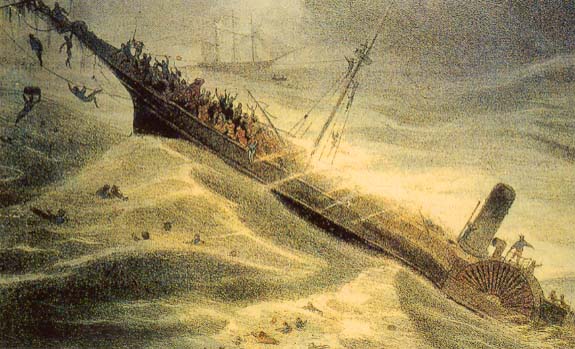 Steamship Central America Sinks In Storm Over $2 Million in Gold Lost On September 12, the USS Central America, a side-wheel steamer carrying nearly six hundred passengers returning from the California Gold Rush and heavily laden with between 13 and 15 tons of gold sank in a great storm somewhere off the coast of the Carolinas. We’re saddened to report that most of the souls on board perished. On September 3, 1857, 477 passengers and 101 crew left the Panamanian port of Colón, sailing for New York City under the command of William Lewis Herndon. After a stop in Havana, the ship continued north. On September 9, the ship was caught up in a furious hurricane while off the coast of the Carolinas. On September 11, the high winds and heavy surf had shredded her sails, she was taking on water, and her boiler was threatening to go out. When a leak developed in one of the seals to the paddle wheels, her fate was sealed. At noon that day, her boiler could no longer maintain fire and steam pressure dropped, shutting down both the pumps keeping the water at bay and the paddle wheels that kept her pointed into the wind. The passengers and crew flew the ship's flag upside to try a signal a passing ship. No one came. A bucket brigade was formed and her passengers and crew spent the night fighting a losing battle against the rising water. During the eye of the storm, attempts were made to get the boiler running again, but these all failed. When the second half of the storm struck, the ship was on the verge of foundering. Without power, the storm was carrying the ship with it, so the strong winds would not abate. The next morning, two ships were spotted, including the brig Marine. 153 people, primarily women and children, managed to make their way over in lifeboats. But the Central America remained in an area of intense winds and heavy seas. The ship and most of her company were pulled away from rescue. Ultimately the ship and the roughly 425 people still on board sank at around 8 pm that night. Loss of Central America Fuels Financial Panic The storm clouds of recession continue to gather. Led by agriculture, individual sectors of the economy have continued to draw against their bank deposits, putting greater and greater pressure on the gold reserves that banks rely upon to back their privately issued notes. With the August collapse of The New York office of the Ohio Life Insurance and Trust, many of the New York banks that were creditors of Ohio Life have failed. A concurrent delay of gold shipments from California has contributed to the despair. Now, with the sinking of the Central America, the problem has been compounded. The loss of the Central America sent its huge load of gold -- some estimates say a value equal to one-fifth of the gold in Wall Street coffers -- to the bottom of the sea. With that gold, it had been hoped that banks could withstand any run; without it, those that have managed to survive to this point are at grave risk of failure. General William Tecumseh Sherman, a prominent New York banker told the Republic that the "absolute loss of this treasure will likely swell the confusion and panic of the day." Kansas Assembly Approves Pro-Slavery Constitution The Constitutional Convention held in September, 1857 in Lecompton, Kansas Territory has approved a constitution that supports the existence of slavery in the proposed state and protects rights of slaveholders. In addition, the constitution provides for a referendum that allows voters the choice of allowing more slaves to the territory. The convention was boycotted by free-soilers so the referendum concerning additional slaves to the Kansas territory was passed overwhelmingly. There is much fear that this latest development in the Kansas saga could reignite violence between pro-slavery and anti-slavery factions in the territory. Some Washington insiders say President Buchanan strongly supports the Lecompton plan and will make strong efforts to steer the referendum through the U.S. Congress. Immigrants Murdered in Utah Territory Indians blamed but suspicion falls on Mormons On September 11, a California-bound wagon train of approximately forty families, mostly from Marion, Crawford, Carroll, and Johnson counties in Arkansas, was reportedly attacked by Indians at the mountain-ringed Mountain Meadows in southwestern Utah territory, a widely known stopover on the old Spanish Trail. It is said that most of the 120 immigrants in the party -- including women and children -- were murdered. The Utah Paiute tribe has been implicated in the attack. However, there is some suspicion that members of the Mormon sect in Utah also may have been involved, either directly or indirectly. Only a few months earlier popular Mormon leader Parley P. Pratt was murdered in Arkansas by the ex-husband of one of Pratt's plural wives. It is thought that the Mormons may have incited the Paiutes to attack the wagon train in retaliation. In addition, Mormon leader Brigham Young declared martial law in the territory on September 15 -- a possible first step toward open hostilities between the sect and the U.S. government. WORLD NEWS Indian Mutiny -- Brits Retake Delhi After nearly two months of laying seige to the city, British forces attacked Delhi on September 14. The British broke through Delhi’s Kashmiri gate and after a week of fierce street fighting have retaken the city. The plan of attack called for a 1,000-man column from the 75th Highlanders to mount the Kashmir Bastion, while another column from the 52nd (Oxfordshire & Buckinghamshire) Light Infantry would force the Kashmir Gate, enabling the British troops to fight their way into the city itself. Other columns would breach the Lahore Gate. A total of 5,000 men took part in the British assault on Delhi, whose estimated 30,000 sepoy defenders reportedly were under the command of Bakht Khan, an artillery officer who had 40 years of military experience. The attack began 3 a.m. on September 14. Not all went well. The 75th Highlanders outran its ladder-bearers and was left exposed in the 16-foot moat, where they were raked by withering fire from the mutineers on the walls above them. When the ladder parties caught up with them, General John Nicholson led the survivors in a charge through a breach that had been made in the wall by his supporting artillery. Colonel George Campbell rushed his column to within striking distance of the critical Kashmir Gate and sent a small party of Bengal Engineers, under Lieutenant Duncan Home, to pack explosives under the gate. A firing party of the 52nd covered them as best it could, but the exposed sappers drew terrible fire. Half of them were killed and Lieutenant Philip Salkeld was mortally wounded. Sergeant John Smith finally managed to touch off the explosion that blew a hole in the gate. As Bugler Robert Hawthorne of the 52nd sounded the attack, the British troops poured through the opening to be met only by the charred corpses of the sepoy defenders. Now within the city gates, three columns joined forces in an area between the Kashmir Gate and the Anglican church. The fourth column, whose artillery failed to appear amid the confusion, had been forced to retreat beyond the field of fire due to heavy casualties. The troops within the Kashmir Gate had to make their way some 250 yards down a 10-foot-wide lane flanked by flat-topped buildings, from which sepoys maintained a constant rain of fire. Making matters worse were two artillery pieces at the head of the lane and some 1,000 mutineers waiting to fire on the approaching British from atop the so-called Burn Bastion. The 1st Bengal Fusiliers took the lead in making the dash up the lane toward the Lahore Gate, which had to be opened to admit other British units. Powerless against the sheets of rifle fire from the rooftops, the fusiliers fell back. Nicholson then personally led a new attack on the Lahore Gate. Just as he flourished his saber, however, a mutineer fired on him point-blank from a window. Badly wounded, he mustered the strength to prop himself up on one elbow and once again shouted encouragement to his men, but his troops were unable to force this death trap and had to retire. In six hours, the British had lost 66 officers and 1,104 men. On September 16, British forces captured an enemy magazine and took 171 guns and vast stores of ammunition. The narrow lane leading to the Lahore Gate was widened and made navigable by blasting the houses along its curbs. On September 19, the Burn Bastion was taken, and on the following day the Lahore Gate finally fell to the British. As the weary days of fighting continued, news of victories was welcome. News of Nicholson's ebbing life was not. When the great soldier died, he was widely mourned. The last remaining redoubt of the sepoys was believed to be the king's palace, but when its gates were blown open, it was found to be nearly deserted. At dawn on September 21, a royal salute told all within hearing distance that Delhi had been taken by the Army of Retribution. The seat of the once-great Mogul Empire was forever gone. Bahadur Shah, the self-proclaimed Mogul emperor, had hidden a few miles north of the city in Emperor Homayun's tomb. This was discovered by the intrepid but headstrong Major William Hodson, leader of hard-riding irregulars known as Hodson's Horse and who now managed intelligence for the British at Delhi. With 50 of his men he set out on September 21 to bring in the errant king. Bahadur Shah had huddled inside the cloisters of the tomb while thousands of his servants and well-wishers sullenly watched the approaching British horsemen. The king knew that resistance on his part would be pointless, and he accepted Hodson's promise that the major would spare his life if he gave up quietly. Followed by a vast entourage of Indians, Hodson led his captive back to Delhi. Then, he and 100 of his irregular cavalrymen returned to Homayun's tomb, this time to bring back the king's two sons and grandson. Despite a mob of royal retainers and partisans, many of whom were armed, Hodson was able to flush the young scions of the Mogul dynasty from their hiding place. Hodson, surrounded by a hostile crowd, raised his carbine and summarily executed the three princes. Amazingly, the shocked mob did nothing. The bodies were dumped unceremoniously at the spot where the king's sons were thought to have committed atrocities against the English. It is reported that the troops of the besieging force have proceeded to loot and pillage the city. A large number of the citizens have been killed in retaliation for the Europeans and Indian 'collaborators' that had been killed by the rebel sepoys. Artillery has been set up at the main mosque in the city, the Jama Masjid, and the neighborhoods within the range of artillery have been bombarded. These include the homes of the Muslim nobility from all over India.
__________________
GM, Miami Sharks, IHOF Founder & President, SFL GM, Oklahoma Outlaws, GEFL Read my "Sports and History Dynasty" Last edited by sflcat; 02-26-2007 at 10:49 PM. |
|
|
|
 |
| Bookmarks |
|
|


