 |
 Home | Webstore Home | Webstore
|
|
Latest News:
OOTP 26 Available
- FHM 12 Available
- OOTP Go! Available
Out of the Park Baseball 26 Buy Now! |

|
|
||||
| ||||
 06-07-2023, 11:02 AM
|
#281 |
|
Hall Of Famer

Join Date: Jan 2002
Location: Behind The Lens
Posts: 2,928
|
Unpublished writings of Roger Cleaves, circa June 1945:
Editor's note: Roger Cleaves kept his writing ability a close secret until nearly 20 years after the war had ended. He kept a detailed personal diary of his time in the Pacific theater but years afterward explained that he would never want to see it published. "War may be fought between nations," he said, "but for every soldier, sailor, Marine and airman, it is intensely personal. That's what comes of being in a literal life or death struggle for days, weeks, months on end." The following passage was written during and immediately after the Battle of Okinawa. Roger had been recently promoted to sergeant and reassigned to the machine gun platoon of the 3rd Battalion of the 8th Marine Regiment, leaving behind his friends who remained in Company C, 1st Battalion, 8th Marines. June 19, 1945 - Battle for Okinawa War Diary of Sergeant Roger Cleaves, Section Sergeant - 3rd Battalion, 8th Marine Regiment, Machine Gun Platoon We pushed forward today, guns blazing, sweat pouring, and the sounds of battle echoing in our ears. The Kiyamu Peninsula lay before us, and our mission was clear - to pierce the heart of the enemy's defenses. As the section sergeant of the machine gun platoon, I led my men through the treacherous terrain, our weapons ready and our spirits high. The morning sun cast long shadows over the rugged landscape, providing us with a semblance of cover. Lieutenant Colonel Wallace's voice boomed through the air, urging us to press on. With each step, the weight of our gear seemed to increase, but we soldiered on, determined to break through. The Japanese resistance was fierce. Machine gun nests peppered the hillsides, raining bullets upon us. Mortar shells exploded around us, sending dirt and debris flying. But we were Marines, battle-hardened and resolute. We returned fire with everything we had, our machine guns roaring, spitting out death to the enemy. My section fought with unwavering resolve. Private Williams, a crack shot with an uncanny ability to pick off enemy gunners, laid down suppressive fire, allowing the rest of us to advance. Corporal Martinez, always cool under fire, skillfully maneuvered our heavy weapons through the chaos, setting them up at strategic points to deliver a devastating barrage. We inched closer, yard by yard, taking cover behind rocks and fallen trees. The cacophony of battle drowned out all other sounds, but I could see the determination in the eyes of my men. Their trust in me as their leader spurred me forward. We fought as one, a well-oiled machine, each of us knowing our role and executing it flawlessly. As we reached Ibaru Ridge, our assault intensified. The enemy clung to the high ground, their resistance growing more desperate. With a thunderous boom, our artillery unleashed a barrage of white phosphorus smoke, shrouding the ridge in an eerie haze. It provided the cover we needed. I gave the command, and we charged forward, bayonets fixed, adrenaline pumping through our veins. The enemy defenders were caught off guard by our ferocity, stumbling backward in disarray. Bullets whizzed past, narrowly missing us, but we pressed on, undeterred. The ridge became a battlefield, a maelstrom of chaos and violence. Hand-to-hand combat ensued as we fought tooth and nail to drive the Japanese down the slope. The determination in their eyes matched our own, but we had the advantage of numbers and the will to win. In the midst of the melee, I caught sight of Private Spinelli, his face etched with determination, firing his machine gun with deadly accuracy. But in an instant, a burst of enemy fire found its mark, and Spinelli fell to the ground, clutching his bleeding leg. I yelled for a corpsman, but the chaos swallowed my voice. I could only hope that help would reach him in time. By 1700 hours, we had achieved a breakthrough. The enemy lines had crumbled under our relentless assault. We regrouped atop the ridge, catching our breath and assessing our losses. It had been a hard-fought victory, but the battle for Okinawa was not yet over. Over the next three days, the 8th Marines joined forces with other units, clearing out pockets of resistance and ensuring the island's security. Company I of our battalion faced heavy losses during a fierce engagement in Makabe, but the indomitable spirit of the Marines prevailed. On June 22, the final objective loomed ahead - Naha. Our boots pounded the war-torn ground as we advanced, the end in sight. General Geiger's announcement reverberated through the air, signaling our victory. Okinawa was ours. Reflecting on the battle, I am filled with a mix of emotions. We had fought with valor and resilience, paying a heavy price. The loss of brave comrades will forever weigh upon my soul. Yet, we emerged triumphant, having accomplished our mission. As I write this diary entry, surrounded by the echoes of war, I cannot help but feel a sense of pride in my men. Together, we faced the horrors of battle, standing tall against the onslaught. Our machine guns, once mere tools of war, became instruments of salvation. Now, as we prepare to redeploy, we turn our gaze towards the horizon. The invasion of Japan looms ahead, a daunting prospect. But for now, we rest, heal our wounds, and honor the fallen. We will carry their memory with us, drawing strength from their sacrifice. The battle for Okinawa may be over, but our journey as Marines continues. The war rages on, and we stand ready, knowing that whatever lies ahead, we will face it with the unwavering spirit of the 8th Marine Regiment. ------------------------------------------------------------------------------------------  Sgt. Roger Cleaves leads his men towards Naha, Okinawa, June 1945 ------------------------------------------------------------------------------------------
__________________
 Hexed & Countered on YouTube Hexed & Countered on YouTubeFigment League - A fictional history of baseball, basketball, football, hockey & more! Want to join in the fun? Shoot me a PM! Read the story of the Barrell Family - A Figment Baseball tale Same Song, Different Tune - The Barrells in the Modern Era |

|

|
|
06-12-2023, 09:41 AM
|
#282 |
|
Hall Of Famer
Join Date: Jan 2002
Location: Behind The Lens
Posts: 2,928
|
July 10, 1945: Chicago, IL:
Rufus Barrell's first month as the Washington Eagles' team president had been quite a whirlwind. He and Alice had moved into the home of their old friend, Thomas Potentas. Thomas, Rufus' former partner in the OSA, had spent most of the war in London working on behalf of the Polish government in exile. Thomas had a deep connection to his homeland of Poland, even more so than baseball. Meanwhile, Rufus and Alice had moved into the vacant house in Georgetown. Rufus was unsure how long he would be running the Eagles, as it depended on when the war with Japan would come to a victorious conclusion. In the meantime, he had a baseball team to manage. Rufus had spent his entire career in scouting and had never considered himself an "executive," but now he found himself in that role. During the first week, he closely followed the Eagles' scouting director, Elmer Harman. Rufus knew and respected the 52-year-old Kansan, leaning on him to get up to speed on the team. Rufus and Harman spoke the same language, as Rufus had put it when Harman questioned why the new team president was spending time with a scout. The Eagles showed great promise as a talented team. Ironically, the Philadelphia Keystones, the team Rufus's new club was chasing, happened to be the best team in the Federal Association. Their lineup was centered around a slugging outfielder named Barrell—Bobby, Rufus and Alice's son. Bobby was a true star, and both Rufus and Alice couldn't be prouder. He had won the 1944 Whitney Award as the Fed's top player and was having a fantastic 1945 season. The Keystones had won the 1944 pennant (though they lost to the Cincinnati Cannons in the World Championship Series) and were the favorites to win it again in '45. Rufus's job was to beat them to the flag. Harman believed that Washington had enough talent, but "everything needs to go right." Rufus agreed with that assessment. Now, Rufus was in Chicago for the All-Star Game at Cougars Park. He had attended a Federal League owners meeting the previous day. Being in baseball for fifty years, Rufus knew everyone who mattered in the sport. The owners, both from the Federal and Continental Leagues, knew him as well. They were a cantankerous bunch, mainly focused on money, but some also wanted to win. Rufus observed the range of personalities, from Boston's Jesse Barton, an elderly man like Rufus, who looked down on most people, to younger men like Chicago's Billy Whitney, who had been a good friend to Joe Barrell, Rufus's oldest son, before his tragic death in a plane crash. Barton was a crusty old S.O.B., while Whitney, though profit-oriented, was more down-to-earth. The meeting itself was largely perfunctory, with most of the discussion revolving around the new man in the White House, Harry Truman. Truman had succeeded FDR in April after the latter's death. He was an unknown factor, but he seemed to be a baseball fan like FDR. The owners, including Rufus, hoped Truman would also be a friend to the game. There was frustration over the players who were still in the military. Many, like Barton, believed that with Germany defeated, the war was nearly over. "Japan never had a chance, and we'll whip 'em soon, and they don't need my ballplayers to do it," Barton grumbled. Rufus's youngest son, Harry, played for Barton's Boston Minutemen and was closely following the discussion. He knew firsthand the challenges of managing a team with key players serving in the military. After the meeting concluded, Rufus found himself engaged in conversations with various owners and executives. He shared a drink with Billy Whitney, who expressed his condolences for Joe's untimely death and spoke fondly of their friendship. They reminisced about the good times and the positive impact Joe had on Whitney himself. Rufus appreciated the kind words and found solace in knowing that his son was remembered and respected. As the All-Star Game approached, Rufus made his way to Cougars Park, a relatively new venue that had already hosted countless memorable baseball moments thanks to the quality of the Chicago Cougars themselves. The atmosphere was electric, with fans buzzing in anticipation of the exhibition match between the Federal and Continental Leagues' finest players. Thankfully today was game day, and Rufus could settle back into his familiar role of watching the game with a scout's eye. He had two sons, Bobby and Tommy, playing in the game, as well as his grandson, named Rufus for his grandfather, but better known as Deuce. Deuce and Tom were pitching for the Continental League's Cannons, while Bobby played for the Federal Association as a member of the Keystones. As a Federal League executive, Rufus naturally rooted for the Feds. However, since it was an exhibition game approved by President Roosevelt back in February (waiving the wartime travel restrictions), Rufus simply wanted his sons and grandson to play well and avoid injury. Rufus and Alice had excellent seats just behind the home dugout. They were joined by Deuce's twin-sister, Gloria, and Bobby's wife, Annette. Bobby and Annette's two sons were also present. Five-year-old Ralph sat beside his mother, while Alice held Bobby Junior on her lap. Despite his young age, Bobby Junior was well-behaved and accustomed to the ballpark environment. Bobby started in left field and batted cleanup for the Federal All-Stars. In his first at-bat, he faced Toronto's George Garrison in the top of the second inning. Rufus admired his son's near-perfect swing, which he had possessed since childhood. Bobby fouled off the first two pitches before taking a couple of balls. Ultimately, Garrison managed to make him fly out to left field with a well-executed changeup that disrupted Bobby's timing just enough. Deuce Barrell entered the game as a pitcher for the Continental All-Stars in the fourth inning. He successfully forced Larry Colaianni, a member of the Eagles, to ground out to shortstop and struck out the tough Al Tucker of St. Louis on three pitches. This set the stage for Bobby's second at-bat. Rufus squeezed Alice's hand, and she smiled in return, sharing his pride in watching their eldest grandchild pitch to his uncle. It wasn't the first time they had faced each other, having done so in other games, including the previous October's World Championship Series. Deuce grinned at his uncle, and Bobby smiled while shaking his head slightly. The first pitch was a perfectly executed curveball, and Bobby hit it to center field, where Saints outfielder Bill Greene made the catch. The game remained scoreless when Deuce returned for his second inning of work. Rufus nodded at him, and Deuce acknowledged it. St. Louis' Hal Sharp hit a ground ball back to Deuce, who fielded it cleanly and threw to first for the first out. Cal Page came up to bat and hit a clean ground ball past the shortstop for a single. Although Page had good speed, Deuce's strong move as a left-handed pitcher kept Page's lead at first base under control. Bill Van Ness, the catcher for the Boston team, stepped up to the plate. After taking a ball and two fastball strikes, Rufus anticipated that a changeup would work well in this situation. However, Deuce shook off the catcher and proceeded to throw another fastball. It proved to be a mistake as Van Ness capitalized on it, hitting a home run into the right field seats, giving the Federals a 2-0 lead. Annette cheered, Gloria and Alice frowned, and Rufus was left unsure how to react. Deuce stomped around behind the mound, visibly frustrated with himself. Rufus imagined Deuce's Cannons teammate and catcher, Tom Bird, a seasoned veteran, was not pleased at being shaken off. Deuce struck out John Busby and retired Larry Gregory on a fly ball to right, but he was still shaking his head as he walked back to the dugout. In the bottom of the fifth inning, the Continental All-Stars scored a run, making it 2-1. The score remained the same until the eighth inning when Tom Barrell entered the game. Rufus had high hopes for Tom, who had experienced ups and downs due to injuries, lost velocity in his fastball, trades, and time spent in the bullpen. However, he was currently having a resurgence with the Cincinnati team, back in the rotation and making the All-Star team. Rufus couldn't have been prouder. Tom faced Bob Martin, a veteran player from the Chicago Chiefs known for his professional hitting approach. As expected, Martin displayed patience and took four consecutive pitches, consisting of two balls and two strikes, before hitting a line drive single to center field. Pittsburgh's Johnny McDowell moved Martin to second with a slow grounder. Tom then walked Joe Henry of Detroit, loading the bases. Al Tucker, another dangerous hitter, stepped up to the plate. Tom managed to get him into a 1-2 count and made a good pitch, but Tucker made solid contact and hit a ball up the middle. Brooks Meeks, the second baseman for the Foresters, dove to knock it down, but Tucker reached first safely, and the bases were loaded. Bobby stepped to the plate. Having faced each other countless times while growing up, Tom, being two years older, often had the upper hand over Bobby. However, Bobby had now become one of the best hitters in baseball. Tom frowned at his brother, and Bobby winked in response, causing Rufus to shake his head, knowing it might make Tom angry. Tom delivered a nice fastball over the outside corner for strike one, and Bobby gave him a small nod. The next pitch was similar but had more of the plate. Bobby hit a scorching line drive up the middle, just past Tom and over the second base bag, into centerfield. Tom raced to back up home plate as Bobby rounded first base. Bobby remained at first, clapping his hands as Martin and Henry scored, giving the Federals a 4-1 lead. Tom retired Washington's Sig Stofer on a ground ball to second base to end the inning, but he was still shaking his head as he walked off the field. Bobby patted Tom on the shoulder, and Tom said something that made Bobby smile. In the bottom of the eighth inning, the Gothams' ace Ed Bowman struggled, giving up three runs, including a double by Cougars infielder Skipper Schneider, which tied the game and sent the Cougars Park crowd into a frenzy. The game entered the ninth inning tied at four runs each. Neither team scored in the ninth inning. In the top of the tenth inning, with Ben Curtin pitching for the Cougars, the Federals mounted a rally. Joe Henry walked with one out, and Tucker reached base on a fielder's choice. Bobby then drew a walk, putting two men on with two outs. Curtin hit Stofer, loading the bases. Chick Donnelly from Boston stepped up to the plate. After taking a ball and two strikes, the second of which he disagreed with, Donnelly hit a deep fly ball to left field, clearing the fence for a grand slam. The four runs proved to be more than enough as the Federals held on to win the game 8-4. Rufus realized he had thoroughly enjoyed himself and cherished the opportunity to watch his sons and grandson play together on the same field. He also realized that as the current Eagles club president, he could attend as many games as he wished. He made the decision to be in the owner's box for every Eagles home game until Captain Stockdale returned from the war and Rufus could return to the farm.
__________________
Hexed & Countered on YouTubeFigment League - A fictional history of baseball, basketball, football, hockey & more! Want to join in the fun? Shoot me a PM! Read the story of the Barrell Family - A Figment Baseball tale Same Song, Different Tune - The Barrells in the Modern Era Last edited by legendsport; 06-21-2023 at 03:40 PM. |
|
|
|
|
06-21-2023, 06:12 PM
|
#283 |
|
Hall Of Famer
Join Date: Jan 2002
Location: Behind The Lens
Posts: 2,928
|
July 13, 1945: Auckland, New Zealand:
Roger Cleaves leaned against the ship's rail as it docked in Auckland. He flicked his cigarette into the water, avoiding any trouble with the Navy crew who were meticulous about keeping the deck clean. The journey had been uneventful, with the Navy sailors on edge for Japanese submarines, but Roger and the few Marines with him were unfazed. After surviving the battles of Tarawa, Saipan, and Okinawa, he had a feeling luck was on his side. Surely, fate wouldn't allow him to be torpedoed now, not on this particular voyage. After the campaign on Okinawa had wrapped up, Roger had hoped they would send the entire 8th Regiment, if not the entire 2nd Marine Division, back to New Zealand. But he had quickly learned two things: first, they were bound for Saipan, and second, he was scheduled to return to the States. Three campaigns under his belt, and they deemed it time to send him home. "Home? What am I supposed to do there?" he had asked, genuine curiosity etched on his face. After three long years, he had almost forgotten what 'home' felt like. He wasn't sure he was ready to go back. The war wasn't over yet, with the impending invasion of Japan on the horizon unless the Japanese decided to surrender, which seemed highly unlikely in Roger's eyes. Having fought them enough, he knew their tenacity. Captain Woods had provided some insight, saying, "You'll probably be training the next batch. You've done your duty, Cleaves. It's time for some easier assignments," the captain had assured him. Roger had furrowed his brow, unsure if he wanted to return to the States. Captain Woods was a good man, as far as officers go, and they had gotten along well since playing rugby back in Auckland. The mere thought of Auckland brought someone special to mind, someone he wouldn't mind seeing again. The very reason he had hoped they were going back to New Zealand. They'd sent the 5th Marine Division back to Hawaii after Iwo Jima, so Roger had hoped the 2nd Division would catch a similar break. No dice. "Say, Captain, any chance I could stick around?" Roger had mustered the courage to ask. Woods shook his head, a hint of regret in his expression. "The paperwork is already finalized, Cleaves. It would be easier to move a Sherman tank than to change the Corps' decision," he admitted with a wry grin. "Why? Are you still trying to get yourself killed?" Woods teased. Roger shook his head and replied, "Not at all, sir," but after a brief pause, he sighed and added, "I just don't know if it feels right leaving my men with the job unfinished." Woods shrugged, understanding the sentiment. "That's commendable, Cleaves, but my hands are tied. Your replacement will be here tomorrow." Roger chewed on his lip, contemplating his options, and finally asked, "Well, what about transferring to one of the other regiments. Surely, there must be someone who needs an experienced NCO, right?" Woods frowned, considering the request. "I suppose among the six full divisions the Corps has in the Pacific, there must be a unit in need of an NCO. But you're crazy, you know that?" Woods said, shaking his head. "You're one stubborn Marine." It took some effort and persuasive arguments, but Roger's impeccable record eventually secured him an assignment to another combat unit - the 26th Marine Regiment, part of the 5th Marine Division that had suffered heavy losses during the Battle of Iwo Jima and was being reconstituted at Camp Tarawa on the big island of Hawaii. But before that, Roger had another plan in mind. He needed to see his cousin. He managed to catch a ride to Isley Field and made his way to the hardstand where "Clouting Claudia" sat. The big silver bomber was incredibly impressive. Roger could barely fathom how James could fly that behemoth. "Hey buddy, is Major Slocum around?" he asked the man whose upper half was hidden by the engine cowling as he worked on one of the big engines. "Well... he's not here," Roger heard and frowned. He realized that was his own fault for not phrasing the question better. He tried again, "Do you know where he might be found?" The man dropped something, and it clattered to the concrete at Roger's feet. The man cursed. "Can you grab that for me, friend?" he asked in a much friendlier tone of voice. "Sure," Roger said as he bent down to pick up the item. He held it out and asked, "So, where's Slocum?" The guy's torso appeared as he reached out and took the part. "Probably at the officer's club," he said. Then he thanked Roger and disappeared again. Roger sighed and muttered, "Great," knowing he wouldn't exactly be welcome in the O-Club. Not only was he not an officer, but he was a Marine, not a flyboy. However, luck was on his side as he asked a fresh-faced second lieutenant he met outside the club if he could find Major Slocum. The guy knew James and said he would send him out if he was inside. It turned out, he was. "Roger! Good to see you," he said. "Guess you made it off Okinawa in one piece." Roger nodded, then he asked James for a favor. James rubbed his chin, which reminded Roger of someone, but he couldn't quite place it. Then James said he would see what he could do. What he could do ended up being getting Roger a ride on a C-47 to Guadalcanal. From there, Roger managed to finagle his way onto a Navy ship bound for Auckland. Technically, he was on leave and had transport orders for Hawaii, but he decided to worry about that when he got to Auckland. He figured the Corps wouldn't care if they had to ship him from Auckland or Saipan - the way he saw it, New Zealand was marginally closer to Hawaii, so he was saving someone some aviation gas. Finally, as Roger stood on Auckland's soil once again, he couldn't help but feel a surge of excitement and anticipation. He had fought battles, seen comrades fall, and faced the horrors of war. But in this moment, he allowed himself a glimmer of hope for the future. He had a girl waiting for him in this city, a love that had grown through letters exchanged during his deployments. It was time to reunite with Evelyn, to hold her in his arms, and to ask her the most important question of all. After a quick stop, Roger made his way to the address written in her letters. He knocked on the door, his heart racing in his chest. The door swung open, revealing a familiar face with a wide grin. "Well, well, well, if it isn't the Yank who fancies himself a rugby player," Oliver Wilson said. Ollie was the one who had dared Roger to try rugby, and they had become close friends. It was through Ollie that Roger had met... "Ev! Your Yank is here!" Ollie shouted for his sister, slapping Roger on the shoulder. "Good to see you, mate," he said before disappearing back into the house, leaving Roger standing on the doorstep. And then, she appeared. "Evelyn," he whispered, his voice filled with love and longing. They embraced tightly, a hug that bridged the distance of their separation. In that moment, the hardships of war melted away, replaced by the warmth of their love. As they pulled apart, Roger gazed deeply into her eyes, his voice steady yet filled with emotion. "Evelyn, I can't imagine my life without you. These past battles have shown me how fleeting life can be. Will you marry me?" Evelyn's eyes shimmered with tears of joy, and she nodded, unable to speak. Roger slipped a small ring onto her finger, a symbol of their love, which he had purchased just moments before, sealing their commitment in a profound moment of connection. ------------------------------------------------------------------------------------------  Roger Cleaves arrives in Auckland, July 1945 ------------------------------------------------------------------------------------------
__________________
Hexed & Countered on YouTubeFigment League - A fictional history of baseball, basketball, football, hockey & more! Want to join in the fun? Shoot me a PM! Read the story of the Barrell Family - A Figment Baseball tale Same Song, Different Tune - The Barrells in the Modern Era |
|
|
|
|
06-22-2023, 10:13 AM
|
#284 |
|
Hall Of Famer
Join Date: Jan 2002
Location: Behind The Lens
Posts: 2,928
|
August 6, 1945: Brooklyn, NY:
The sound coming out of Powell & Claudia Slocum's big Westinghouse radio crackled only slightly as the people in the room listened to an announcement from the White House: "Sixteen hours ago an American airplane dropped one bomb on Hiroshima, an important Japanese Army base. That bomb had more power than 20,000 tons of T.N.T. It had more than two thousand times the blast power of the British "Grand Slam" which is the largest bomb ever yet used in the history of warfare. The Japanese began the war from the air at Pearl Harbor. They have been repaid many fold. And the end is not yet. With this bomb we have now added a new and revolutionary increase in destruction to supplement the growing power of our armed forces. In their present form these bombs are now in production and even more powerful forms are in development. It is an atomic bomb. It is a harnessing of the basic power of the universe. The force from which the sun draws its power has been loosed against those who brought war to the Far East." The voice reading the statement was not the President's, though the words were said to be his. Truman himself was at sea, returning from the Potsdam Conference. The statement continued for several more minutes, ending with the hope that the power of the atom could be harnessed to help maintain world peace. Tom Barrell frowned as he heard those words, slowly shaking his head. "I hope he's right," Deuce Barrell muttered. Jack Cleaves shook his head in agreement, remarking, "No one's putting that genie back in the bottle. If there's one thing mankind's always been good at, it's killing other people. This just makes it a lot more efficient." Claudia Slocum looked at her husband, seeking reassurance. Powell shook his head to reassure her and said, "I doubt James had anything to do with that mission." Claudia sat there, looking stricken. She'd been a Red Cross nurse in her native Germany during the First World War and all the wanton destruction over the past six years had left her brokenhearted. Deuce shrugged and remarked, "This is kind of good news, though, isn't it?" Tom frowned and replied, "In the short term, yes. I don't see how the Japanese can keep fighting if we can wipe out entire cities with one bomb." Jack added his agreement. All the people in the room had close ties to servicemen in the Pacific. They discussed their loved ones who were involved in the war, expressing hopes that the bombings would bring about a quicker end to the conflict and ensure the safe return of their family members. The day had started on a high note: the Cincinnati Cannons had arrived in Brooklyn for a series with the Kings. However, the war had disrupted baseball's schedule, resulting in two days off before the series began on Wednesday. Deuce, Tom, and Jack all played for Cincinnati, while Powell managed the Kings. Tom and his brothers Dan, Fred, and Harry had previously played for Powell in Brooklyn. Jack brought news, through his brother George, that Roger had somehow managed to get married in the middle of the war. "His telegram was short," Jack said, adding, "But that knucklehead somehow found someone dumb enough to marry him." Deuce smirked, finding Jack's stiff, moralistic view on their shared half-brother amusing. Roger and Deuce shared a father, while Jack and George Cleaves shared a mother with Roger. Roger was illegitimate, and his last name should have been Barrell, but he only discovered he wasn't a Cleaves in his teenage years. Roger had been a troublemaker, a trait Deuce secretly admired. "I've heard that Roger has changed quite a bit since he joined the Marines," Deuce said, based on what George had heard. George, who kept tabs on Roger because his father-in-law worked in the Pentagon, looked out for their youngest brother unlike Jack. "But married? I just can't fathom it," Deuce said to Jack. Jack nodded in agreement. "She must be a helluva gal," he said. "George did say she's from New Zealand. Maybe they like knuckleheads over there," he finished. After the discussion about Roger ended, Tom chimed in. "Well, with my nephew now engaged, I suppose I can piggyback on that by announcing that Marla and I are getting hitched too," Tom said with a grin. Claudia's eyes widened. Among the Barrells, Tom had always seemed destined for permanent bachelorhood, not because he didn't like women but rather because he liked them too much. "You? Married?" she asked with a merry laugh. Tom took it good-naturedly; he was well-aware of his reputation as a lady killer. "Yep, finally found one I can take home to mother," he said. They discussed the wedding plans, which were still rudimentary at that point but would obviously take place after the World Championship Series. The Cannons were two-time world champs and favorites to make it three in a row. Then Powell announced that he had been talking with Claudia and decided that 1945 would be his last year as a manager. "I've been around baseball my whole life, and it's time to let the younger folks take over," he said. Slocum, originally from Alabama, had played in Baltimore and Brooklyn before transitioning into coaching and managing, which kept him in the north. However, he still longed to go back "home." "Too much hub-bub for an ol' Reb like me," he said. "I'm coming to the end of the road too, Powell," Tom admitted. "My fastball's got no hop. I'm getting by on chicanery and the occasional foreign substance," he said with a twinkle in his eye. Powell laughed and said, "I knew it!" before adding, "Don't worry, I won't say anything to the umpires." They all had a good laugh, with Tom cracking up even harder when he saw the expression on Deuce's face. "I'm joking, Deuce," Tom said. "You can ask Tom Bird, if you think I'm lying." Powell wiped a tear from his eye. "You know Tom, I always had you pegged for a skipper after you hung it up." Tom grew serious. "Huh, I never really thought about that, to be honest," he admitted. "Really?" Claudia asked. Powell nodded and told her, "Ballplayers never look past the next game, the next season. We have to act like we're immortal. It's how we keep our edge." Tom, sober-faced, nodded in agreement. "I married a pilot and somehow ended up in a family of crazy baseballers," Claudia said, shaking her head. ------------------------------------------------------------------------------------------ A similar scene was unfolding in Detroit. Bobby was visiting his two oldest living siblings at Rollie Barrell's home. Bobby was in town with the Keystones, who were preparing for a series against the Detroit Dynamos starting the next day. It was also a farewell gathering for Jack Barrell and his family. "Tacoma?" Rollie asked his brother. The three Barrell brothers sat in Rollie's home office, while the women—Rollie and Jack's wives and daughters—were in the living room, listening to the radio. Jack shrugged and replied, "The Lions were the only club that made me an offer. Bill Yeadon has always told me how beautiful the Pacific Northwest is. Now I'll get to find out." "Marie and the girls okay with this?" Bobby asked. Before Jack could respond, Allie rushed into the room and said, "You all need to hear this," then quickly hurried back into the living room. Jack glanced at Rollie, who shrugged and stood up. "I wonder what's going on?" Rollie mused as the three of them left the office. They caught the last two-thirds of the announcement. "A single bomb that can wipe out a city?" Bobby said, his voice tinged with awe and fear. "I guess it's a good thing the Nazis didn't build it first," Rollie added. Marie hugged Jack and said, "Hopefully, this means the Japanese will surrender, and Agnes can come home." Jack gave a small smile and said, "If she does, I hope she'll like Tacoma." ------------------------------------------------------------------------------------------ In the nation's capital, Rufus had just arrived home, taking a half-day at the office to review receipts from the recently concluded homestand. The Eagles had an off-day, as they would be heading to Chicago the next morning to begin a road trip. Like most FABL teams, they had Monday and Tuesday off. Rufus had decided to let the players spend the day at home. He just wished that Sunday's doubleheader against Boston had gone better. The Minutemen had won both games, leaving the Eagles at 56-52 and missing an opportunity to gain ground on the first-place Keystones, who had lost both games in their Sunday doubleheader with Pittsburgh. As Rufus was hanging up his hat, he heard the radio announcer interrupt Alice's favorite show, stating that the White House had a special announcement. Rufus frowned and said, "Truman hasn't returned from Germany yet. I wonder what this is about?" "Oh, I hope it's good news!" Alice exclaimed, standing up and giving Rufus a "welcome home" kiss on the cheek. Ten minutes later, they sat in stunned silence. "This is good news, right?" Alice asked after a moment. Rufus nodded and said, "Yes, it should mean the war will be over soon. No one can withstand this kind of weapon." "Well, that's good then," Alice said firmly. "It means James, Roger, Aggie, and all our boys can come home." Rufus nodded. "Yes, and it'll mean Captain Stockdale can come home too." Alice patted Rufus' hand. "You knew this thing with the Eagles was only temporary, dear." Rufus nodded again, his mouth set in a straight line. "Rufus, you're 72 years old. It's time," Alice said gently. Rufus nodded for the third time, but he didn't appear convinced. ------------------------------------------------------------------------------------------ 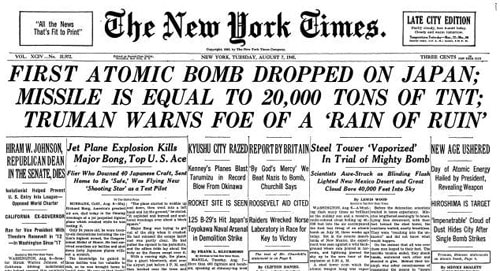 New York Times front page, August 7, 1945 ------------------------------------------------------------------------------------------
__________________
Hexed & Countered on YouTubeFigment League - A fictional history of baseball, basketball, football, hockey & more! Want to join in the fun? Shoot me a PM! Read the story of the Barrell Family - A Figment Baseball tale Same Song, Different Tune - The Barrells in the Modern Era |
|
|
|
|
06-23-2023, 09:25 AM
|
#285 |
|
Hall Of Famer
Join Date: Jan 2002
Location: Behind The Lens
Posts: 2,928
|
August 9, 1945: Frankfurt, Occupied Germany:
The crowd began to gather around the makeshift ballfield as an Army truck pulled up, and the passenger door swung open. A man in civilian clothing stepped out, offering gratitude to the driver before closing the door. A smirk played on his lips as he observed the men warming up on the field. Approaching him, an MP spoke in broken German, questioning his presence. "I'm looking for my kid brother," the man replied in English. "You're American?" the MP asked, eyeing the man's slightly worn attire. "As sure as the day is long, friend," he said with a broad grin, extending his hand. "Fred Barrell." "Fred Barrell? The ballplayer?" the MP exclaimed as they shook hands. "In a different life, my friend," Fred replied, nodding. "But, yes, that's me." "Nice to meet you," the MP, Tony Donelli, said. "I'm from Brooklyn. I saw you play many times." Fred engaged in a conversation with Sergeant Donelli before gesturing toward the field. "I'm going to see if I can find my brother Harry," he said. The past two months had been peculiar for Fred Barrell. The soldiers who had essentially captured him in Berlin brought him to their regimental HQ. Fred had proven his worth by tapping into his memory of the German defenses, having previously mapped them with the underground resistance. The Soviets appreciated the information but remained confident in their ability to crush the fascists regardless. Fred didn't doubt it. He had never witnessed such an overwhelming force of men, tanks, and artillery. He was grateful that, at least nominally, the Soviet Union was allied with the U.S. However, the situation became delicate. The commissar in charge of Fred seemed eager to extract as many American secrets as possible, even though Fred had limited knowledge of his own forces. While he knew that some American troops had been in Berlin as early as June, it wasn't until July, during the Potsdam conference, with representatives from all the Allied powers converging, that Fred was finally allowed to rejoin his countrymen. He underwent thorough debriefing and even had a brief encounter with President Truman, who sought his impressions of the Red Army. Fred described them as "formidable." He had been impressed by Truman's plain-spoken nature, thinking he'd have made an excellent baseball manager if he didn't already have a slightly more important job. He'd then been allowed to get on a transport plane for a flight to Frankfurt, where he was told to report to Third Army headquarters presumably to help with the Army's denazification efforts. Upon arrival, he discovered that everyone was at a ballgame, where Harry Barrell happened to be playing. Hitching a ride with a group of GIs who were enthused by his past as a professional baseball player, Fred found himself on his way to the game. Now, he strolled toward the field, scanning the players but not spotting Harry among them. His gaze shifted to the crowd, and there, he saw his brother in baseball uniform engaged in conversation with a group of Army officers. Fred headed towards them. As he approached, a couple of MPs noticed him and began to close in. Harry caught sight of their movement, did a double-take, and said something to a colonel standing next to him. "Let that man through!" the colonel ordered. Fred smiled and nodded at the bewildered MPs, making his way to the group standing with Harry. "Fred, what on earth are you doing here?" Harry asked, pulling him into a bearhug. "Just making my way home from Berlin," Fred replied nonchalantly. "Berlin?" a voice exclaimed from his left. Fred turned and was surprised to see General George S. Patton giving him a stern gaze. As usual, Patton wore his helmet adorned with four stars, despite the war having ended. "Yes, sir," Fred responded, leaning towards Patton and speaking in a low voice. "I'm with the OSS. I was sent there in February to work with the underground." Patton scowled at him. "And?" he snapped. Fred was taken aback. "Well, I was stuck there when the Russians arrived ahead of our boys." "Only because Washington was too scared to let us take it," Patton replied bitterly. Fred didn't know how to respond, so he simply nodded. Patton proceeded to interrogate him about the Soviets for ten minutes. Fred divulged everything he could, realizing that Patton held a disdain for the Russians. "Do you trust them?" Patton finally asked. Fred pondered for a moment before replying, "I trust them to do what's best for the Soviet Union." Patton nodded and turned to a colonel standing beside him. "You see, Bigsby? We can't trust those shifty..." Fred turned back to Harry with raised eyebrows while Patton continued his profanity-laced rant about the Russians' untrustworthy nature. Afterward, Patton settled down to watch some of the game. Harry went off to play, and Fred sat beside Colonel Bigsby, who happened to be related to the prominent New York Bigsby family. The colonel shared intriguing plans about bringing professional baseball to the West Coast, hoping that Patton would consider investing. It seemed that the general was quite wealthy, perhaps even more so than Bigsby himself. During the game, an announcement was made that a second atomic bomb had been dropped on Japan, this time targeting Nagasaki. Fred found Patton's reaction surprising — anger. Colonel Bigsby explained that "the general still had hopes of getting a command in the Pacific. These atomic bombs probably mean the war is over." Bigsby leaned over and said, "I remember you as being a good ballplayer. Want to get out there one more time?" He nodded towards the field. Harry laughed and said, "He hasn't played since '42. I bet he doesn't even remember how to hold the bat." Fred felt the old stir of his competitive juices. "Sure, why the hell not," he said, shooting Harry a sharp look. "I've had a really long - and strange - war, but baseball is in my blood." He stood up and asked, "Where's my uniform?" ------------------------------------------------------------------------------------------  Fred Barrell, one last game, August 9, 1945 ------------------------------------------------------------------------------------------
__________________
Hexed & Countered on YouTubeFigment League - A fictional history of baseball, basketball, football, hockey & more! Want to join in the fun? Shoot me a PM! Read the story of the Barrell Family - A Figment Baseball tale Same Song, Different Tune - The Barrells in the Modern Era |
|
|
|
|
06-27-2023, 12:14 PM
|
#286 |
|
Hall Of Famer
Join Date: Jan 2002
Location: Behind The Lens
Posts: 2,928
|
September 5, 1945: Cincinnati, OH:
Tom Barrell was feeling quite content. The war had ended; just two days prior, the Japanese had officially surrendered on the deck of the USS Missouri in Tokyo Bay. Harry had returned home a couple of weeks earlier, having been discharged, and immediately rejoined the Boston Minutemen. Since his military service involved playing baseball, he didn't require much "late spring training." Not everyone had the same luxury, but Harry had been an All-Star player and received special treatment. Fred was still in Germany, working on something called "denazification." Tom wasn't entirely sure what it entailed, but he suspected Fred was involved in capturing Nazis. When the war ended, the Nazis scattered like cockroaches when someone switches on a light in a dark room. As for his nephews, both of them were still serving and likely would be until early 1946. James would probably return to the U.S. before Roger, assisting in bringing back some of the B-29s now that the war was over. Roger was stationed in Hawaii but would eventually complete his service and bring his new wife home. Tom was quietly grateful that he had avoided military service. Four of Rufus and Alice Barrell's sons were color blind: Joe, Rollie, Dan, and Tom. Joe had passed it on to Deuce, which kept both Tom and his nephew from being drafted. Bobby's bullet wound had also exempted him, although it hadn't affected his ability to hit home runs. He had won the Whitney Award the previous year and seemed likely to win it again. Tom was looking forward to a World Championship Series rematch between his team, the Cannons, and Bobby's team, the Keystones. The Cannons were aiming for a third consecutive championship, a feat that had only been achieved once before, nearly 20 years ago by the New York Stars. True to his nature, Tom sat quietly, lost in his thoughts, undisturbed by others. He was the starting pitcher for the Cannons' game against the Montreal Saints. Sitting on his stool, he stared at his locker while the clubhouse buzzed with the pre-game activity. This was an important game, as the Cannons held a record of 79-51 and were currently in first place, but the Toronto Wolves, with a record of 76-54, were trailing by just three games. The Saints, with a record of 66-65, were playing better than usual, and Tom didn't want to underestimate them. Tom Bird, the catcher, briefly stopped by. Catchers were exempt from the rule of not talking to the starting pitcher. They discussed strategy, most of which was obvious to a veteran like Tom: don't give Vic Crawford anything on the inside, and Otis Parker could be lured into chasing high pitches. After Bird moved on, Tom contemplated retirement. At 37 years old, his once-powerful fastball had lost its velocity due to years of injuries. He envied Deuce, who could still throw with great speed whenever he wanted. Tom relied on his experience and cunning to succeed. He had pitched almost 3000 innings as a professional, 2700 of them in FABL, and he understood how to approach different hitters. The information about Parker was particularly valuable since Tom hadn't faced him before. Perhaps it was time to step away from the game. After all, he was getting married in October. Marla was unlike any woman Tom had ever known, and he had known quite a few. She had boldly called him a misogynist, a term he hadn't heard before and initially rejected when she explained its meaning. "What?! I love women!" he had protested. "Sure, you think you do. But you objectify women and view them only as objects of your desire," she had told him. "Well, yeah," he had replied, adding, "I'm a red-blooded American male, after all." She shook her head and went on to explain the flaws in his thinking. Tom didn't entirely agree, but she did make some valid points. Besides, it was somewhat irrelevant now as he was marrying her and would no longer be on the market. "Don't you forget that," she had firmly stated. Tom looked forward to spending the rest of his life with Marla. They might even have children. Marla was 27 years old, a decade younger than Tom. He had enjoyed being a mentor, in his own way, to both James and Deuce. Both boys had lost their fathers, and Tom had found fulfillment in being there for his nephews, filling the void left by his brothers Joe and Jimmy. All of his siblings had children, even Harry and Betsy. Betsy's husband, Tom Bowens, had also returned from the war and was playing football for the Boston Americans. Tom went out to warm up, his pitches showing good form. Bird acknowledged this with a nod and a grin. Soon, they were on the field, and an opera singer emerged to perform the national anthem. The atmosphere in the stadium was electric. The fans were enthusiastic and joyful—the Cannons were in first place, the war was over, and the future seemed promising. When the game began, Tom retired the leadoff batter, Jake Hughes, with a flyout to the sure-handed Fred Galloway in center field. He followed that up by striking out Pete Wood with a well-placed curveball. Although he struggled a bit against Vic Crawford and issued a walk, Tom regained control and struck out Bill Greene. As they left the field, Bird remarked, "Hot damn, Tom, you've got some great stuff today!" In the second inning, Tom walked Ted Brown, which frustrated him, but he quickly recovered and induced Otis Parker to pop out on a high pitch (Tom nodded at Bird after he caught the pop-up). Ben Richardson grounded out to shortstop, ending the inning. Tom breezed through the third inning, retiring the side in order. In the bottom of the inning, the Cannons' bats came alive, scoring six runs, including a three-run homer by Denny Andrews. Tom contributed with a sacrifice bunt, reveling in the comfort of a six-run lead. He continued his dominant performance in the fourth inning, retiring the Saints' batters without allowing a hit. He entered the fifth inning with a no-hitter, which was broken up by Ben Richardson with two outs. In the sixth inning, Jake Hughes led off with a single, and later stole second base, much to the frustration of Tom Bird. However, Tom managed to retire Bill Greene on a fly ball to Galloway, ending the modest threat. By the time Tom took the mound for the seventh inning, the Cannons had built an 8-0 lead. He walked Gordie Perkins, his third walk of the game. With an eight-run lead, Tom wasn't overly concerned, but his frustration grew when Ted Brown hit a triple into the right-center field gap, scoring Perkins and ending Tom's shutout bid. The young Parker came up next, and Tom induced him to hit a fly ball to left field, which wasn't deep enough to bring home Brown. Richardson stepped in, and Tom received the sign from Bird. A fastball was the call. Glancing over at Brown, who danced off third base, knowing that Denny Andrews wasn't positioned for a throw, Tom initiated his delivery. However, as he drove forward, he felt a pop in his often-injured left leg. The fastball ended up being more of a changeup, and Richardson weakly tapped it to shortstop. Jim Hensley fielded the routine ground ball skillfully and opted to make the smart play at first, retiring Richardson and making the score 8-2. Bird made his way to the mound, and Tom, hunched over, removed his glove and placed his left hand on the back of his leg. "It's the damned hamstring," he groaned to Bird. Bird motioned toward the dugout, and trainer George Gorham hurried out, followed closely by manager Ad Doria. "Hamstring," Bird informed Gorham. Doria signaled to the bullpen before reaching the mound, and Glenn Payne grabbed his glove, preparing to enter the game. "It's over," Tom told Doria. The manager frowned but remained silent for a moment. Then he spat at his feet and instructed Gorham, "Take care of him, Doc." Gorham supported Tom, allowing him to lean on his shoulders as they hobbled toward the dugout. The crowd rose to its feet, and the stadium fell into an eerie silence. Suddenly, Deuce Barrell emerged from the dugout, applauding. Tom, head hung low, heard his nephew and looked up. As he did, the fans joined in the applause. By the time Tom began descending the steps into the dugout, the entire crowd was giving him a standing ovation. It was a moment that Tom would always cherish. Later, he told his father that at that very moment, he knew two things: his career was over, and he wouldn't have changed a thing. ------------------------------------------------------------------------------------------  Tom Barrell, 1945 ------------------------------------------------------------------------------------------
__________________
Hexed & Countered on YouTubeFigment League - A fictional history of baseball, basketball, football, hockey & more! Want to join in the fun? Shoot me a PM! Read the story of the Barrell Family - A Figment Baseball tale Same Song, Different Tune - The Barrells in the Modern Era |
|
|
|
|
06-28-2023, 12:21 PM
|
#287 |
|
Hall Of Famer
Join Date: Jan 2002
Location: Behind The Lens
Posts: 2,928
|
September 18, 1945: Philadelphia, PA:
Bobby Barrell stepped up to the plate, his heart pounding with anticipation. The September sun cast a warm glow over Broad Street Park as the Philadelphia Keystones battled their archrivals, the Washington Eagles, in a pivotal afternoon game. The tension was palpable as both teams were fighting tooth and nail in a tight pennant race. Bobby had been on fire all season. Coming off a Triple Crown campaign, he was tearing up the league once again, boasting a .337 batting average with a league-leading 39 home runs. Back in spring training, when new manager Otto Schmidt had spoken to the entire club for the first time, he'd made a point to say: "This is Bobby Barrell's team." That had floored Bobby and made him realize, for the first time, that he was indeed, the star of the team. He'd grown into the role slowly, having had Rankin Kellogg as his mentor while a young player. Kellogg was a legend - in Bobby's opinion the second-best player of all-time behind only Max Morris. Kellogg himself had long ago, before his illness sapped his abilities, told Barrell that he was the Keystones' future. However, Bobby wasn't feeling like it was his team on this day. The game had entered the bottom of the 11th inning, and Bobby found himself hitless, going 0-for-4 thus far. The game stood tied at three runs apiece, and the pressure was mounting. The Eagles had exhausted their starting pitcher, Del Burns, after ten grueling innings, and they turned to their top reliever, 31-year-old right-hander Kid Campbell. While Campbell was known for his talent, his wildness on the mound was equally infamous. As Bobby settled into the batter's box, Campbell unleashed a fastball that sailed just outside the strike zone. The crowd was restless, hoping Bobby could deliver a winning blow. Undeterred by his wild first offering, Campbell regrouped and quickly got ahead in the count, 1 and 2. Bobby focused intensely, determined to do something, anything, to give his club a chance to win. With the weight of the game and the pennant race on his shoulders, he prepared himself for Campbell's next offering. The right-hander wound up and hurled a fastball towards the plate, hoping to catch Bobby off guard. But Bobby was ready. With a swift, powerful swing, he connected with the ball, driving it solidly into the opposite field for a clean single. Bobby rounded first and went back to the bag, nodding happily. Eagles' first baseman Sig Stofer, who'd belted a home run back in the fourth inning, grinned at Bobby and said, "I was kind of hoping I wouldn't get a chance to say hello to you today." Bobby chuckled and replied, "Well, if you hadn't hit that homer, we wouldn't be tied and you wouldn't be talking to me right now." With Bobby on base, and taking a modest lead (no one wants to get picked off in the eleventh inning), Campbell's wildness began to rear its ugly head. The pressure seemingly got the better of him as he struggled to find the strike zone. He issued consecutive walks to Leo Costello and Johnnie Wolsey, loading the bases with just one out. Now, it was the unheralded rookie catcher, Jack Kempner's turn at bat. The young player had been given an opportunity to shine in this crucial moment. The tension in the air was electrifying as the count reached 2-2. Kempner, with a resolute determination, made contact with Campbell's next pitch. The crack of the bat echoed throughout the stadium as the ball shot past the shortstop, finding its way into left-center field. Bobby trotted towards home plate, clapping and nodding. The crowd erupted in a deafening roar as Bobby crossed the plate, scoring the winning run in a thrilling 4-3 victory for the Keystones. The win gave them a crucial two-game lead over the Eagles with just five games remaining in the season. Bobby may have started slowly, but when it mattered most, he delivered. Bobby joined his teammates in mobbing the rookie catcher, showering Kempner with congratulations and praise for his clutch hit. Bobby's smile was wide, knowing that he had played a small, but pivotal, role in propelling his team one step closer to the pennant. As he stood there, basking in the glory, he couldn't help but feel a sense of pride in his team as they took another step closer to the pennant, and a chance to erase the poor ending of last season's World Championship Series loss to Cincinnati. The victory that day was just one step on the path to the Keystones' ultimate goal, and Bobby Barrell already knew his name would forever be etched in the hearts of Philadelphia fans. Bobby was happiest for Jack Kempner, and knew it was a day that the kid would remember for the rest of his life. ------------------------------------------------------------------------------------------  Bobby Barrell, 1945 ------------------------------------------------------------------------------------------
__________________
Hexed & Countered on YouTubeFigment League - A fictional history of baseball, basketball, football, hockey & more! Want to join in the fun? Shoot me a PM! Read the story of the Barrell Family - A Figment Baseball tale Same Song, Different Tune - The Barrells in the Modern Era |
|
|
|
|
06-30-2023, 05:51 PM
|
#288 |
|
Hall Of Famer
Join Date: Jan 2002
Location: Behind The Lens
Posts: 2,928
|
October 10, 1945: Philadelphia, PA
"Can you feel it, Bob?" Bobby Barrell was lacing up his left cleat when he heard the voice. It sounded like the writer, Johnny Bologna. But Bologna wouldn't be here; the clubhouse was closed to the press while the Keystones prepared to take the field for the sixth game of the 1945 World Championship Series. Bobby lifted his head, trying to locate the source of the voice. It came from behind him. "I said, can you feel it?" the voice spoke up again. "Bologna? How did you sneak in here?" he asked, spinning on his stool. Grinning mischievously like a cat that had just devoured a canary stood Billy Woytek, the second baseman. Known for his expert mimicry, Woytek had apparently added the sportswriter to his repertoire. "You're worse than my brother Harry, I swear, Bill," Bobby shook his head, expressing his amusement. "And that's saying something." Woytek, having rejoined the Keystones in early September after serving in the Navy during the 1942, 43, and 44 seasons, chuckled and replied, "My question still stands, Bob." "What question?" Bobby inquired, puzzled. "Can you..." Billy leaned in and whispered, "feel it?" "Feel what?" Bobby asked, his exasperation growing. "We're going to win this thing today," Woytek confidently declared. Bobby raised his eyebrows skeptically and responded, "Nothing's guaranteed. Don't you ever get nervous?" Woytek shook his head and, in a pitch-perfect imitation of FDR, solemnly said, "The only thing we have to fear is fear itself!" Chuckling to himself, Woytek walked away while Bobby pursed his lips, watching his teammate's retreating back. The guy really was worse than Harry. ------------------------------------------------------------------------------------------ Meanwhile, in the visitor's clubhouse, Deuce Barrell sat in his undershirt, pants, and socks. He wasn't pitching; that duty belonged to Dan Adams for game six, as Deuce had pitched in game four three days earlier. "Still too lazy to get dressed early?" Deuce heard a familiar voice mock him. He turned around abruptly and stood up. "Charley!" he shouted, pulling his teammate, best friend, and brother-in-law into a bear hug. "You're back!" "Obviously," Charley McCullough dryly noted. "Come on, let go of me, you galoot," he said a moment later. "What are you doing here?" Deuce asked, elated. "I'm part of this team, aren't I?" Charley replied. Deuce tilted his head, puzzled, and asked, "But aren't you still in the Navy?" "Nope, got my discharge papers right here," Charley replied, tapping his coat pocket. "Why am I just hearing this now?" Deuce asked, feeling slightly affronted. "Aww, don't get bent out of shape, Deuce. I wanted to surprise Gloria," Charley said with a smirk. "And I knew if you knew, you'd blab. You couldn't keep a secret from your sister if your life depended on it." "We're twins, Charley." Charley shrugged, changing the subject. "So, the team has won this thing the last two years without me. Heck, they won last year without you too." "Yep, they sure did," Deuce interjected. "So why does it look like we're not going to win this year?" Charley inquired. Leaning in as if about to disclose a great secret, Deuce replied, "It's simple. They have Uncle Bob, and we don't." Charley let out a derisive noise. "Bobby Barrell is good, but come on, Deuce." Deuce shook his head. "No, you don't understand. He's been dominating us throughout the entire series." Charley frowned and remarked, "Well, you guys better win today, that's all I'm saying." He patted Deuce on the shoulder. "Now I'm going to see my wife." Deuce smiled and said, "She's sitting with our grandparents and my brother." "Roger? Is he back from the Marines?" Charley inquired. "No, not Roger. The kid... Charlie," Deuce replied. Charley rubbed his head and said, "Oh yeah, I forgot about him. The kid with the movie star mother, right?" "That's the one," Deuce confirmed. Charley smirked mischievously and said, "So, if your old man had kids with three different women..." Deuce put his hand on his friend's chest. "Stop right there. I have a girlfriend," he said. "It's about time," Charley replied, then turned and walked off, leaving Deuce standing there with an insulted look on his face. ------------------------------------------------------------------------------------------ At that moment out in the grandstand, Charlie Barrell was receiving some unwanted advice from his grandfather. "Charlie, there's more to life than sports," Rufus told his grandson. He had received reports from Dan, who provided a home for Charlie while the boy attended Capital Academy in D.C. Charlie was a mediocre student, just like his father, but excelled as an athlete, much like his father. "Don't worry about me, Gramps," Charlie boldly replied. "I've got options," he added confidently. "Options?" Alice Barrell interjected. "What do you mean by that?" "I play baseball, basketball, and football, and I'm great at all of them. Coach Wilson said I can have my pick," the boy explained. Rufus wasn't pleased about this. Charlie had turned 15 during the summer and was now a sophomore. The football coach had filled the boy's head with nonsense about a bidding war between different sports. "Don't pay attention to empty praise; it won't help you improve. Find someone who can offer constructive criticism," Rufus advised him. Charlie reminded Rufus too much of Joe, a sentiment shared by Dan, who saw the boy daily. Rufus had spent a considerable amount of time with Charlie while working with the Eagles, but that chapter was coming to an end. He expected Captain Stockdale to take over the club before spring training began. "Criticism? I don't want to hear that nonsense. I scored four touchdowns on Friday," Charlie told his grandfather. Alice wore a scowl that Rufus knew all too well. "Someone needs to give you a good scolding," she said sternly to Charlie. The boy's eyes widened, and wisely, he remained silent. Gloria, sitting beside Charlie, chimed in, "They're right. Don't get complacent with accolades; always strive to improve." Charlie rolled his eyes. "Oh, not you too!" he moaned. He genuinely liked Gloria; she was his favorite sibling, even though he also cherished his bond with Deuce. Although he had never met Roger, he often boasted at school about having a Marine brother who valiantly fought the Japanese. Gloria changed the subject, asking, "So, why are they calling you the 'Heartbreak Kid'? What's that about?" Charlie slumped in his seat. "Oh, that..." he mumbled. Gloria grabbed his chin and made him look at her. "Yes, that," she insisted. "Well... there are these two girls. Somehow, they both got the idea that I'm their boyfriend," Charlie confessed, speaking quietly as he sensed Rufus listening attentively beside him. "And, uh, maybe I told them that," he admitted. "Both of them?" Gloria asked skeptically, raising an eyebrow. Gloria shook her head. "And who started calling you the 'Heartbreak Kid'?" "Uncle Dan. He got phone calls from both girls' mothers," Charlie revealed. Gloria shook her head. The kid was undeniably good-looking, even in her sisterly eyes. He was also a talented athlete. No wonder he didn't want to put in any effort. Everything seemed to be handed to him. She was about to respond when someone covered her eyes with their hands, and she heard a familiar voice say, "Guess who?" "Charley!" she exclaimed, jumping to her feet and embracing her husband with kisses and hugs. The surrounding crowd began buzzing, and eventually, they pulled apart, leaving Gloria feeling somewhat embarrassed. Others in the crowd recognized Charley, and he was soon asked for autographs. The other Charlie—her brother—watched it all with a smirk on his face. Gloria couldn't believe it. Her husband was finally back, having survived the war despite voluntarily signing up for combat duty and serving on a destroyer. She was overjoyed, and even the Keystones' victory over the Cannons with a score of 7-3 (Bobby hit his fifth home run of the series) and their championship win couldn't dampen her gratitude and euphoria at having Charley home. ------------------------------------------------------------------------------------------  Charlie Barrell - "The Heartbreak Kid" - at age 3 with his parents Joe Barrell and the actress Dorothy Bates, circa 1933 ------------------------------------------------------------------------------------------
__________________
Hexed & Countered on YouTubeFigment League - A fictional history of baseball, basketball, football, hockey & more! Want to join in the fun? Shoot me a PM! Read the story of the Barrell Family - A Figment Baseball tale Same Song, Different Tune - The Barrells in the Modern Era Last edited by legendsport; 06-30-2023 at 09:39 PM. |
|
|
|
|
07-01-2023, 12:35 PM
|
#289 |
|
Hall Of Famer
Join Date: Jan 2002
Location: Behind The Lens
Posts: 2,928
|
October 14, 1945: Washington, DC:
"This was really nice of you, Pop," Betsy Bowens (née Barrell) expressed her gratitude to her father. "Well, your mother and I haven't seen much of you since you moved off to Boston," Rufus responded to his only daughter. "That's what happens when you get married, dear," Alice chimed in, addressing her husband. Rufus grunted, a non-committal sound that Alice recognized as his way of expressing disagreement without causing a fuss. After a brief pause, Rufus added, "Besides, what's the point of being a bigshot baseball executive if you can't use the owner's box whenever you feel like it?" The Boston Americans, the AFA football club employing Tom Bowens (recently back from the Army), were visiting the Washington Wasps, who shared Columbia Stadium with the Washington Eagles. George, Betsy's five-year-old son with Tom Bowens, tugged on Rufus' sleeve. "Grampa, who's that soldier man?" he asked, pointing towards the doorway. Rufus craned his neck to see, and indeed, there was a man in an Army uniform standing there. Betsy gasped and said, "Dear Lord, it's Jimmy!" "Not exactly," Alice clarified. "Hello James," she greeted the man. Then she turned to Rufus and said, "Rufus, tell the usher to let our grandson into the box." Rufus muttered, "Oh yes, of course," and instructed the usher to admit James. "Sorry about that, Major," the usher apologized to James. James reassured him, telling him not to worry, and proceeded to enter the box—a large room with a giant window overlooking what used to be the left field of the baseball diamond, now transformed into one of the gridiron's end zones. "My daddy was in the Army too," George informed James. James smiled down at the boy and then kneeled, saying, "You must be George." He extended his hand and added, "I'm your cousin. My name is James." George looked at the outstretched hand, placed his small hand in it, and they shook hands. "You have lots of medals," the boy observed, a smile on his face. James glanced down at the ribbons adorning his chest. "Oh, I suppose," he replied. "Wait until you meet your cousin Roger. He's a Marine, and he has even more medals than I do." George's eyes widened. James grinned at him, then stood up to hug his grandparents and aunt. "I was about George's age when your father... died," Betsy shared with James. "My memory may be a bit faded, but the resemblance is uncanny." Alice quietly agreed, "It is," her voice carrying a hint of sadness. James nodded, acknowledging that many people had made similar observations about his resemblance to Jimmy Barrell. "So... what brings you here?" Rufus inquired, causing Alice to give him a glare, finding his directness a little too abrupt. James offered a half-grin. "I'm reporting to General Arnold tomorrow," he informed Rufus. "Hap Arnold?" Rufus asked. James nodded. "Yep. Turns out when a five-star general calls, the Army ensures you can get to Washington toot-sweet, even when you're sitting halfway around the world on Saipan." "Were you involved in the atomic bomb program?" Alice asked, her curiosity having lingered for two months. James shook his head. "No," he responded. "Those missions were flown from Tinian, the next island over from Saipan. All very hush-hush." Rufus circled back to his original question. "So, what does Arnold want with you?" James blushed slightly and proceeded to explain. It turned out that Arnold, one of only four men with the five-star rank (Eisenhower, Marshall, and MacArthur being the others), had been impressed with James' work in helping revive the stalled B-29 program. Now that the war was over and a massive demobilization was underway, Arnold was concerned about the military losing the scientific brainpower it had acquired during the war. He was working on establishing a think-tank program in cooperation with Douglas Aircraft. Arnold wanted James to be part of it. They called it Project RAND, short for Research and Development, or so James had heard. It was still in its early organizing phase. "He does know you're not a scientist, though, right?" Alice asked, seeking clarification. "That's correct. I'm a pilot first and foremost, Gramps," James replied, adding, "Sorry." James was well-aware that Rufus still harbored dreams of seeing James join Deuce as next-generation Barrells playing in the FABL. James explained that Bill Melton had also offered him a job flying for Northeastern Airlines. Additionally, the Brooklyn Kings had sent him a telegram, inquiring about his plans to leave the air force, if at all. "It seems you're a wanted man, nephew," Betsy remarked, wearing a smile. During the first half of the game, Rufus and James sat at the back of the room, engaged in conversation while Betsy, Alice, and George watched the game. George, with the unbridled enthusiasm of a five-year-old, wholeheartedly cheered for his father's Boston Americans. Rufus persistently urged James to leave the military. "I'm inclined towards a baseball career," he advised his grandson. "I'm not much of a ballplayer, Grampa," James candidly admitted. "I'm alright, and sure, I might make it to FABL. But I'm not Uncle Bobby," he said, referencing Bobby, the presumptive Whitney Award winner (again) who had already won WCS MVP honors and been feted as a hero in the Keystones' championship parade down Broad Street in Philadelphia just yesterday. Rufus explained that very few people were as talented as Bobby. "And I'm not just saying that because he's my son," Rufus clarified. "From a scout's perspective, Bobby's swing is near perfect." He patted James on the shoulder. "You don't have to be Bobby Barrell to play big league baseball. Keep in mind that you only have a short window to be a professional ballplayer, James. You can always pursue your think-tank job or fly planes all over the world later." They rejoined Alice, Betsy and George and settled in to enjoy the game, which turned out to be an exciting one. The Americans successfully held off a fierce fourth-quarter rally by the Wasps and secured a 24-21 victory, much to the dismay of the crowd at Columbia Stadium but to the delight of the people in the owner's box. During the game James was quiet and thoughtful as he considered his future. There was a fourth option he was considering but hadn't mentioned, largely because he knew his grandparents - to say nothing of his mother - would be strongly opposed to it. ------------------------------------------------------------------------------------------  Betsy Bowens, 1945 ------------------------------------------------------------------------------------------
__________________
Hexed & Countered on YouTubeFigment League - A fictional history of baseball, basketball, football, hockey & more! Want to join in the fun? Shoot me a PM! Read the story of the Barrell Family - A Figment Baseball tale Same Song, Different Tune - The Barrells in the Modern Era |
|
|
|
|
07-02-2023, 09:01 AM
|
#290 |
|
Hall Of Famer
Join Date: Jan 2002
Location: Behind The Lens
Posts: 2,928
|
November 13, 1945: Tacoma, WA:
It was a crisp November afternoon in 1945, and the echoes of the Second World War were slowly fading away. Jack Barrell, kicked out on his ear from a coaching job he'd loved, had recently been hired to lead the Tacoma Lions hockey club. Jack knew this was about as far from the NAHC as it was possible to fall while still technically being professional hockey. So Jack, accompanied by his wife Marie and their daughter Vera, had packed up their lives and made the move to Tacoma, Washington. Their eldest daughter, Jean, had found a job with an ad agency in New York City, embarking on her own journey into the world of career and independence. Meanwhile, Agnes, Marie's daughter from Jack's late brother Jimmy, arrived from Hawaii. Having just been discharged from the WAVES (Women Accepted for Volunteer Emergency Service), she found herself feeling adrift and uncertain about her future. Jack was instantly captivated by the stunning beauty of the Pacific Northwest. He immersed himself in his work. Unlike the NAHC clubs he'd been working with for decades, his new club was full of teenagers, offering him an opportunity he hadn't realized he'd been missing: the opportunity to teach the game and shape these players. His goal was to return to the NAHC, but he felt like he was making a difference now and was determined to make the most of his time in the Great Western Hockey League. And he was still deeply hurt by what he viewed as an unjust betrayal by Junior Connolly. Both Jack and Marie worried about Agnes who was by turns morose and bitter. Jack had raised Agnes as his own daughter and her unhappiness was a lead weight on his heart. After his rigorous coaching sessions with the Lions, he began to take long walks with Agnes, seeking solace in the natural surroundings. As they strolled along, their conversations delved deep into the disappointments and trials of life. One evening, as the setting sun cast a warm golden glow over the city, Jack and Agnes found themselves seated on a bench overlooking the tranquil waters of the Puget Sound. Agnes, her heart heavy with the weight of loss and a sense of purposelessness, finally mustered the courage to share her innermost thoughts with Jack. "Dad," she began, her voice trembling with a mix of sadness and vulnerability, "I had hoped that the defeat of Japan would bring me closure, a sense of peace after the loss of Bill. But now that the war is over, I find myself feeling even more empty." Jack listened attentively, his eyes filled with empathy and understanding. He reached out and gently squeezed Agnes' hand, offering her a comforting presence. "Agnes, losing someone you love, especially under such tragic circumstances, leaves an indelible mark on your heart. Closure may not come easily, but that doesn't mean you're alone in this journey." Agnes let out a long sigh, her gaze fixed on the distant horizon. "It was because he was such a good guy that Bill was aboard the USS Arizona at Pearl Harbor when it was attacked," she whispered, her voice laced with a mixture of pain and longing. "He volunteered to run the work detail so his friend could have the weekend off. His loss still haunts me, Dad. I miss him so much, and I don't know how to move forward without him." Jack's mind went back to his impression of Bill McCullough. He'd been a good man, a promising Naval officer, and someone whose level-headed dependability would be the perfect counterweight to Agnes' tendency to be a free spirit. Jack and Marie had both felt Bill was the perfect husband for Aggie. Jack's voice grew softer, his words carrying a deep well of compassion. "Agnes, grief takes time, and everyone's journey is different. It's okay to feel lost, to yearn for something that's no longer there. But remember, Bill would want you to find happiness and purpose in your life. He would want you to honor his memory by embracing the opportunities that come your way." Agnes turned to face Jack, her eyes brimming with tears. "But what purpose is there for me now? I served my country, I did my duty, but now that the war is over, I feel like I've lost my sense of belonging." Jack's gaze met Agnes', his voice gentle yet resolute. "Agnes, purpose can be found in the most unexpected places. It may not come instantly, but keep your heart open to new experiences and possibilities. You have a strength within you that's carried you through the darkest of times. Bill's memory lives on through you, and by embracing life, you can honor his sacrifice." As the words settled between them, a sense of hope flickered in Agnes' eyes. She wiped away her tears and offered Jack a faint smile. "Thank you, Dad. Your words mean more to me than you'll ever know. I'll try to find that strength within me, to move forward and discover a new purpose." Jack returned her smile, his presence unwavering. "Agnes, you're not alone in this journey. I may not be your biological father, but you are my daughter in my heart and in every way that matters. We'll face the challenges ahead together, and I have no doubt that you'll find your path." In that quiet moment, overlooking the tranquil waters, Agnes felt a glimmer of hope rekindling within her. With Jack's unwavering support, she knew she had the strength to face her grief, discover her purpose, and navigate the uncertainties of the post-war world. And together, they would forge ahead, honoring the memory of those they had lost and finding solace in the journey that lay before them. ------------------------------------------------------------------------------------------  Jack Barrell and Agnes Barrell McCullough, 1945 ------------------------------------------------------------------------------------------
__________________
Hexed & Countered on YouTubeFigment League - A fictional history of baseball, basketball, football, hockey & more! Want to join in the fun? Shoot me a PM! Read the story of the Barrell Family - A Figment Baseball tale Same Song, Different Tune - The Barrells in the Modern Era |
|
|
|
|
07-03-2023, 09:41 AM
|
#291 |
|
Hall Of Famer
Join Date: Jan 2002
Location: Behind The Lens
Posts: 2,928
|
December 18, 1945: Boston, MA:
"You sure about this Tom?" Betsy asked her husband. "Absolutely. I was talking with Coach Daniels and he said the club might be willing to keep me on as a coach," Tom Bowens told his wife. "My love for the game... it's faded some. I think... maybe, the war took a lot out of me. Changed my perspective." Betsy chewed her lip. She knew how much football meant to Tom. "Well, if you're sure, you're sure." Tom nodded and said, "I'm sure." Two days later a feature ran in the Boston Globe, penned by William "Doc" Shaw: Tom Bowens: A Gridiron Hero Rides into the Sunset Tom Bowens, a name that reverberated throughout the football world, had earned his place among the legends of the game. Born and raised right here in the heart of Boston, Massachusetts, Tom's journey began in the vibrant city where football was more than a sport—it was a way of life. Tom's passion for football ignited during his college years at St. Blane University, a revered institution located in the football-rich state of Pennsylvania. It was there, in 1934, that he crossed paths with Betsy Barrell, a fellow student whose infectious spirit and love for sports matched his own. Their connection grew stronger each day, and by the time Tom had embarked on his professional football career, they had become inseparable. In 1937, after Tom's debut with the Boston Americans, he and Betsy exchanged vows, solidifying their bond in marriage. Their love formed the foundation that propelled Tom to greater heights, on and off the field. Together, they welcomed their son, George Bowens, into the world in 1940, a testament to the happiness they found in their shared journey. Tom's arrival in Boston marked the beginning of an illustrious professional career. The Boston Americans, our very own club in the American Football Association (AFA), recognized Tom's remarkable abilities and secured his services. As an all-around talent, Tom's excellence as a receiver, blocker, and defender set him apart from his peers. His tireless work ethic and dedication endeared him to fans and teammates alike. Off the field, Tom found solace and support in his loving wife, Betsy, who stood by his side through every victory and defeat. Betsy's unwavering belief in him fueled his drive to excel, and their enduring love provided the stability he needed amid the demands of the game. The war came, and as it did for so many, pulled Tom away from everything he had known. He served in the Navy, and though he did on occasion find time to play football on service teams, he also saw active duty on the USS Earle, a destroyer that served as a convoy escort in the Atlantic and Mediterranean. Tom was discharged in August, with the war ended and the Earle back in Norfolk where it had been for conversion to a minesweeper in preparation for the invasion of Japan. Tom rejoined his football club for the 1945 campaign, and the Boston Americans completed a resounding regular season, dominating the AFA's Eastern Division with a remarkable 9-1 record. The team's sights were set on the AFA Championship Game, where they would face the formidable Detroit Maroons, champions of the West, at Boston's Minuteman Stadium. Coincidentally, the Maroons were owned by Betsy's brother, Rollie Barrell, adding an extra layer of intrigue to the matchup. As the championship clash loomed, Tom and his teammates prepared diligently. Del Thomas, the esteemed quarterback hailed as the league's best, orchestrated the offense with precision. Alongside Tom, running backs Brian "Bull" Young and the elusive Bulldog Stein formed a formidable backfield, ready to tear through opposing defenses. Tom Molloy, another talented receiver, provided a formidable tandem with Bowens, tormenting defenses throughout the season. In the AFA Championship Game, the clash of titans took center stage. The Americans and the Maroons engaged in an epic battle, exchanging blows on the field. The Boston Americans delivered a breathtaking display of offensive brilliance, dominating the Maroons in a stunning fashion. Brian Young showcased his explosive running skills, rushing for 134 yards and two touchdowns, while Bulldog Stein added 79 yards on the ground. Tom Bowens proved his worth as a playmaker, recording three catches for 55 yards and a touchdown, while Tom Molloy contributed three catches for 62 yards. However, it was the masterful performance of Del Thomas, the quarterback extraordinaire, that stole the show. Thomas displayed remarkable precision and composure, completing 18-of-21 passes for 215 yards and three touchdowns with no interceptions. His exceptional performance earned him the coveted title of MVP. As the final whistle blew, the score displayed the Americans' dominance—a resounding 56-24 victory over the Detroit Maroons. Tom Bowens, fueled by a desire to triumph and fueled by love for his family and the game, played a pivotal role in the team's triumph. The championship trophy raised high, he shared the moment with his teammates, his family, and the passionate fans who embraced him as one of their own. Tom Bowens had etched his name in football history as a gridiron hero. And now, just days removed from that championship-winning contest, Tom Bowens has elected to retire. "It's time," he said simply. His legacy shall endure long after his playing days. His achievements on the field, coupled with his humility and devotion to those he loved, have cemented his place in the hearts of fans and in the annals of football history. Tom Bowens became synonymous with greatness, resilience, and the indomitable spirit of the gridiron. We join the Boston American football club and the fans of Boston in wishing our hometown hero well as he embarks on the next chapter of his life alongside his wife and son. ------------------------------------------------------------------------------------------  Tom Bowens in 1941 ------------------------------------------------------------------------------------------
__________________
Hexed & Countered on YouTubeFigment League - A fictional history of baseball, basketball, football, hockey & more! Want to join in the fun? Shoot me a PM! Read the story of the Barrell Family - A Figment Baseball tale Same Song, Different Tune - The Barrells in the Modern Era |
|
|
|
|
07-06-2023, 11:05 AM
|
#292 |
|
Hall Of Famer
Join Date: Jan 2002
Location: Behind The Lens
Posts: 2,928
|
January 13, 1946: Washington, DC:
The Capital Academy Colts were in the midst of a fierce basketball game against their rival, the Wilson Tigers. The halftime buzzer had just sounded, and the Colts found themselves trailing by ten points. Charlie Barrell, had emerged as the team's best player, but he was having a particularly off night, struggling with his shots. As Charlie made his way into the locker room, he was the last to arrive. He had stopped to have a word with the referee about the excessive physicality of the Wilson forward who had been guarding him. Frustrated, Charlie voiced his concerns, warning the referee that if the opposing player wasn't cautioned, he might end up decking him. The referee wasn't impressed with this particular line of reasoning and said he'd be keeping an eye on the opponent - and Charlie in the second half. Finally entering the locker room, Charlie's eyes fell upon a pinup poster of his mother, actress Dorothy Bates, taped to the front of his locker. Laughter and snickers echoed around the room as his teammates jeered. One of them, Eldon Meek, sneered, "Hey Barrell, maybe your mother should be playing instead of you. She can distract the Tigers with some va-va-voom!" Charlie was touchy about his mother: for one thing she was only 21 years older than he was and still a very attractive woman, particularly to teenaged boys. She was also in Hollywood and Charlie rarely saw, or even spoke with her. He felt she put her career first, and this embittered him. So Meek's taunt caused Charlie's anger to flare, and without thinking, he lunged at Eldon, fists swinging. The coach swiftly intervened, breaking up the altercation, but Charlie had gotten one or two good shots in by then. The coach sternly reprimanded both players and made the decision to bench them for the remainder of the game. Charlie's punishment didn't end there; he was also suspended from the team for a week. Disappointed and angry at himself, Charlie made his way home after the game. His uncle, Dan Barrell, had been a spectator that evening and had only learned of the fight after the fact. Concerned, Dan sat Charlie down for a serious conversation. "Charlie, we need to talk," Dan began, his tone firm yet caring. "I understand that you were provoked, but you have to remember that part of being an athlete, especially a talented one like you, is dealing with hecklers and people who are simply jealous of your success." Charlie listened attentively, his head hung low. "Your father, Joe, was a hot-head, and it frequently got him into trouble," Dan continued, his voice tinged with sadness. "I hope you can learn from his mistakes. If you want to make it as a professional, you'll need to become more detached, block out all the external distractions, and focus solely on doing your job." Dan had been a successful athlete, competing in the Olympics, playing college football and professional baseball and Charlie respected his opinion. Charlie looked up, meeting his uncle's gaze. He saw the concern and wisdom in Dan's eyes, and a sense of determination filled his own. "You're right, Uncle Dan," Charlie said, his voice tinged with determination. "I need to keep my temper in check and rise above the distractions. I won't let it happen again." Dan nodded, a small smile playing at his lips. "I believe in you, Charlie. You have the talent and the drive to succeed. Just remember to channel your emotions into your game, not into fights with others. Stay focused and give it your all. You have the potential to do great things." Charlie took a deep breath, a newfound resolve burning within him. He understood the weight of his uncle's words and knew that he needed to grow not only as an athlete but also as a person. "Thank you, Uncle Dan," Charlie said sincerely. "I won't let you down. I'll work hard to become the best version of myself, on and off the court." Dan placed a hand on Charlie's shoulder, conveying his support. "I know you will, Charlie. Remember, it's not just about the game; it's about the person you become through it. I'm proud of you, and I believe in your potential. Now, let's focus on the future and make sure it's a bright one." With a renewed sense of determination, Charlie and Dan spent the following week working together. They practiced relentlessly, honing Charlie's skills and teaching him strategies to block out distractions. They focused not only on his physical abilities but also on developing mental resilience and emotional control. Dan had never been a basketball player and his knees were terrible, but his natural athleticism - and competitiveness - shone through and he did not go easy on his nephew. Dan's wife, Aunt Gladys, had actually been a basketball scout before she married and she sat in on their practices, even making small adjustments to Charlie's footwork and shooting form. Dan also brought out his own son, 12-year-old Mike Barrell, himself a promising multi-sport athlete to guard Charlie when his own knees were barking too much for him to do it himself. When Charlie returned to the team after his suspension, he carried himself with a newfound composure. Keeping a cool head was still a work in progress but he did his best not to let taunts or jeers affect him, and to stay focused on the game at hand. Charlie's shooting improved, and he showcased his talent, leading the Colts to a string of victories. As the season drew to a close, the Colts found themselves in the city championship game against their archrivals, the Wilson Tigers. Charlie's stellar performances had propelled them to this point, and the entire team rallied around him. With his uncle Dan watching proudly from the stands, Charlie remained calm and focused though the same Wilson forward again employed overly physical tactics in an attempt to throw Charlie off his game. Instead of giving in to his overwhelming urge to fight fire with fire, Charlie focused on his play, showcasing his shooting prowess and leading the Colts to a hard-fought victory. The joy and triumph in Charlie's eyes were evident as he celebrated with his teammates, their spirits soaring high. After the game, Charlie sought out his uncle and aunt, a broad smile stretching across his face. "We did it, Uncle Dan, Aunt Gladys! We won!" he exclaimed. First Gladys and then Dan embraced Charlie, pride swelling in Dan's chest as he said, "Yes, we did, Charlie. But this victory goes beyond the game. You've grown so much, both as a player and as a person. I couldn't be prouder of you." Charlie grinned, realizing that his journey had just begun. He had learned the value of discipline, resilience, and controlling his emotions. With the support of his uncle, teammates, and the lessons he had learned, Charlie was ready to face whatever challenges lay ahead. As if reading his mind, Dan told his nephew, "Remember, baseball season is right around the corner, and you'll need the same mental toughness." Charlie nodded and with a smirk added, "And then football in the fall." Dan laughed and said, "Well... there you can let your anger come out, a little. Just keep it within the rules!" As they walked off the court together, the sound of applause and cheers echoing in their ears, Charlie knew that he had not only found success in the game of basketball but also discovered the strength to overcome any obstacles that came his way. The future looked bright, and with his newfound maturity and determination, Charlie Barrell was ready to seize it. ------------------------------------------------------------------------------------------  Dorothy Bates in the World War II pinup poster hung on Charlie's locker by Eldon Meek ------------------------------------------------------------------------------------------
__________________
Hexed & Countered on YouTubeFigment League - A fictional history of baseball, basketball, football, hockey & more! Want to join in the fun? Shoot me a PM! Read the story of the Barrell Family - A Figment Baseball tale Same Song, Different Tune - The Barrells in the Modern Era |
|
|
|
|
07-06-2023, 08:58 PM
|
#293 |
|
Hall Of Famer
Join Date: Jan 2002
Location: Behind The Lens
Posts: 2,928
|
February 20, 1946: Tacoma, WA:
It was February 20, 1946, and the Tacoma Lions hockey club had just clinched first place in the Great Western Hockey League, securing their shot at the coveted Yeadon Cup. Excitement filled the air in the locker room as the players celebrated their hard-fought victory. Jack Barrell, the Lions' coach, made his way through the bustling room, his heart swelling with pride for his team's accomplishment. As Jack rounded the corner, he unintentionally overheard a conversation between Quinton Pollack, the star center, and Alex Gagnon, a very promising left wing. Their voices carried with a hint of curiosity and concern. Intrigued, Jack paused, realizing they were discussing a young blonde woman who had been seated in the first row, just past the penalty box during the game. Quinton, his voice filled with compassion, mentioned that the woman seemed sad, and her beauty only amplified the heartbreak he felt upon seeing her in such a state. Jack's heart skipped a beat as he confirmed that they were certainly talking about Agnes, his daughter. Intrigued, he decided to stay and listen a little longer. In broken English, Alex playfully teased Quinton, believing his interest in the woman stemmed from a desire to date her. Quinton vehemently denied this, assuring Alex that his concern was genuine, driven by the desire to help her through whatever was causing her sadness. He admitted that her beauty had initially caught his attention, but it was her unmistakable sorrow that tugged at his heartstrings. Feeling compelled to intervene, Jack stepped forward, emerging from behind the row of lockers. He stood before Quinton and Alex, who were seated on their stools in front of their lockers, side-by-side. Jack cleared his throat, capturing their attention, and began to speak. "Gentlemen, I couldn't help but overhear your conversation," Jack began, his voice steady and filled with a mixture of gratitude and concern. "The young woman you're discussing is none other than my step-daughter, Agnes." Quinton's eyes widened with surprise, and Alex looked sheepishly at Jack, realizing they had been unknowingly discussing someone very dear to him. Sensing the gravity of the situation, both players gave their coach their undivided attention. Jack continued, his voice softening with empathy. "Agnes has been carrying the weight of grief for far too long. Her husband, a naval officer, was tragically killed aboard the USS Arizona at Pearl Harbor. They were newlyweds, and she loved him dearly. She has never fully recovered from that loss." Understanding dawned upon Quinton and Alex's faces as they comprehended the depth of Agnes' sorrow and the weight she had carried during the war as a WAVES officer seeking solace and retribution. Quinton spoke up, his voice filled with sincerity. "Coach, I would be honored to meet Agnes and offer any support I can. It's clear she's been through so much, and if there's anything I can do to help her find some semblance of peace, I want to try." Jack's gaze met Quinton's, appreciation gleaming in his eyes. However, he felt compelled to give Quinton a gentle reminder. "Quinton, I should mention that Agnes is several years older than you and is in a fragile emotional state. I trust you to approach this with the utmost care and sensitivity. Agnes holds a special place in my heart, and I will not tolerate any harm coming her way." Quinton nodded earnestly, his voice filled with determination. "Coach, I assure you, I will tread lightly and respect Agnes' emotions. I understand the importance of what you're entrusting me with, and I will do everything in my power to be there for her without causing any harm." Jack's stern expression softened into a grateful smile. He placed a hand on Quinton's shoulder, conveying his trust and appreciation. "Thank you, Quinton. Your willingness to help means a great deal to me." Quinton stood up from his stool, ready to take on this newfound responsibility. "Coach, please introduce me to Agnes." Jack nodded and was about to speak when Alex spoke up. "I still think he is doing this because of her beauty." Quinton shot a glare at his friend, his mouth falling open in disbelief. Jack chuckled, derailing an argument before it could begin. "I believe Quinton knows he will have a tough time with me if he does anything ungentlemanly," he said, punctuating this with a stern look at first Quinton and then Alex. He nodded again and said, "I will arrange a meeting between the two of you. Just remember, Quinton, Agnes has been through a tremendous loss. Be patient and understanding, and above all, show her kindness." Quinton nodded, his determination shining through. "I understand, Coach. Agnes is important to you, and I promise to treat her with the utmost care and respect." At home the next day, Jack introduced Agnes to Quinton and she agreed to go to dinner with him. She made light of being older than him, calling herself "an old maid" to boot despite being only 26 years old. Jack was impressed with how deftly Quinton handled this potentially uncomfortable situation and felt that he was putting Agnes in good hands. In the months that Jack had been working with the promising young player, he'd discovered that Pollack was more mature than most hockey players of 23 years of age. Marie worried, but Jack was sure that Quinton would be good for Aggie. When Marie grumbled about not trusting athletes, Jack reminded her that she'd been married to one for over twenty-five years. "Ah, but you are one of a kind, mon chéri," she told him and pecked him on the cheek. Vera had been listening from the kitchen and she stepped out to join her parents after Agnes and Quinton had left. "When are you going to find me a handsome hockey player, Papa?" she asked with a twinkle in her eye. Sure enough, Marie rose to the bait. "You are but sixteen! A slip of a girl! I should hit you with a rolling pin!" Jack put his hand on Marie's shoulder before she could really get going. "I think she's pulling your leg, dear," he said softly. Marie looked back at her daughter and Vera was indeed chuckling. Marie shook her head. "I think she gets this from you," she said, jamming a finger into Jack's chest to punctuate the point. Jack raised his eyebrows at his daughter as Marie stalked into the kitchen. "I don't think your mother appreciated that," he said. Vera shrugged. "Do you really think this Quinton fellow will help Aggie?" she asked. "I sure hope so," Jack said. Then he sighed and added, "It'd be a real shame if I had to kick his tail for him." ------------------------------------------------------------------------------------------  Agnes with Quinton Pollack, Tacoma, 1946 ------------------------------------------------------------------------------------------
__________________
Hexed & Countered on YouTubeFigment League - A fictional history of baseball, basketball, football, hockey & more! Want to join in the fun? Shoot me a PM! Read the story of the Barrell Family - A Figment Baseball tale Same Song, Different Tune - The Barrells in the Modern Era |
|
|
|
|
07-07-2023, 08:59 AM
|
#294 |
|
Hall Of Famer
Join Date: Jan 2002
Location: Behind The Lens
Posts: 2,928
|
February 20, 1946: Brooklyn, NY:
Tom Barrell had never felt this nervous, not even when pitching in Game Seven of the World Championship Series. In fact, he wasn't even sure if he wanted to be there. This interview was the result of listening to his brothers, and now he found himself uncertain about the job and the man he would potentially work for, Daniel Prescott, the owner of the Brooklyn Kings. As Tom waited in the outer office, observing Prescott's secretary giving herself a manicure while wondering why she didn't have more important tasks to attend to, he realized his deep affection for the team and the borough of Brooklyn. It was part of New York City, yet it had its own distinct identity. The intercom on the secretary's desk buzzed, and she reluctantly set aside her emery board to answer the call. "Send him in," Prescott's voice came through the slightly tinny speaker. Tom stood up before the secretary could say anything, causing her to pick up her emery board and resume her previous activity. Tom smirked a little and entered Prescott's office. "Tom, thank you for coming on such short notice," Prescott said from behind his desk, not bothering to rise or offer a smile. Tom expected as much—his departure from the Kings hadn't been on good terms. He hadn't wanted to be traded to Pittsburgh, a move supposedly influenced by Prescott against the objections of Powell Slocum, his former manager and close friend. Tom took a seat, crossed his legs, and brushed away imaginary lint from his pants. He took a deep breath and met Prescott's gaze. "As you know, Powell Slocum retired from managing. He specifically requested you as his replacement, and since the new general manager had no objections, I was inclined to follow Slocum's recommendation," Prescott explained. He went on to mention that the new GM, who had recently been hired and was in the process of moving from Detroit, would join the team in Florida the following week. Tom nodded, knowing the new GM by reputation and anticipating a smooth working relationship. "To be honest, Mr. Prescott," Tom began, "I have reservations about accepting the job. It's not that I don't want it, but I've never seriously considered becoming a manager." Prescott frowned. "I'm not sure how many ballplayers do think about it," he said, adding, "At least not until they've retired." Tom agreed and explained further, "My brothers, several of them, along with my father, all encouraged me to take the job." "Which brothers?" Prescott asked with genuine interest, as he was familiar with most of the Barrells, many of whom had played for him. "Well, Dan, for starters. Then I also heard from Fred, and of course, Harry. Even Rollie and Jack thought I should do it. My father... well, it was as if he was taking the job himself." Prescott laughed. "Your father is a true baseball man. He's probably made of rawhide himself." Tom chuckled. "That's true. It drives my mother crazy. She's been urging him to retire for good for about fifteen years." Prescott's tone softened as he added, "Your father is a good man, Tom. He's the main reason I offered you the job." This revelation surprised Tom, and he expressed his surprise. "Well, we spoke at the owners' meetings in December. I mentioned that I would need a new skipper, and he suggested you and your brother Fred," Prescott explained. He paused, opened a cigar box on his desk, and retrieved a cigar. Holding it up, he asked, "Cuban?" Tom shook his head, as he had never developed a taste for cigars. Prescott continued speaking while he clipped and lit his cigar. "To be frank, I wanted to hire Fred. I've always believed that ex-catchers make the best managers," he said, explaining that their unique position on the field and involvement in every pitch granted them insights that other players lacked. "So why didn't you ask him?" Tom inquired, feeling a tad miffed at being the second choice. Prescott grunted and replied, "I couldn't locate him. Apparently, he was still in Germany when I began the search. By then, I had expanded my options, but I kept coming back to you." "Why me?" "The more I thought about it, the more I believed you had the right mentality for the job. The club has faced challenging times, as you know. With our new GM, who is a shrewd dealmaker, I expect the talent level to rise." Tom nodded, sharing the same sentiment. Prescott continued, "Now, Fred is a cerebral guy, very intelligent, but he lacks that edge. You," he pointed his cigar at Tom, "are all about that edge. At least you were. I've heard you've mellowed a bit." He smirked as he took a puff before continuing, "I need that edge. I need the man who gave me hell for trading him away from here. I know you love this town and this team. You're what I need, and you're what the Kings need." Tom felt moved by Prescott's words. He still possessed the competitive fire, and any mellowing had occurred because he recognized that his edge, as Prescott called it, would only lead to frustration given his declining arm. There was a brief silence in the office as Prescott puffed on his cigar and Tom pondered. He had discussed the opportunity with Marla, and she had encouraged him to follow his instincts. He made his decision: "I'll do it." Prescott smiled. "Good." He pointed his cigar again. "We need to work out the details. Let me get our elusive general manager on the phone, and we can start negotiating the terms." ------------------------------------------------------------------------------------------  Daniel Prescott in his office, 1946 ------------------------------------------------------------------------------------------
__________________
Hexed & Countered on YouTubeFigment League - A fictional history of baseball, basketball, football, hockey & more! Want to join in the fun? Shoot me a PM! Read the story of the Barrell Family - A Figment Baseball tale Same Song, Different Tune - The Barrells in the Modern Era |
|
|
|
|
07-07-2023, 08:29 PM
|
#295 |
|
Hall Of Famer
Join Date: Jan 2002
Location: Behind The Lens
Posts: 2,928
|
February 25, 1946: Clearwater, FL:
Roger Cleaves stood outside the Keystones spring training facility, gazing longingly at the bustling major league camp across the road. He knew his destiny lay in the minor league camp, but the hope of making it to the big leagues burned within him. Lost in his thoughts, he was startled when a shiny Packard pulled up and parked nearby. A fiftyish man stepped out and approached Roger with a deliberate pace. "You're Cleaves, aren't you?" the man asked. Roger, surprised by the recognition, turned and replied, "Yes, sir," his ingrained respect for authority shining through from his days in the Marine Corps. The man waved his hand dismissively. "You don't need to call me sir, Roger," he said with a warm smile. Extending his hand, he introduced himself, "Clint Casstevens." Roger eagerly shook his hand. Casstevens continued, "I'll be managing Bakersfield, Class B." Roger knew exactly who Clint Casstevens was. The former outfielder had spent 11 years in the FABL, playing for Montreal and Pittsburgh. He even won the 1924 Whitney Award while with the Miners. Casstevens' son, Pete, was currently the starting catcher for the Gothams, considered one of the best catchers in the game—an accolade Roger hoped to earn for himself. "I heard you had quite a war," Casstevens remarked as they walked toward the Quonset hut-like building that served as the minor league clubhouse. Roger nodded, sharing some of his experiences in the Pacific—gritty battles at Tarawa, Saipan, and Okinawa. "It was tough," Roger admitted, "but it wasn't all bad. I found myself a wife in New Zealand." Casstevens chuckled, genuinely interested. He asked how she was adjusting to life in the States. Roger confessed that it was a whirlwind. He had been discharged just before Christmas, arranging transportation for his wife from Honolulu to New Jersey. They had to find a place to live (Roger was adamant about not bringing his wife to live with his mother) before relocating to Florida for spring training. "And then, who knows where I'll end up playing this season," Roger added, reflecting on his nomadic lifestyle during his time in the Marines. Adjusting to constant change was new for Evelyn. "Her head is spinning," he concluded with a smile. Casstevens confided that he'd been told Roger was ticketed for Bakersfield, and would therefore be playing for him. Roger nodded in appreciation. "I remember your brother Jack as a youngster, he was just getting started as my career was winding down, but man oh man was he a helluva player," Casstevens said. Roger reflected on his poor relationship with his oldest brother and decided not to burden Casstevens with that knowledge so he simply said, "That he was." Jack had retired after the 1945 season. As they continued their conversation, Roger found himself growing fond of Clint Casstevens. He appreciated the manager's easygoing demeanor and his genuine interest in his players. Casstevens informed Roger that Bakersfield was a growing city, but cautioned him about the brutal heat it could bring. Roger replied, "Things got pretty hot on some of those Pacific islands, but I appreciate the heads-up," a mix of determination and concern for how Evelyn would fare in Bakersfield running through his mind. Before parting ways, Casstevens delivered an encouraging prediction. "I don't think you'll be in Bakersfield all summer," he said with a twinkle in his eye. "I've seen your swing, and I think you'll be moving along presently." Roger's heart swelled with optimism. With Clint Casstevens as his manager, he felt a renewed sense of purpose and a belief that his dream of reaching the big leagues was within reach. The journey ahead was uncertain, but he was ready to embrace every opportunity that came his way. ------------------------------------------------------------------------------------------  Clint Casstevens, Bakersfield Bears manager 1946 ------------------------------------------------------------------------------------------
__________________
Hexed & Countered on YouTubeFigment League - A fictional history of baseball, basketball, football, hockey & more! Want to join in the fun? Shoot me a PM! Read the story of the Barrell Family - A Figment Baseball tale Same Song, Different Tune - The Barrells in the Modern Era |
|
|
|
|
07-08-2023, 08:54 AM
|
#296 |
|
Hall Of Famer
Join Date: Jan 2002
Location: Behind The Lens
Posts: 2,928
|
March 30, 1946: Detroit, MI:
"You're out of your mind, you know that?" Francie Barrell exclaimed, her hands planted firmly on her hips, glaring at her husband. Rollie shook his head, his expression unwavering. "No, what I am is a businessman, and this decision makes sense." Francie shot back, her tone testy, "Do you remember the first time you tried this?" Rollie replied calmly, seated at his desk in his home office. He had anticipated Francie's reaction but had already made up his mind. "Yes, I do. But times have changed. We're not about to face another global depression." "You don't know what the future holds," Francie exclaimed. "The war only ended last year, and half the world is still in ruins." "But not here," Rollie patiently countered. "Basketball? Again?" Francie shook her head, clearly disapproving. Just then, Allie bustled into the room, clutching a stack of folders. She dropped them on her father's desk, casting a quick glance at both her parents. "Let me guess," she said to Rollie. "Mom thinks this is a terrible idea." Rollie chuckled and nodded, confirming Allie's observation. Allie turned to her mother, about to voice her opinion, but Francie held up a hand and spoke sharply, "Don't even try, young lady. What does a 16-year-old girl know about business?" Allie's mouth closed abruptly, hurt evident on her face. "That's not fair, Mom!" she retorted before storming out of the office. "Well done, dear," Rollie said quietly, his tone tinged with disappointment. Francie frowned as she turned back to face Rollie. "This has gone on long enough, Roland," she declared. "What has? Allie?" Rollie inquired. "I recall you being very supportive of her interest in learning about the sports business." Francie huffed, begrudgingly acknowledging that Rollie had a point. "That was then, and this is now," she replied childishly. "You've brainwashed her," she added. Rollie gestured toward the folders on the desk. "Take a look," he urged. Curiously, Francie picked one up and began flipping through its contents. "These are very well done, but I'm not convinced these numbers will hold up," she stated. "Allie put those together," Rollie revealed. As Francie stared at him, disbelief etched on her face, he added, "In fact, she compiled all of them." "All of them?" Francie echoed, astonishment creeping into her voice. "Yes, one for each potential market. A total of ten," Rollie confirmed. "Ten markets... you mean cities?" Francie clarified, mentally backpedaling as she absorbed this information. Rollie remained silent, simply looking at her. "Alright, fine. Maybe this could work. But Rollie, it's a significant investment," Francie conceded, her true concern about potential financial losses finally surfacing. "It's not as daunting as you think," Rollie reassured her, pointing once again at the folders. "If you read through all of them, you'd see that we've done our homework. This can work. The Eastern Loop is just that—Eastern. We'll be in the Midwest with little real competition. Eventually, we'll either absorb the other league or drive it out of business." "That's quite optimistic," Francie responded, not bothering to hide her skepticism. "The numbers are solid. The ABC—the Eastern League—has teams in Boston, Brooklyn, New York, and D.C. But their other markets are second-rate. We'll establish teams in Philadelphia, Cleveland, Chicago, Toronto, Baltimore, and here in Detroit. The other two spots will likely be Buffalo and Cincinnati. All significant cities. This will work," Rollie explained confidently. "What about your old buddy, Prescott? He runs the Brooklyn team, right?" Rollie had partnered with Daniel Prescott on the Brooklyn club in the original ABC back in the late 1920s until the Great Depression struck. The team was now called the Red Caps, but it remained essentially the same franchise with a four-year hiatus, just like the other teams. Prescott was a shrewd businessman who had made his fortune in the bottling industry. Rollie knew he wouldn't be thrilled, but there was little he could do. Rollie never allowed others' feelings to factor into his business decisions. "He can scream all he wants, for all I care," Rollie replied with conviction. "He's in Brooklyn, and I'm here in Detroit. He and the other ABC owners can try to run us out of business, but they won't succeed." Francie shook her head, remarking, "This is madness." Yet, the fire in her voice had diminished. Deep down, she knew she wouldn't change her husband's mind. "These projections, are they accurate?" she asked, holding up the folders. Rollie nodded. "They are. I believe our daughter is going to become a remarkable businesswoman one day." Rollie chuckled and added, "Who am I kidding? I think she already is." "What are you planning to name this league?" Francie inquired. "The Federal Basketball League," Rollie replied proudly. "And as for our team... the Detroit Mustangs." "Mustangs?" Francie contemplated, her brow furrowed. "Yes, Allie came up with that too. A mustang represents a wild horse, and it also pays homage to the P-51 Mustang fighter plane," Rollie explained. Francie nodded, beginning to grasp the idea. "But those planes weren't manufactured here in Detroit," she astutely pointed out. Rollie waved his hand dismissively. "It doesn't matter. The name will evoke the spirit of our fight against fascism. It's a smart and powerful concept," he concluded. "You might be onto something," Francie admitted, her skepticism gradually dissipating. "Perhaps you should go tell Allie that," Rollie suggested, winking at her playfully. Francie scowled at him, but couldn't help but smile. She left the office, taking the folders with her and determined to find their youngest daughter. As Rollie watched Francie depart, an overwhelming surge of excitement and anticipation swelled within him. He recognized that the road ahead would be strewn with challenges, yet his unwavering confidence in the success of the Federal Basketball League and the Detroit Mustangs remained steadfast. Rollie had always harbored an aversion to failure, and although his initial foray into owning a professional basketball team had ended in disappointment, he had gleaned valuable lessons from that experience, as failures often yield if one is attentive. This time, however, he was determined that things would take a different course. ------------------------------------------------------------------------------------------  Francie Barrell (l) with Allie and her folders, 1946 ------------------------------------------------------------------------------------------
__________________
Hexed & Countered on YouTubeFigment League - A fictional history of baseball, basketball, football, hockey & more! Want to join in the fun? Shoot me a PM! Read the story of the Barrell Family - A Figment Baseball tale Same Song, Different Tune - The Barrells in the Modern Era |
|
|
|
|
07-09-2023, 10:31 AM
|
#297 |
|
Hall Of Famer
Join Date: Jan 2002
Location: Behind The Lens
Posts: 2,928
|
April 3, 1946: Sarasota, FL:
It was a warm April evening in 1946 when Harry Barrell found himself sitting across from his brother Bobby at a cozy seafood restaurant in Sarasota, Florida. The Boston Minutemen had just played a spring training game against Bobby's defending world champion Philadelphia Keystones earlier that day. It had been an exciting contest, with the Minutemen securing a thrilling 4-3 win in the bottom of the ninth inning. However, both Barrell brothers had been taken out of the game before that crucial moment. Bobby had gone 1-for-2 with a double and run scored, while Harry had gone 0-for-1 with a walk. As they enjoyed their meal, Harry took a sip of his drink and looked at Bobby with a contemplative expression. It had been a while since they had a chance to catch up, and there was something important Harry wanted to share. "Bobby," Harry began, "I need to tell you something. A few weeks ago, I came incredibly close to joining Thomas Bigsby's Great Western League." Bobby's eyes widened in surprise. "The GWL? You were considering leaving the FABL?" Harry nodded. "Yeah, I was seriously considering it. Colonel Bigsby told me about this when we were both in the Army in Europe. He talked about starting a rival league on the West Coast, a league where players would have more freedom and options, rather than being essentially tied down. He owns the Los Angeles Knights now. He offered me a contract with a significant raise over what Boston is paying me." Harry's salary with the Minutemen was already a good one by FABL standards, so Bobby understood that this wasn't a decision made lightly. Bobby leaned back in his chair, absorbing the information. "So, aside from the obvious—money—what made you consider it?" Harry took a deep breath. "Well, you know how players in the FABL feel about the reserve clause and the pay disparity. Bigsby's idea was to provide players with a choice, a chance for fairer compensation and better working conditions." Bobby's brow furrowed. "I get it, Harry, but you know I'm happy in Philadelphia. We've had success, won championships, and I have a good life with Annette and the boys." Bobby paused and added, "I actually received a GWL contract offer too, from San Francisco, but I didn't really consider it. Pop's philosophy of 'your word is your bond' really sunk in, I guess," Bobby concluded with a smirk. Harry nodded, understanding Bobby's perspective. "Yeah, Sarah was against the move to California too. She pointed out that the FABL has been around since the 1890s, and the GWL is a brand-new venture that might not last. It was a tough decision." Bobby nodded slowly. "I understand, Harry. It's a big decision to make. The FABL has its flaws, but it's also steeped in history. Let's be honest here, it's an American institution at this point. Sometimes, the grass isn't always greener on the other side." Harry smiled appreciatively. "You're right, Bob. It's just that the idea of change, of something new and different, was enticing. But in the end, I couldn't ignore the loyalty I feel to the Minutemen, the fans, and the unfinished business we have in Boston." Bobby chuckled and said, "I bet some of that unfinished business is successfully corrupting Buddy Schneider." Harry's double-play partner, second baseman Buddy Schneider, was one of the three baseball-playing Schneider brothers (one of whom- Skipper - was becoming a star for the Chicago Cougars). Buddy was humble and self-deprecating almost to a fault. Harry was, ultimately, a good team mate, but he liked things loosey-goosey and Buddy was too straight-laced for him. Harry laughed in reply and said, "That's still a work in progress." Bobby gave his brother a warm smile and got back to the topic at hand. "I'm proud of you, Harry. Sometimes, staying true to what you know and what you believe in is the best choice." As they finished their meal, the brothers continued to talk and reminisce about their careers, sharing stories and laughter. The decision to stay with the FABL lingered in the back of Harry's mind, and if he had been a younger man without a wife and child, he might have taken the chance. But he knew he had too much at stake, and he liked playing in Boston. ------------------------------------------------------------------------------------------ Same day, Washington, DC: While their clubs were preparing for the first postwar spring training season, the owners of the FABL gathered in the nation's capital, Washington. The FABL had its offices there since William Whitney stepped down as league president almost fifty years earlier, and little had changed within the baseball "Halls of Power" since. Rufus Barrell was present, serving as an advisor to Calvin Stockdale, the new owner of the Eagles. Stockdale, fresh out of a thirty-year career in the US Navy, had commanded a heavy cruiser in the Pacific theater. With limited knowledge of running a baseball organization, he admitted to Rufus that he would rely on the Eagles' staff for day-to-day operations, preferring to remain "hands-off" with the team. Rufus believed that Stockdale would eventually become more involved, though he decided to keep that observation to himself. Stockdale wanted Rufus's guidance as he and the other owners discussed the threat posed by the "upstarts out West," as Sam Belton had referred to the new GWL. The reactions of the various owners varied. Leland Winthrop, owner of the Gothams, felt that the GWL was beneath notice, stating, "They will come and go like a bad dream." Others, such as Bernie Millard of the Toronto team, were ready to go to war and crush the GWL. Most owners fell somewhere in between, showcasing a range of attitudes from dismissive to concerned, and even belligerent. Rufus himself believed that the GWL presented a serious threat and that the FABL owners might have to do something they had never done before: change the way they handled their players. At 78 years old, Jesse Barton of the Boston team represented what Rufus privately referred to as the "old guard." Alongside Jacques Cartier of Montreal, Dan Prescott of Brooklyn, Al Mielke of the Stars, and Powell Thompson of Detroit, they were, in Rufus's opinion, dinosaurs in the modern era. Despite being in the same age bracket as these men, Rufus found their ideas rigid and unchangeable. On the other hand, the younger crowd, led by Chiefs owner Billy Whitney (grandson of the FABL founder), Matilda Johnson, the owner of the Sailors (the only female owner in the FABL), and Rick Marshall of Cleveland, held more progressive ideas. Reflecting on the meeting later with Alice, Rufus described it as "a bunch of rich people acting like, well, spoiled rich people." They were accustomed to having things go their way, and most were offended by Tom Bigsby and his associates' attempt to encroach on their exclusive domain. "They'll wreck the game!" Millard had shouted. In the end, not even Sam Belton could bring the group to a consensus. The official stance from the FABL was a "wait and see" approach. Each club would make its own decisions. Millard declared that his Wolves would never sign a player "who had turned traitor" by joining the GWL. Whitney, on the other hand, stated, "If they can play, I'd sign them." Rufus left the meeting thinking it was fortunate that it had been kept private. If Bigsby and the other GWL owners had witnessed the internal strife caused by their upstart league, they would have likely celebrated. ------------------------------------------------------------------------------------------  Calvin Stockdale (l) and Rufus Barrell (r), 1946 ------------------------------------------------------------------------------------------
__________________
Hexed & Countered on YouTubeFigment League - A fictional history of baseball, basketball, football, hockey & more! Want to join in the fun? Shoot me a PM! Read the story of the Barrell Family - A Figment Baseball tale Same Song, Different Tune - The Barrells in the Modern Era |
|
|
|
|
07-10-2023, 12:46 PM
|
#298 |
|
Hall Of Famer
Join Date: Jan 2002
Location: Behind The Lens
Posts: 2,928
|
June 16, 1946: Chicago, IL:
Harry Barrell was frustrated. It was uncharacteristic of him, as he had always been relaxed and laid-back. His "real" return to the FABL (he refused to count his brief appearance at the end of 1945 after being discharged from the Army) hadn't gone as planned. By his standards, he had gotten off to a terrible start. Bobby had been shot in the arm, and somehow that had made him even better. Meanwhile, Harry, who had spent years playing baseball in the Army, felt like he wasn't getting the opportunities he deserved. Sitting in the visitor's clubhouse at Whitney Park, Harry clutched his bat tightly, hoping for that one hit that would bring him to his milestone of 2,000 hits. Harry believed his teammates weren't aware of his current count, at least until Buddy Schneider told him, "Don't press, Harry. It'll come." It wasn't like he was in a slump; he just felt like he wasn't given the chance to prove himself. Being part of a three-way shortstop platoon with Lew McClendon and Buddy was infuriating. If he were his brother Tom, he would have stormed into manager Bill Boshart's office long ago, demanding to start every day and maybe even throwing things around. But that wasn't Harry's style. With a heavy sigh, Harry stood up and walked over to the wall, examining the lineup. A smile crossed his face when he saw his name written in Boshart's neat scrawl, "Barrell, SS," in the number eight spot. The eighth spot stung a bit, but Harry was a realist. He knew he needed to regain the confidence of his skipper. Al Miller was starting on the mound for the Chiefs, and Harry wasn't particularly fond of facing pitchers like him. Miller was tall, fast, and had great movement on his pitches. Fortunately for Harry, Miller threw right-handed, and Harry, a left-handed hitter like his brother Bobby, had that slight advantage. Nevertheless, he knew it would be a tough battle. Harry got his first chance against Miller in the top of the second inning. The Minutemen had taken a 1-0 lead thanks to a sacrifice fly by Buddy Schneider. Miller had struck out Bill Burkett to start the inning, and Jiggs Jackson had reached base on an error. Harry stepped into the batter's box, and Miller delivered a fastball on the outer half. Eager as he was, Harry made contact, but it resulted in a routine fly ball to center field that was easily caught by Bill May, his former teammate in Brooklyn. 0-for-1. It took a while before Harry had his next at-bat. Both teams had exchanged 1-2-3 innings, and then the Chiefs launched a relentless attack on Boston pitcher Johnny Harry. Seven consecutive batters reached base, and the Chiefs scored six runs in the inning. Finally, Bill May grounded out to Buddy, allowing the Minutemen to record an out, but the damage was done. Two more singles followed, and the score was 7-2 in favor of the Chiefs before Johnny Harry was replaced on the mound. Tom Martin entered the game, and Bob Martin hit a ground ball to Harry, who made a routine play, flipping the ball to Buddy at second base for the final out of the inning. In the top of the fifth inning, with the Minutemen trailing 7-2, Harry stepped up to the plate again. He swung at the first pitch, fouling it off as his timing was slightly off. He took two balls from Miller, reminding himself to stay patient and wait for a good pitch to hit. With a 2-1 count, Miller threw a change-up, resulting in a weak ground ball to first baseman Ron Rattigan, who made the play unassisted. 0-for-2. The Minutemen managed to score a run in the inning, cutting the Chiefs' lead to 7-3. In the top of the sixth inning, Harry had another opportunity as the Minutemen attempted to stage a rally. After Buddy grounded out, Billy Dalton hit a double, and Burkett grounded out, advancing Dalton to third. Then Tom Martin, the pitcher, surprised everyone with a double of his own, driving in Dalton and making the score 8-4. With two outs and a runner in scoring position, Harry faced Miller for the third time. Fueled by frustration, Miller struck out Harry on four pitches. 0-for-3. It wasn't until the ninth inning that Harry would have another chance. By then, the Chiefs held a commanding 12-4 lead, and Miller was in line for the win. Burkett led off the inning with a single against Dick Higgins, and Joe Watson pinch-hit for Tom Martin and also singled. With no outs and runners on first and second, Harry stepped up to the plate. Higgins, a former teammate of Harry's, delivered the first pitch, which was a ball. Harry remained patient and took another ball, widening the count to 2-0. Higgins managed to paint the corner with his next pitch, making it 2-1. Another ball followed, bringing the count to 3-1. Harry hadn't swung his bat yet. He knew Higgins had to throw a strike, and he did. Harry fouled the pitch back into the screen, filling the count at 3-2. On the next pitch, Harry made contact, hitting a ground ball that was slowly making its way toward center field. Freddie Jones, the Chiefs' second baseman, fielded the ball, stopped, and made an off-balance but accurate throw. Harry, giving it his all, beat the throw. Bases loaded, no outs, and hit number 2,000 for Harry. First base coach Hank Dishman slapped Harry on the back, congratulated him, and quickly refocused on the game. Harry understood. Despite the Minutemen's effort to score five runs in the inning, it wasn't enough, and they ultimately lost 12-9 in a wild contest. With the loss, the Minutemen fell to 35-25, remaining one and a half games behind the first-place Keystones, who had also lost. Bobby, struggling in his own right, had gone 0-for-4, lowering his average to .191 with only eight home runs halfway through the season. Harry almost felt sorry for his brother, but Bobby and his Keystone teammates were chasing a third straight pennant, and the Minutemen were determined to put an end to their streak. ------------------------------------------------------------------------------------------  Harry Barrell, Boston Minutemen, 1946 ------------------------------------------------------------------------------------------
__________________
Hexed & Countered on YouTubeFigment League - A fictional history of baseball, basketball, football, hockey & more! Want to join in the fun? Shoot me a PM! Read the story of the Barrell Family - A Figment Baseball tale Same Song, Different Tune - The Barrells in the Modern Era Last edited by legendsport; 07-10-2023 at 01:13 PM. |
|
|
|
|
07-11-2023, 05:28 PM
|
#299 |
|
Hall Of Famer
Join Date: Jan 2002
Location: Behind The Lens
Posts: 2,928
|
July 13, 1946: Knoxville, TN:
James Slocum stepped out of the clubhouse door of Knoxville Baseball Park, taking a moment to appreciate the rather (un)original name before reflecting on how far he had come since his visit to his grandparents in DC back in October. Yet, despite his journey, he felt that very little of it actually constituted progress for him. His blonde hair was still damp from the shower he had taken, although he hadn't really needed it since he had spent the entire game on the bench—a common occurrence lately, despite his .297 batting average. Unsurprisingly, he found no fans waiting outside since the Knights, despite being a fairly decent club, never managed to fill their cracker box ballpark beyond half capacity. Knowing he wouldn't be able to find a cab, James started walking towards his apartment. He had a lot on his mind. He had ultimately decided to turn down General Arnold's offer to join Project RAND. However, since then, he had constantly questioned whether it had been the right decision. His grandfather's persuasion to return to baseball had heavily influenced his choice to go back to the Kings. The fact that they had placed him in AA instead of even AAA made him doubt that decision as well. Opting for baseball meant turning down Bill Melton's offer too. Commercial piloting was no longer an option for James, at least not for now. Melton had assured him that his "door was always open." As for the other option he had been contemplating, it weighed on him the most. Perhaps it was because Rose Winfield had been the one to propose it. With the war over, Rose had been forced out of Boeing (she referred to it as "chauvinism," and James couldn't argue—she was incredibly brilliant when it came to engines). She had returned to her family business: automobile racing. Rose had suggested that James might make a good driver. While he had flown bombers instead of fighters, she knew from James that this was his choice—he could have flown Mustangs or Corsairs if he had wished. Plus, he was Jimmy Barrell's son, and Rose's father had often claimed that Jimmy had been the best natural driver he had ever seen. Rose... James couldn't get her out of his head, not that he wanted to. However, it was a puzzle for him. He believed he might love her, but he was uncertain about her feelings towards him. Sometimes she treated him like a friend, or worse, like a brother. He wanted to ask her to marry him, but he felt that it might be rushing several steps in their relationship. So when she suggested that he consider becoming a racer, he knew he couldn't dismiss it without serious consideration. He was aware that his mother would absolutely detest the idea, given that racing had taken Jimmy's life, and his grandparents would likely disapprove as well. That left one person to whom James had always turned in the past for advice: his uncle Tom. Tom now served as the skipper of the Brooklyn Kings. James fervently wished he could make it to FABL just to play for him. Tom was straightforward, there was no doubt about it. But if he could be tough, he was also fair, and James respected that. It was what had drawn him to work for Hap Arnold—no-nonsense, straightforwardness, and getting the job done. Tom Barrell was the same. "Racing?" Tom had asked, not attempting to hide his surprise and dismissive tone regarding the idea. "You know it killed your father, right?" "Yes," James had replied. They had this conversation over the phone two weeks ago when James had been feeling down as his playing time diminished in Knoxville. With baseball rapidly becoming a dead-end, he had decided to sound out Tom about a career change. "And? You think it can't happen to you?" Tom pointedly inquired. James hesitated for a moment before responding, "No, of course not. But I flew nearly ninety combat missions over Germany and Japan, and death was always beside me. I'm not afraid." Tom emitted a low chuckle that sounded more like a growl. "How noble of you. But you're neglecting to consider the people who love you. Your poor mother, for one," he stated. James knew Tom was about to go down that road. "I'm 26, Tom, and as I just mentioned, I'm a combat veteran. I need to stop worrying about how my mom will react to what I do," he replied, sounding more resolute in that sentiment than he truly felt. Tom sighed. "Fair enough. It's your life, and I can certainly relate to marching to the beat of your own drum." This was true—Tom had a bit of a rebellious streak, just like Jimmy Barrell, albeit in a completely different way. Ultimately, Tom assured him that he would support James in whatever he chose to do, and if necessary, he would speak with Claudia, James' mother, about her wayward son now that he was back in Brooklyn. "I wouldn't read too much into your playing time either," Tom had advised. "We're flooded with young outfielders. The new GM is still trying to figure out who fits and who doesn't. Just hang in there, kid." James didn't find it as simple as Tom made it sound, but he promised to give it a try. By the time James had replayed that entire conversation in his head, he had reached his apartment. It wasn't much, just a kitchen, living room, bedroom, and a bathroom, but he didn't need much space. As he unlocked the door, he discovered Rose Winfield sitting in his living room. "Hi, Rosie," he greeted her with a smile. She had appeared on his doorstep that morning, declining his invitation to attend the ballgame. She had come for an entirely different reason. The Dixie League, of which the Knights were a part, had a three-day break. Ostensibly, this was for their so-called "All-Star Showcase," which wasn't a game but more of a festival, and unsurprisingly, James hadn't been invited. "Come with me to North Carolina," Rosie had proposed. James, having nothing better to do, agreed. "We're going to meet some old moonshiners," she had cryptically mentioned when James asked what awaited them in North Carolina. "Moonshiners, you mean bootleggers, like during Prohibition?" James had asked. "Yes, those boys are some of the best drivers you could ever hope to meet," she explained. "And they've modified their cars for speed and handling. My father believes this could be a great foundation for a racing circuit." "Bootleggers as the basis for a racing circuit?" James shook his head, but as Rose elaborated on Jack Winfield's idea, he couldn't shake the feeling that it just might work. "Well, I suppose I'd love to go to North Carolina with you, Rosie," he said. And so, they did. ------------------------------------------------------------------------------------------  James Slocum & Rose Winfield, North Carolina, 1946 ------------------------------------------------------------------------------------------
__________________
Hexed & Countered on YouTubeFigment League - A fictional history of baseball, basketball, football, hockey & more! Want to join in the fun? Shoot me a PM! Read the story of the Barrell Family - A Figment Baseball tale Same Song, Different Tune - The Barrells in the Modern Era |
|
|
|
|
07-12-2023, 08:41 PM
|
#300 |
|
Hall Of Famer
Join Date: Jan 2002
Location: Behind The Lens
Posts: 2,928
|
September 18, 1946: Chicago, IL:
It was a mid-September afternoon, and the Philadelphia Keystones found themselves out of the pennant race for the first time in three years. Bobby Barrell, the team's left fielder, was dissatisfied with his performance. Despite hitting 30 home runs, he was trailing behind his teammate Hank Koblenz, who had 33. Bobby's batting average had plummeted to .272, a substantial drop from his career mark, leaving him feeling uncertain about his future as he turned 35. As he stood in Chicago, his wife Annette's hometown, thoughts of retirement and his pursuit of his 3000th career hit swirled through his mind. Bobby entered the game at Whitney Park with 2,999 hits, eager to reach the milestone. Before the game, as batting practice came to a close, Bobby lingered on the field. Bob Martin, the Chiefs' star third baseman and a member of the exclusive 3000 hit club, approached him and wished him good luck. Martin had achieved the milestone back in July and offered Bobby some perspective. "It's really just another hit," Martin explained, "but the fans go nuts for this stuff, and the writers make it out to be a big deal." Bobby nodded in agreement, sharing that his father had instilled in him the significance of joining the exclusive club. Until Al Wheeler of the Cannons accomplished the feat in 1945, only six men had reached 3000 hits, with Powell Slocum standing as the immortal leader with more than 4000 hits. "So it is a rarefied air kind of thing," Bobby explained. Martin smirked at him and said, "You're not a college man, as I recall," to which Bobby nodded and then Martin adds, "'Rarefied air' indeed," and walked away laughing. John Stallings was to be the Chiefs' starting pitcher. A big, hard-throwing lefty, Stallings had been the first overall pick in that summer's draft and the Chiefs thought so highly of him that they'd brought him straight to Chicago. He'd never pitched against Philadelphia, but Bobby had gotten a scouting report from Harry, who'd gone 0-for-3 with a walk against him a few weeks earlier when the Chiefs were visting Boston. Harry's opinion was that Stallings was talented, but raw, hadn't yet harnessed his ability and was wild. In the lineup posted by first year skipper Jack Everhart, Bobby was penciled in his usual #3 spot, with Koblenz batting behind him and Billy Woytek ahead. The game commenced with Wilbur Zimmerman, the leadoff man, drawing a walk but getting caught attempting to steal second base. Woytek lined out to center field, and Bobby faced his first at-bat. With a 2-1 count, Bobby made contact with Stallings' fastball, hitting a ground ball to Ossie Grogan at second base, who threw him out. His next opportunity came in the third inning. Tim Humphrey, the eighth-place hitter, opened the inning with a ground-ball single up the middle. Pepper Tuttle, the Keystones' pitcher, sacrificed Humphrey to second, and Zimmerman drew another walk with his keen eye at the plate. Woytek, swinging at the first pitch, sent a fly ball to right field, setting up a two-on, two-out situation for Bobby. Bobby settled into the batter's box, observing Stallings on the mound. The young pitcher appeared slightly rattled, and Bobby thought this might make his control a bit tenuous. Deciding to wait for a favorable pitch, Bobby watched a curveball for strike one, followed by a well-located fastball for strike two. Smiling confidently, Bobby's demeanor may have unsettled Stallings, who proceeded to throw three consecutive balls, filling the count. True to Bobby's instincts, Stallings aimed to avoid loading the bases for Koblenz and delivered a tempting fastball just inside the middle of the plate. In a swift motion, Bobby turned on the pitch, making solid contact as he sent the ball sailing into the left-center field gap. Humphrey scored easily, and as Bobby rounded first base, he saw the third-base coach waving Zimmerman home. With a burst of speed, Bobby sprinted towards second base as the outfielder retrieved the ball. Bill May's throw was accurate, but Bobby slid safely into second base with a two-run double, securing hit number 3000. Completing his journey around the bases, Bobby scored on Koblenz's RBI single, extending the Keystones' lead to 3-0, which turned out to be the final score of the game. Pepper Tuttle pitched a gem, and Bobby added another single for hit #3001. The victory pushed the Keystones one game above the .500 mark, with a record of 74-73. After the game, surrounded by eager journalists in the clubhouse, Bobby was asked about his hitting philosophy. Reflecting for a moment, he shrugged and replied, "I never think about it too much. I just see the ball and hit it." Although his answer didn't fully satisfy the newshounds, Bobby added with a grin, "Hey, I'm just a simple guy from Georgia." ------------------------------------------------------------------------------------------  Bobby Barrell in the clubhouse after his 3,000th hit 9/18/45 ------------------------------------------------------------------------------------------
__________________
Hexed & Countered on YouTubeFigment League - A fictional history of baseball, basketball, football, hockey & more! Want to join in the fun? Shoot me a PM! Read the story of the Barrell Family - A Figment Baseball tale Same Song, Different Tune - The Barrells in the Modern Era |
|
|
|
 |
| Bookmarks |
|
|


