|
Hall Of Famer
Join Date: Feb 2010
Location: Chicago IL
Posts: 4,350
|
San Diego Padres — Cooperstown League Roster Preview

There are teams in the Cooperstown League that arrive with overwhelming force, built to impose their will through power and spectacle. The San Diego Padres are not one of those teams. What they bring instead is something far more deliberate—a roster constructed with intention, shaped by environment, and grounded in a clear understanding of how they must win. Under the leadership of Bruce Bochy and playing in the uniquely demanding conditions of Petco Park, the Padres have built a club that thrives not on excess, but on control.
This is a team that will not rush the game. It will not chase it. It will take it inning by inning, at-bat by at-bat, forcing opponents to operate within its rhythm. At the center of that identity stands Tony Gwynn, the captain and defining figure of Padres baseball, whose approach at the plate and professionalism set the tone for everything that follows. Around him is a roster that does not overwhelm in any one area, but instead closes every gap—defensively sound, offensively disciplined, and built around a pitching staff that understands exactly how to leverage its home field. In a tournament setting, where mistakes are magnified and margins shrink, that kind of construction can be quietly devastating.
Manager
Bruce Bochy
Quite simply, one of the most important figures on this roster. His career has been defined by his ability to navigate postseason baseball, where every decision carries weight and every inning can shift a series. Bochy’s strength is not in overmanaging but in understanding when the moment demands intervention. He trusts his players, but he is never passive, particularly when it comes to handling his pitching staff.
For a team like the Padres, whose success is tied so closely to pitching structure and late-inning execution, Bochy is an ideal fit. He knows how to deploy a bullpen without exposing it, how to ride a starter without overextending him, and how to manage the emotional tempo of a game. In a league filled with talent, those edges matter. And Bochy has built a career on finding them.
Ballpark
Petco Park
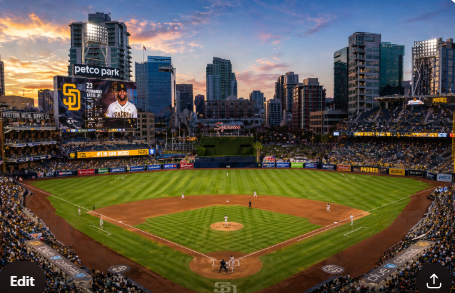
Not simply where the Padres play—it is central to who they are. Few ballparks in baseball shape outcomes as consistently as Petco does. The deep alleys, the heavy night air, the marine layer that settles in as the sun goes down—all of it conspires to suppress offense and reward precision. Fly balls that leave other parks as home runs die here. Mistakes that would be punished elsewhere become survivable.
The Padres have not ignored this reality; they have embraced it. Their roster is constructed to maximize the advantages Petco provides. Pitchers are encouraged to attack, trusting that the ballpark will protect them from occasional misfires. Defenders are expected to convert opportunities, knowing that extra-base hits are harder to come by but more valuable when they occur. And hitters are built to grind, to extend at-bats, and to manufacture offense rather than rely solely on power. In a neutral setting, this team is disciplined. At Petco, it becomes something more calculated.
Position Players
Catcher
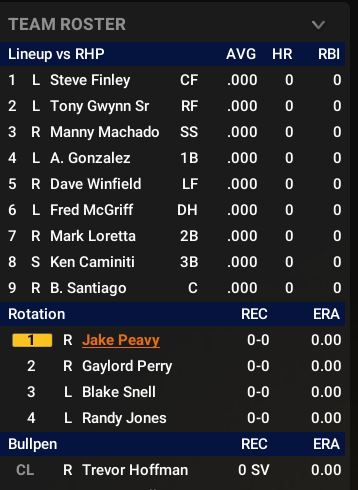
Benito Santiago
Few catchers in baseball history combined defensive presence and offensive capability quite like Santiago at his peak. His arm alone changes the way opponents approach the running game, effectively removing one dimension from the opposing offense. Pitchers can work more freely, focus more intently on hitters, and trust that any attempt to steal will be met with resistance. Beyond the arm, Santiago’s athleticism behind the plate allows him to control games in subtle ways—blocking pitches, framing strikes, and maintaining composure in high-pressure moments.
Offensively, he is far from a liability. Santiago brings legitimate power and the ability to produce runs from a position that often demands defensive sacrifice. In a lineup built around balance, that kind of contribution from behind the plate is a significant advantage.
Terry Kennedy
Kennedy provides the Padres with something equally valuable in a different form: reliability. He is the type of player who does not disrupt the structure of the team when inserted into the lineup. His approach is straightforward—put the ball in play, execute situationally, and avoid unnecessary risk. Over the course of a tournament, where depth becomes critical, Kennedy’s ability to step in without a drop in performance ensures stability at one of the most demanding positions on the field.
First Base / Designated Hitter
Adrian Gonzalez
Gonzalez stands as one of the rare hitters who not only survived Petco Park, but produced within it at an elite level. That alone tells you what kind of offensive player he was. His approach is built on balance—he does not sell out for power, nor does he simply play for contact. He controls the strike zone, drives the ball to all fields, and punishes mistakes without forcing the issue. In a lineup that values discipline, Gonzalez becomes a central figure, capable of anchoring the middle while adapting to whatever the situation demands.
Defensively, he brings a level of reliability that quietly elevates the entire infield. His ability to handle throws, save errors, and maintain consistency at first base allows the rest of the defense to play more aggressively. He is not just a contributor—he is a stabilizing force.
Fred McGriff
Where Gonzalez is measured, McGriff is inevitable. His production is not flashy, but it is constant. Year after year, he delivered power, drove in runs, and maintained a presence in the heart of the order that pitchers could not ignore. As the designated hitter, he provides the Padres with something they otherwise lack in abundance: dependable middle-of-the-order force.
McGriff does not need ideal conditions to produce. He does not need a mistake every at-bat. Give him enough opportunities, and he will find a way to impact the game. In a ballpark that limits power, that kind of consistency becomes even more valuable.
Second Base
Mark Loretta
Loretta represents the quiet engine of this lineup. He is not the player who draws headlines, but he is the one who keeps innings alive. His contact ability, strike zone awareness, and willingness to take what the pitcher gives him make him perfectly suited for the Padres’ approach. In Petco Park, where big innings are hard to manufacture, players like Loretta become essential.
He forces pitchers to work. He limits empty at-bats. And over time, that pressure compounds. Loretta is the kind of hitter who turns a lineup over efficiently and ensures that opportunities are not wasted.
Bip Roberts
Roberts brings a different dimension—speed, movement, and unpredictability. He is a player who can alter the rhythm of a game the moment he steps on the field. Whether as a late-inning substitute, a pinch runner, or a situational starter, Roberts gives the Padres flexibility that extends beyond the box score.
In tight games, where a single base can determine the outcome, his presence becomes a weapon.
Shortstop
Manny Machado
Machado’s inclusion at shortstop speaks to both his versatility and his importance to this roster. While his reputation was built at third base, his ability to handle shortstop at a high level allows the Padres to maximize their overall defensive alignment. More importantly, it keeps his bat in a position of impact.
Offensively, Machado provides a blend of power and situational awareness. He is capable of driving the ball out of the park, but he is equally capable of adjusting his approach when the moment calls for it. He does not need to dominate every at-bat—he needs to win the important ones. And he does.
Garry Templeton
Templeton is the definition of steady. He brings experience, defensive reliability, and a calm presence that fits seamlessly into the Padres’ structure. He is not asked to carry the position—he is asked to maintain it. And that consistency ensures that the team does not lose its footing when rotations or substitutions are required.
Third Base
Ken Caminiti
At his peak, Caminiti was one of the most complete players in baseball. The 1996 MVP season was not a fluke—it was the culmination of a player capable of impacting the game on both sides of the ball at an elite level. His power gives the Padres a legitimate offensive threat, particularly in moments where a single swing can change the game.
Defensively, he is just as valuable. His range, arm strength, and instincts anchor third base, allowing the infield to function with confidence. Caminiti is one of the few players on this roster who can take control of a game outright—and in a tournament setting, that matters.
Chase Headley
Headley provides balance and continuity. He does not need to replicate Caminiti’s peak—he needs to ensure that the position remains productive and stable. His ability to get on base, play solid defense, and contribute across multiple areas makes him an ideal complementary piece.
Outfield
Tony Gwynn
Gwynn is not just the best player on this team—he is its identity. His approach at the plate defines how the Padres play the game. He does not chase, he does not panic, and he does not waste at-bats. He studies pitchers, adapts in real time, and executes with a level of precision that few players in baseball history have matched.
As captain, his influence extends beyond his own performance. He sets the tone for the lineup, for the dugout, and for the team as a whole. Everything begins with him.
Dave Winfield
Winfield brings presence. There is a physical and psychological impact to his game that forces opponents to account for him at all times. His power, combined with his athleticism, gives the Padres a middle-of-the-order force capable of changing the direction of a game in a single moment.
He is not just a power hitter—he is a complete offensive player who understands how to produce in different situations.
Fernando Tatis Jr.
Tatis introduces chaos—in the best possible way. His combination of power and speed creates constant pressure on opposing teams. He can hit the ball out of the park, take an extra base, or create opportunities where none seemed to exist.
On a roster built around control, Tatis is the element that disrupts the opponent’s control.
Steve Finley
Finley’s value is most evident in the space he covers. In a ballpark like Petco, where the outfield demands range and awareness, his presence in center field becomes critical. He turns difficult plays into routine ones and limits extra-base hits that could otherwise shift a game.
Brian Giles
Giles provides a different kind of offensive strength—patience. His ability to draw walks, extend at-bats, and consistently reach base gives the Padres another path to scoring. He does not force offense; he builds it.
Pitching Staff
Starting Rotation
Gaylord Perry
Perry anchors the rotation with experience and durability. He is the type of pitcher who controls the pace of the game, working efficiently and keeping hitters off balance. His ability to pitch deep into games reduces strain on the bullpen and gives the Padres a steady foundation.
Jake Peavy
Peavy is the counterbalance to Perry. Where Perry controls, Peavy attacks. His strikeout ability and intensity allow him to dominate lineups, particularly when he is working ahead in the count. He brings an edge that defines the competitive spirit of the rotation.
Randy Jones
Jones represents efficiency. He does not overpower hitters—he outmaneuvers them. His ability to induce weak contact and keep hitters off balance makes him a perfect fit for Petco Park.
Blake Snell
Snell is the wildcard. At his best, he is nearly unhittable, capable of striking out any lineup in the league. His inconsistency is part of the package, but in a short series, his upside can change everything.
Andy Ashby
Ashby provides stability. He is not asked to dominate—he is asked to keep the team in the game. And he does that consistently.
Bullpen
Trevor Hoffman
Hoffman finishes games with precision. His command and composure make him one of the most reliable closers in baseball history.
Heath Bell
Bell brings power and intensity, capable of handling the highest-pressure situations before the ninth inning.
Mark Davis
A Cy Young-winning reliever, Davis provides elite performance in high-leverage moments.
Kirby Yates
Yates offers strikeout dominance, a pitcher capable of ending rallies before they begin.
Craig Lefferts
Lefferts provides left-handed balance, giving the Padres flexibility in matchup situations.
Mason Miller
Miller adds modern velocity and overpowering stuff, giving the bullpen a dimension few teams can match.
Captain
Tony Gwynn
The captain in every sense of the word, Gwynn defines the Padres’ approach, culture, and identity.
Strengths
The San Diego Padres are defined by their ability to control the rhythm and structure of a game, a trait that becomes increasingly valuable in a tournament setting. Their pitching staff, led by the contrasting strengths of Gaylord Perry and Jake Peavy, gives them multiple ways to attack opposing lineups, while a deep and versatile bullpen anchored by Trevor Hoffman allows them to shorten games and protect even the slimmest of leads. Offensively, the presence of Tony Gwynn sets a tone of discipline and execution that carries throughout the lineup, enabling the Padres to manufacture runs without relying solely on power. Combined with the advantages of Petco Park, where their pitching and defensive strengths are amplified, this is a team built to win tight, controlled games by forcing opponents to operate within its terms.
Weaknesses
The Padres’ greatest vulnerability lies in their limited capacity to keep pace in high-scoring environments against teams built around overwhelming offensive power. While players such as Dave Winfield and Ken Caminiti provide legitimate run-producing ability, the lineup as a whole is not constructed to generate quick bursts of offense, instead relying on sustained execution and situational hitting. This places increased pressure on the pitching staff to consistently maintain control, as the margin for error is smaller than it is for more explosive teams. If the Padres are forced out of their preferred style—particularly in neutral or hitter-friendly settings where their ballpark advantage is diminished—they can find themselves in games that demand a level of offensive output that does not naturally align with their roster construction.
|