|
Major Leagues
Join Date: Sep 2024
Posts: 340
|
⚾ July Crown Ledger: Draft Rooms, Fireworks, and Holding the Line
👑 Friday, August 01 • Royal Pulse: July Report 👑
Kansas City Royals Front Office | Kauffman Stadium
________________________________________
Front Office (GM's) Desk
July was the month that reminded me why this chair has two armrests and zero mercy.
On one side: we're still in first place, still controlling the division, still banking wins like a club that expects to play meaningful baseball late. On the other: July came with the kind of organizational noise that can fracture focus—the First-Year Player Draft, All-Star week, and the trade-market pressure building toward the end-of-month scramble. You don't just manage a roster in July—you manage attention.
We close the month at 60–44 (.577), 1st in AL Central, with a top-tier offense (AVG and run production leading indicators) and elite team defense (conversion + zone impact), counterbalanced by the persistent late-inning stress point (bullpen run prevention). That's the headline that matters. But the July "how" is where the real evaluation lives: 12–11 (.522) for the month. Not a slide—more like a controlled skid on gravel. We didn't lose the wheel, but we definitely felt the road.
Figure JY1. Kansas City Team Dashboard — Record + Team Rankings (July-End Snapshot)

Perspective: July-end performance panel capturing the club's overall position and identity. Included as the primary evidence panel for July's comparative analysis versus May/June.
The reality for us is that Cleveland is right there at 58–46, Minnesota sits at 55–47, and Detroit's hovering close enough to cause trouble. The days of "April oxygen" are gone. We're not sprinting out of sight anymore—we're holding the line while the division keeps trying to crawl into our lane.
What changed from previous months (comparative lens)
1) The offense didn't just remain top-tier—it got back to being a bankable weapon. July's cumulative profile has us 1st in the AL in runs (533), hits (963), and batting average (.267). That's not a fluke. That's identity. The catch is how we're doing it: we're still not buying runs through walks (BB rank: 14th), and we're still not a home-run-first offense (HR rank: tied 8th). This is a pressure offense—contact, traffic, and "keep the inning alive" baseball. When it's rolling, opponents feel like they're pitching downhill with runners everywhere.
2) Starters remain the spine, but the bullpen remains the bruise. Starters' ERA sits 2nd in the AL (3.83)—still a nightly chance to win. But the bullpen? 5.49 (15th in the AL). It remains the loudest operational warning light in the building. July didn't solve that; it simply forced us to manage around it again—carefully, constantly, and sometimes expensively in terms of leverage and workload.
3) Defense is still our separator—quiet, consistent, and incredibly valuable. We remain 1st in the AL in Defensive Efficiency (.713) and 2nd in Zone Rating (+15.1). With our strikeout rank sitting in the bottom half, that's not a nice-to-have—that's structural. We're winning because we convert contact into outs better than anyone in the league, and that reduces the blast radius of bullpen volatility.
4) The record shape is telling us where the next half is decided.
• Home: 37–18 — still strong, still our bank
• Road: 23–26 — still the drag line
• One-run games: 13–14 — essentially a coin flip
• Last 10: 5–5 — steady, but not sharp
July didn't break us, but it didn't let us relax either. It was a month of "win anyway."
Figure JY2. MLB Expanded Standings — August 1, 2025 (League Context + Quality Markers)

Perspective: Expanded standings snapshot used for front office context. This frame supports July's theme: the lead remains, but the margins have tightened, and the workload profile is becoming the story.
________________________________________
July's Operational Layer: Draft + All-Star Week (And Why It Matters)
Draft week: necessary planning, volatile execution
The First-Year Player Draft is the front office equivalent of trying to hit a moving target from a moving car—while the rest of the league tries to swerve into your lane. We did the war-room work the right way: stacks of boards, signability lanes, contingency names, anticipated positional runs… the whole thing.
But draft day itself is volatile by design. A single early surprise can rip through your plan like a bad hop. You don't "execute a perfect draft"—you survive the chaos and still come out with players that match your development lanes. That was the mindset: have a strategy strong enough to guide us, and a posture flexible enough to adapt when the room inevitably changes.
All-Star week: a pause that isn't really a pause
All-Star week is supposed to be a breath. In reality, it’s a mirror. It's where the league takes inventory, agents take the temperature, and your own clubhouse starts thinking about what kind of second half they want. It's also where fatigue hides—because everyone says they're fine. So, we treated it like we treat every midseason seam: rest with intent, keep routines intact, and don't let the calendar steal the edge we built.
July's Player Development: Post-Deadline System Check
July wasn't just about tightening the big-league roster—it was about giving ourselves more answers inside the organization. After the deadline deals, we took a hard look at our player development board, and what jumped out immediately was the shape of the infield pipeline. Earlier in the year, our internal conversations about depth were too often a "who's available?" discussion. Coming out of July, it's finally becoming a "who fits best?" discussion—and that's a meaningful shift.
From a front office view, several of our July moves did exactly what they were supposed to do: raise the floor of the system without stealing oxygen from the top-end prospects. The most obvious improvement is the A+/AA/AAA cluster of infield options—the kind of group that keeps you from panicking when injuries hit or performance dips. Instead of one or two names we're trying to stretch across multiple positions, we now have a more realistic set of true infield bodies, with enough versatility to cover second/short/third without forcing a square peg into a round hole.
Where the depth improved (and why it matters)
• Shortstop and Third Base look "stacked enough" to breathe.
The board shows multiple names clustered at those spots, and that's the first time all season the internal depth chart looks like it can handle attrition. In practical terms, it means we can keep our big-league lineup decisions focused on winning today—not on protecting ourselves from a "what if" that's two weeks away.
• Second Base is no longer a single-thread dependency.
We've got more than one credible option on the board, which gives us flexibility at the MLB level and keeps us from overreacting to short-term slumps. When we're in a divisional race, that matters—because the temptation is always to make a rushed move, and rushed moves create long-term problems.
• First Base depth is now functional, not theoretical.
That's important in our build because we rely on consistent at-bats and situational execution (moving runners, cashing in traffic). Having organizational options gives us leverage—whether that's a matchup-based call-up, injury insurance, or simply a better internal competition environment.
Figure JY3. Prospect Organizational Depth Chart Comparison — After July's Trade Activity
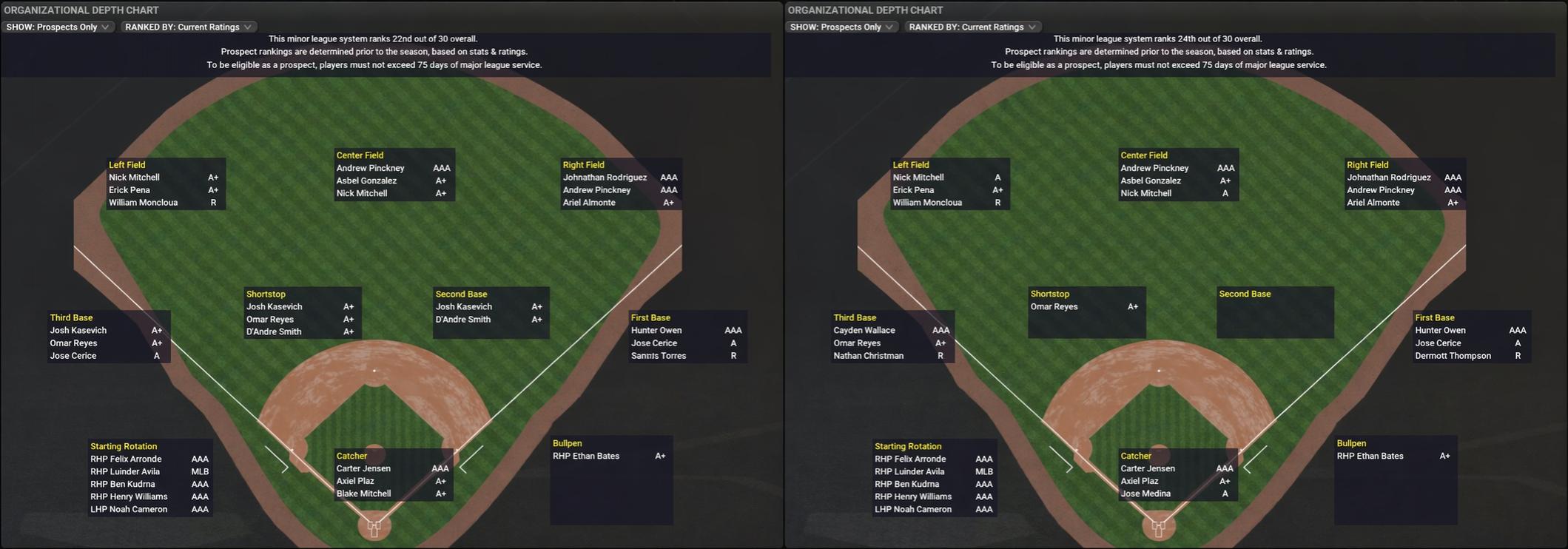
Perspective (Left to right): System snapshot showing the updated organizational depth chart post-trades (Aug 01) and pre-trades/draft (Jul 07), ranked by current ratings. The infield groups—particularly shortstop/third base and the added coverage at second base/first base—reflect improved depth compared to prior months, giving the front office more viable internal options.
The result is a system that's still developing overall, but is now built with more day-to-day roster stability and better internal leverage when the next roster crunch hits.
The "GM/Manager" bottom line
The July trades didn't just add pieces—they changed the texture of our organization. It's the difference between "we're one injury away" and "we can cover it without compromising the major-league plan." In a season where we're leading the division and the margins keep tightening, that kind of depth is a quiet advantage—one that won't show up in the box score, but shows up in September when the roster gets tested every night.
________________________________________
August Snapshot
August is a "no free nights" month. The schedule compresses, the weather gets heavy, the bullpen gets tested by workload more than stuff, and the divisional games start feeling like double-headers even when they aren't. The priority is to bank wins early at home, then be disciplined on the road so the bullpen isn't forced to cover "extra outs" created by sloppy innings.
Figure JY4. August Schedule Grid — Upcoming Opponent & Travel Map (Next-Month Planning View)
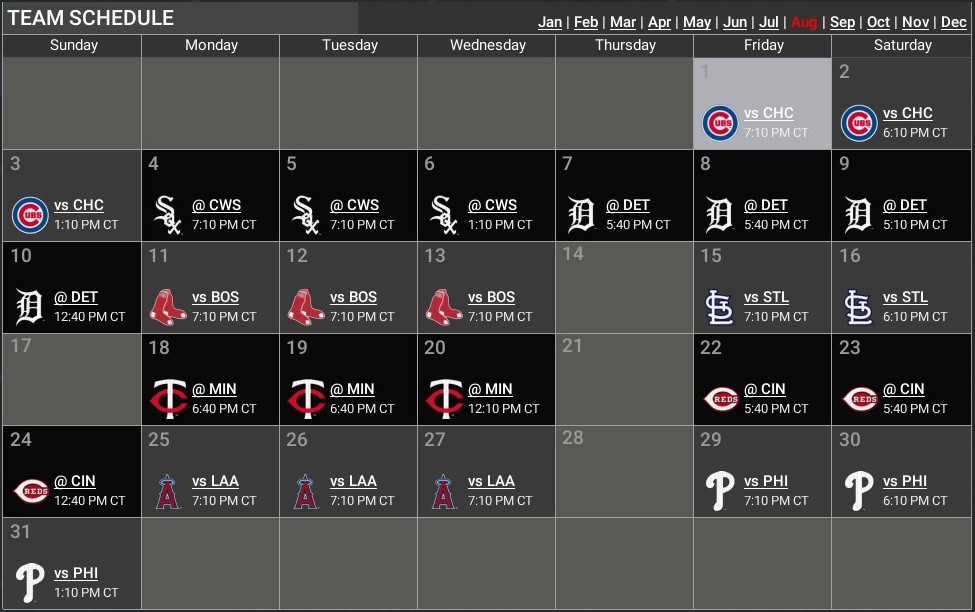
Perspective: Forward-looking schedule snapshot used to frame August planning: series blocks, travel demands, and divisional tension points laid out visually to support workload management decisions—protect starter routines, reduce bullpen overuse, and treat every divisional set as a standings swing.
August Schedule Flow (high level)
• Aug 1-3: vs CHC
• Aug 4-6: @ CWS
• Aug 7-10: @ DET
• Aug 11-13: vs BOS
• Aug 15-16: vs STL
• Aug 18-20: @ MIN
• Aug 22-24: @ CIN
• Aug 25-27: vs LAA
• Aug 29-31: vs PHI
The mission coming out of July is straightforward:
1. Keep banking home wins.
2. Get professional road series—no spirals.
3. Stop letting the 7th/8th inning turn into a coin flip.
4. Protect starter rhythm and keep leverage lanes clear.
If July was "hold the line," August is "push the line."
________________________________________
Manager's Desk
July asked for a different kind of leadership. Not speeches—maintenance.
When the calendar brings the Draft and All-Star week, players feel the hum even if they never mention it. They see the travel blocks. They see the standings tighten. They feel the late innings get tense when the bullpen is searching for clean outs. That's when the manager's job is to keep the clubhouse from playing tight.
What I liked in July:
• We didn't stop scoring. Even in games that didn't feel crisp, we still created traffic and forced opponents to pitch with stress.
• We kept defending. Our gloves didn't drift, and that matters when you're not striking everyone out.
• We stayed upright. A 12–11-month isn't dominance, but it's not collapse either. We didn't let a rough series turn into a rough week.
What I'm addressing immediately:
• Late-inning clarity. I'm done asking relievers to pitch with ambiguity. Roles don't have to be permanent, but they have to be clear tonight.
• Road discipline. We don't need to become road warriors overnight. We need to stop giving away innings—bad reads, extra outs, one mental mistake that turns into three runs.
• One-run execution. We're 13–14 in one-run games. That's not "luck." That's a diagnostic. We can do better with cleaner at-bats late, sharper baserunning decisions, and fewer free passes from the mound.
In baseball terms, we've had too many innings where we let the opponent "open the door," and then we acted surprised when they walked in. August is about slamming it shut.
________________________________________
Around the League
• Tampa Bay remains the pacesetter in the AL, and their profile screams depth and consistency. That's the kind of club that exposes bullpen soft spots in a three-game set.
• The AL Central is turning into a real knife fight: we're still first, but the margins are thin enough that a single bad week can rewrite the tone of the entire season.
• Over in the NL, there are multiple divisions where the top is strong, and the middle is crowded—meaning the wild-card lanes will stay messy, and the deadline market will keep its prices inflated.
Figure JY5. MLB Regular Season Standings — August 1, 2025 (Division Lead Confirmation)

Perspective: Traditional standings view confirms Kansas City's division lead entering August, with Cleveland and Minnesota still within striking distance. Included to anchor the July recap headline: we stayed on top through a month loaded with the Draft, All-Star week, and summer schedule pressure.
The big-picture takeaway for us: we're still leading, but we're no longer allowed to drift. The league doesn't reward first place in August—it rewards finishing in September.
________________________________________
👑 FOR THE CROWN — ALWAYS 👑
Kansas City Royals | Regular Season 2025 – July Recap
(OOTP25 Royals Journey — GM/Manager's Dual Log)
Last edited by Biggp07; 04-23-2026 at 09:23 AM.
|