|
Hall Of Famer
Join Date: Feb 2010
Location: Chicago IL
Posts: 4,394
|
Oakland Athletics — Cooperstown League Franchise Preview

The Oakland Athletics enter the Cooperstown League carrying one of the richest and most complete legacies in baseball history. From the Connie Mack dynasties of Philadelphia to the swaggering championship clubs of 1970s Oakland and the power surge of the late-1980s Bash Brothers era, the Athletics have consistently produced teams defined by intelligence, innovation, and elite talent. This roster reflects that identity — a blend of Hall of Fame greatness, championship pedigree, and lineup balance capable of competing with any franchise in the league. Built to play in Oakland Coliseum and aligned in the NL West, the Athletics present a club combining historic dominance with strategic versatility.
Manager
Connie Mack
No figure in franchise history defines the Athletics more than Connie Mack, the winningest manager in baseball history and the architect of multiple dynasties spanning decades. Mack’s influence on the game extended far beyond tactics — he built cultures of discipline, intelligence, and execution. His ability to manage elite personalities while maintaining strategic clarity makes him the ideal leader for a roster composed of strong individual talents from multiple eras. With Mack guiding the club, the Athletics benefit from unmatched institutional baseball knowledge and a steady hand in high-pressure moments.
Ballpark
Oakland Coliseum
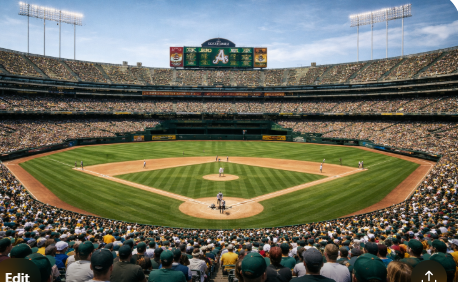
The Athletics will play their home games at Oakland Coliseum, preserving the modern identity of the franchise while hosting one of the most powerful rosters in the league. The Coliseum’s expansive foul territory rewards disciplined pitching and strong defensive play, both strengths of this club. It also provides continuity with the 1970s and late-1980s championship teams that defined the Oakland era.
Catchers
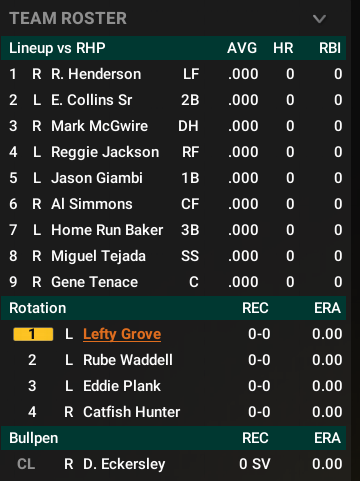
Gene Tenace
Terry Steinbach
Gene Tenace provides rare offensive impact at the catcher position, highlighted by his historic four-home-run performance in the 1972 World Series. His ability to reach base consistently strengthens the middle of the order and complements the club’s power hitters. Terry Steinbach adds durability, defensive reliability, and leadership behind the plate, giving the Athletics stability and depth at one of the most demanding positions on the field.
Infield
1B — Jason Giambi
DH — Mark McGwire
2B — Eddie Collins
SS — Bert Campaneris
SS — Miguel Tejada
3B — Home Run Baker
3B — Eric Chavez
UTIL — Tony Phillips
The Athletics infield combines elite power, historic leadership, and defensive flexibility. Jason Giambi anchors first base with MVP-level on-base ability, while Mark McGwire provides formidable power in the designated hitter role. Eddie Collins, one of the greatest second basemen in baseball history, sets the tone as both table-setter and team captain. Bert Campaneris contributes speed and defensive excellence at shortstop, with Miguel Tejada adding MVP-caliber depth and middle-of-the-order potential. At third base, Hall of Famer Home Run Baker provides early-era power credentials, while Eric Chavez offers elite defensive support. Tony Phillips gives the club exceptional versatility, capable of contributing at multiple positions while maintaining strong on-base production.
Outfield
Rickey Henderson
Reggie Jackson
Al Simmons
Jose Canseco
Joe Rudi
Few franchises can match the depth and impact of this outfield group. Rickey Henderson brings unparalleled speed and on-base ability as baseball’s all-time stolen base leader. Reggie Jackson delivers postseason pedigree and left-handed power, while Al Simmons provides Hall of Fame offensive consistency from the franchise’s early dynasty years. Jose Canseco contributes MVP-level slugging and athleticism, and Joe Rudi rounds out the group with defensive reliability and championship experience from the 1970s dynasty teams.
Starting Rotation
Lefty Grove
Eddie Plank
Catfish Hunter
Rube Waddell
Vida Blue (Swing Starter)
The Athletics rotation features extraordinary historical dominance. Lefty Grove stands among the greatest pitchers ever, supported by Hall of Famer Eddie Plank and strikeout legend Rube Waddell. Catfish Hunter brings championship experience from the 1970s dynasty, while Vida Blue provides Cy Young and MVP-level peak performance in the swing role. This group combines power, control, and historical consistency across eras.
Bullpen
Dennis Eckersley (Closer)
Rollie Fingers
Liam Hendriks
Huston Street
Rick Honeycutt
Darold Knowles
The bullpen blends Hall of Fame excellence with modern dominance. Dennis Eckersley provides one of the most efficient closing profiles in baseball history, supported by Hall of Famer Rollie Fingers and high-strikeout setup man Liam Hendriks. Huston Street offers multi-inning capability, while Rick Honeycutt provides left-handed matchup flexibility. Darold Knowles strengthens the unit with postseason-tested reliability from the Athletics dynasty years.
Team Captain
Eddie Collins
Eddie Collins serves as the on-field extension of Connie Mack’s philosophy. Known for his intelligence, leadership, and consistency, Collins represents the ideal captain for a roster constructed around discipline and execution. His presence provides continuity between eras and establishes the tone for the club’s approach to the game.
Strengths
The Athletics possess elite offensive balance, combining power, on-base ability, speed, and positional flexibility. The lineup features multiple MVP-level hitters and Hall of Fame contributors capable of producing runs in a variety of ways. The rotation is among the strongest in the Cooperstown League, with multiple historically dominant pitchers capable of controlling games deep into innings. The bullpen offers both power and control options, ensuring late-inning stability.
Defensively, the Athletics benefit from strong middle infield play and versatile depth capable of adjusting to matchup situations. The presence of Tony Phillips allows the team to adapt strategically without sacrificing offensive production.
Weaknesses
The roster leans heavily toward left-handed pitching in the rotation, which could create matchup challenges against lineups heavily constructed with right-handed power. Additionally, several players represent peak offensive eras that emphasized power production, potentially leading to streakiness against elite pitching staffs. The club’s success may depend on maintaining lineup balance and maximizing situational execution against top-tier competition.
|