|
Hall Of Famer
Join Date: Feb 2010
Location: Chicago IL
Posts: 4,351
|
Minnesota Twins — Cooperstown League Franchise Preview
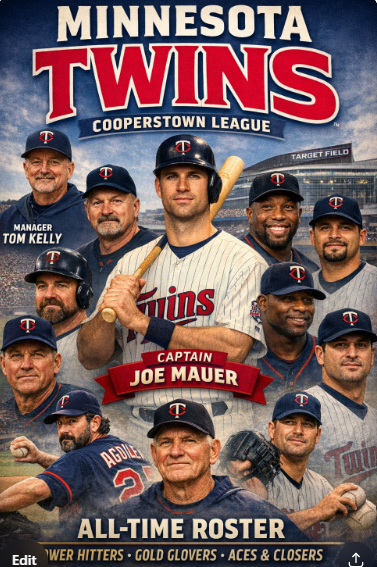
The Minnesota Twins enter the Cooperstown League with a roster built on balance, adaptability, and championship pedigree — a club that reflects the franchise’s long tradition of fundamentally sound baseball. Rather than relying on one dominant era, this Twins roster blends the power of the 1960s contenders, the championship core of the late 1980s and early 1990s, and the disciplined consistency of the modern era. The result is a team that mirrors the identity Minnesota baseball has carried for decades: strong pitching, professional at-bats, defensive reliability, and lineup depth capable of producing in multiple ways.
Unlike some franchises constructed around singular peak dynasties, the Twins’ strength lies in their versatility. This roster features elite contact hitters, Hall of Fame power, deep bullpen flexibility, and multiple players capable of shifting positions seamlessly — exactly the type of roster that historically performs well in tournament environments. With strong leadership in place and multiple tactical options available to the manager, Minnesota enters the Cooperstown League as a disciplined, cohesive contender capable of matching up with any roster in the field.
Manager
Tom Kelly
Few managers in baseball history better embody the identity of their franchise than Tom Kelly. A two-time World Series champion (1987, 1991), Kelly built his reputation on preparation, discipline, and the ability to maximize roster versatility. His teams consistently played clean defensive baseball, executed situational hitting, and displayed the adaptability required to win tight postseason games.
Kelly’s steady leadership is particularly valuable in a short-series tournament environment, where bullpen decisions, defensive alignments, and lineup balance often determine outcomes. His familiarity with multiple players on this roster — including Kirby Puckett, Kent Hrbek, Gary Gaetti, and Greg Gagne-era club structures — ensures a managerial philosophy aligned with the strengths of the personnel.
Ballpark
Target Field

Target Field provides the Twins with an ideal modern outdoor environment that rewards complete baseball teams. The park plays relatively neutral, slightly favoring pitchers in certain conditions while still allowing power hitters to impact games. Weather variability introduces strategic elements absent from indoor environments, reinforcing the traditional baseball atmosphere this roster reflects.
The decision to utilize Target Field over the Metrodome aligns with the roster’s balanced construction — a team built on pitching depth, contact hitting, and defensive range benefits from a natural playing environment.
Position Players
Catchers
C — Joe Mauer
C — Earl Battey
Few franchises can match Minnesota’s strength at catcher. Mauer provides elite offensive production rarely seen at the position, combining batting titles with on-base consistency and leadership behind the plate. Battey complements him perfectly, offering Gold Glove-level defense and veteran experience capable of maintaining stability when Mauer rotates to designated hitter.
Infield
1B — Justin Morneau
1B — Kent Hrbek
2B — Chuck Knoblauch
2B — Brian Dozier
SS — Zoilo Versalles
3B — Gary Gaetti
3B/DH — Harmon Killebrew
The Twins infield blends MVP-level talent with championship experience. Killebrew anchors the middle of the order as one of the most feared power hitters in baseball history, while Morneau provides modern-era middle-of-lineup production. Hrbek and Gaetti reinforce the championship core that defined late-1980s Twins baseball, bringing defensive stability and postseason credibility.
Knoblauch offers high-contact table-setting ability at second base, while Dozier adds rare power depth at the position. Versalles provides elite peak value at shortstop, highlighted by his 1965 MVP season, strengthening a traditionally thinner position for the franchise.
Outfield
OF — Kirby Puckett
OF — Tony Oliva
OF — Torii Hunter
OF — Bob Allison
UTIL — César Tovar
UTIL — Michael Cuddyer
Minnesota’s outfield is among the most complete positional groups in the Cooperstown League. Puckett and Oliva provide elite contact ability and consistent offensive production, while Hunter supplies Gold Glove caliber defense and power. Allison adds on-base ability and power from the corner outfield.
Tovar and Cuddyer provide exceptional versatility, allowing Tom Kelly to adjust defensive alignments and batting order configurations without sacrificing production. Tovar’s ability to play virtually any position offers strategic flexibility rarely matched by other franchises.
Pitching Staff
Starting Rotation
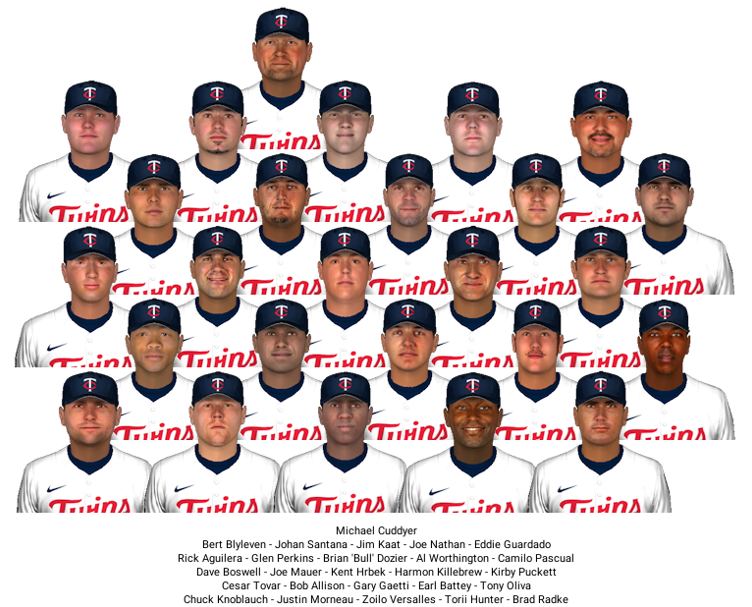
SP1 — Bert Blyleven
SP2 — Johan Santana
SP3 — Camilo Pascual
SP4 — Brad Radke
The Twins rotation combines longevity, peak dominance, and era balance. Blyleven provides a Hall of Fame anchor with exceptional strikeout ability and durability. Santana offers the most dominant peak of any pitcher in franchise history, capable of overpowering elite lineups in short series matchups.
Pascual represents the power arm of the early Twins era, while Radke contributes consistency and one of the longest sustained runs of quality starting pitching in club history.
Swing Starter
SP5 — Jim Kaat
Kaat’s versatility makes him invaluable in tournament play. His ability to start, provide long relief, or neutralize left-handed hitters gives the pitching staff structural flexibility.
Bullpen
CL — Joe Nathan
SU — Rick Aguilera
LH — Eddie Guardado
RP — LaTroy Hawkins
LH — Glen Perkins
RP — Al Worthington
RP — Dave Boswell
The bullpen is a major strength of this roster. Nathan anchors the ninth inning as one of the most dominant closers in franchise history. Aguilera brings championship experience and flexibility to close or set up, while Guardado and Perkins provide strong left-handed leverage options.
Hawkins delivers durability and adaptability, while Worthington and Boswell add multi-inning capability that can preserve bullpen depth during extended series.
Team Captain
Joe Mauer
Mauer represents the modern face of the Twins franchise and provides steady leadership both offensively and defensively. A Minnesota native, Mauer’s career embodies professionalism, consistency, and commitment to team success. His presence behind the plate allows him to influence every pitch and maintain alignment between pitching staff and defensive structure.
His leadership style complements Tom Kelly’s managerial philosophy, emphasizing preparation, accountability, and situational awareness.
Team Strengths
The Twins possess one of the most balanced rosters in the Cooperstown League. The lineup combines high-contact hitters with legitimate middle-of-the-order power, allowing the offense to generate runs through multiple pathways. Defensive strength up the middle, anchored by Mauer and Puckett, supports a pitching staff built on command and strategic pitch execution.
Versatility stands out as a defining advantage. Tovar and Cuddyer allow lineup adjustments without sacrificing production, while Kaat and Boswell provide pitching flexibility that protects the bullpen across multi-game series.
The bullpen itself is deep and adaptable, featuring multiple pitchers with closer experience. This gives Tom Kelly the ability to manage late innings aggressively without overextending a single reliever.
Potential Weaknesses
Compared to some Cooperstown League rosters, the Twins lack extreme power depth beyond the middle of the lineup. Shortstop, while strengthened by Versalles’ peak performance, does not feature the long-term consistency seen at other positions.
Additionally, the rotation does not rely on overwhelming velocity outside of Santana, instead emphasizing command and pitch movement. While historically effective, this approach places greater importance on defensive execution and situational awareness.
Overall Outlook
The Minnesota Twins enter the Cooperstown League as a fundamentally sound and highly adaptable club capable of competing in any matchup environment. With strong leadership, multiple Hall of Fame caliber players, and exceptional positional flexibility, this roster reflects the traditional strengths of Twins baseball.
Well-balanced, disciplined, and strategically versatile, Minnesota projects as a difficult opponent in any short series and a legitimate contender to advance deep into the tournament.

|