|
Minors (Triple A)
Join Date: Sep 2024
Posts: 219
|
⚾ April 2025 — Game 3: Early Bruise, Clear Truth
👑 Sunday, April 6 • Twins Series Game 3 👑
Good moments, bad sequence.
Minnesota Twins at Kansas City Royals | Kauffman Stadium
Weather: Partly cloudy, 57°F, wind out to RF (11 mph) | Attendance: 31,808 | First pitch: 1:10 PM CT
Sunday mornings during the season are quieter on paper but louder in your mind. I feel a certain calm walking out to the infield coach with a folded lineup card, but it’s the kind of calm that comes from carrying the whole week on your shoulders. The clubhouse smells like tape and coffee, the stadium is still half asleep, yet every decision feels like it resonates a little longer because there’s no more ‘tomorrow’ in a three-game set. Today is the last page of Minnesota's first chapter in Kansas City—and I want that page to read like we meant what we said in camp.
McLeod’s Puerto Rico File
Jason McLeod returned to the building like a man coming from a different climate—sunburned, quiet, and carrying a folder that suddenly felt heavier than it should. Puerto Rico didn't give him a headline, but it handed him a few names worth treating like oxygen: handle them carefully, and don't waste them.
His note was clear: keep an eye on the international complex and maintain the file on Alex Morales as a long-term option. Morales is headed to the international complex, but that doesn't mean we're rushing to sign; it means we're staying ready. If the right candidate emerges, we don't want to be the organization that hesitates because we didn't do the homework back in March.
Figure 1. Alex Morales — Scouting Discovery (KC International Complex, Apr 6, 2025)
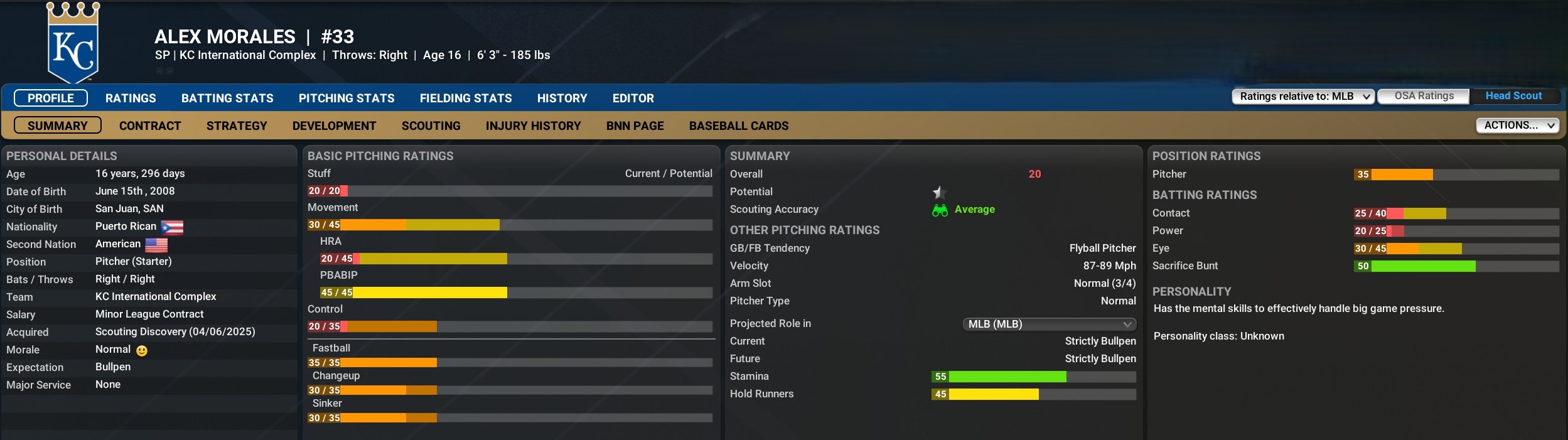 Perspective: A 16-year-old right-hander from San Juan, Morales joins the system as a scouting discovery with starter listed today but a current projection favoring the bullpen. His velocity is modest (87–89 mph), and his ratings are raw, but his makeup appears strong—precisely the type of low-cost arm we allow the development staff to shape before rushing to assign a role.
That’s the GM side of Opening Week—everyone looks at the big-league box scores, but the pipeline is built in places nobody can pronounce on a broadcast. I trust Jason’s expertise, and I trust our process: evaluate carefully, act with purpose, and never let the calendar pressure us into a poor decision.
Perspective: A 16-year-old right-hander from San Juan, Morales joins the system as a scouting discovery with starter listed today but a current projection favoring the bullpen. His velocity is modest (87–89 mph), and his ratings are raw, but his makeup appears strong—precisely the type of low-cost arm we allow the development staff to shape before rushing to assign a role.
That’s the GM side of Opening Week—everyone looks at the big-league box scores, but the pipeline is built in places nobody can pronounce on a broadcast. I trust Jason’s expertise, and I trust our process: evaluate carefully, act with purpose, and never let the calendar pressure us into a poor decision.
________________________________________
April 6th — Game 3 (Final) vs. Minnesota
The Twins don’t give you much. Their starters attack the zone, their defense stays sharp, and they punish mistakes you hope nobody notices. That’s exactly why we rebuilt the roster like we did—more contact, more edge, more adults in the room. The goal isn’t to be entertaining. The goal is to be inevitable.
Pregame Memo (Manager's Desk)
As the manager, I’m thinking about the first inning: making clean catches, delivering solid at-bats one at a time, and avoiding unnecessary outs. As GM, I’m thinking about the first week: who can handle the tough parts of the schedule—travel days, cold nights, and early April when your depth is truly tested.
If we want this series, the first step is discipline: supporting consistent effort, learning from mistakes, and not letting a clean inning become a quick one just because we get impatient.
Series Matchup Board — Minnesota Twins Game 3
Projected pitching matchup (our pitcher listed first):
• LHP C. Ragans (0-0, 0.00 ERA) vs RHP C. Paddack (0-0, 0.00 ERA)
Matchup board for the finale read like a clean test of intent: LHP C. Ragans (0–0, 0.00 ERA) vs RHP C. Paddack (0–0, 0.00 ERA). On paper, it’s early-season symmetry—two zeros, two guys still building their first real workload—but in the dugout, it felt more like a choice. From my GM perspective, I appreciated how this matchup fit our identity—power arm versus command-righty—but from my manager viewpoint, I wanted one thing above all: get the first punch in the first three innings and keep the pressure on their defense.
Ragans gives us the left-handed edge and the kind of stuff that can tilt a series if he's in the zone. When he's right, you can feel the dugout breathe differently—tempo, conviction, and that sharp edge that makes hitters late even when they know what's coming.
Paddack, meanwhile, is the kind of pitcher who wants you to swing—fastballs right at the letters, breakers that look hittable until they aren’t, winning by denying you easy hits. He’ll challenge you early, stay in the zone, and dare you to swing at his pitch instead of your plan.
________________________________________
Game Day Log — Royals vs. Twins (Game 3)
Manager’s Clipboard
My message to the lineup was simple: don't gift him free counts, make him earn his strikes, and win the series. We had Cole Ragans on the mound, so set a tone early, keep traffic to a minimum, and let the offense do enough. After taking the first two, this was the “step-on-it” game.
Inning-by-Inning Beats (Dugout View)
1st Inning
Ragans’ stuff looked lively, but Minnesota wasn’t chasing as much as they did in the first two games. We also didn’t score first—quiet start, but nothing felt out of control yet.
2nd Inning
The game turned here. Luke Voit drove in the first run with a run-scoring single, and the inning continued to shift in their favor—suddenly it’s 2–0 Twins, and we’re playing from behind. From the bench, it wasn’t panic; it was the frustrating kind of inning where a couple of pitches miss by inches and turn into damage.
3rd Inning
Byron Buxton ambushed one for a solo homer—3–0, and the crowd went quiet in that “not again” way. This was the point where I started paying close attention to our body language. You can lose a game early without it being over—if you let the energy leak.
4th Inning
We finally put together better at-bats, but Chris Paddack was in complete control—he was striking out everything that tried to breathe. In the dugout, it felt like we were always one pitch late on decisions, one step behind the count.
5th Inning
Ragans battled to keep it from getting worse, but the workload was climbing. He finished with 5.1 innings pitched—3 runs, 6 strikeouts, and one homer that changed the tone of the afternoon.
6th Inning
A strange, tense inning at the stadium: Buxton was ejected for arguing a strike call. That kind of moment can shift a game emotionally… but we didn’t take advantage of it. We needed to find a way to turn that chaos into momentum and failed to do so.
7th Inning
Our best “quality-contact” inning came late—Mark Payton doubled (and overall swung well with two hits). But with two outs, we couldn’t get the hit that would change the scoreboard.
8th Inning
This is where it got away completely. Ryan Jeffers hit a two-run double to make it 5–0, and now we’re just trying to hold it together instead of aiming for the win.
9th Inning
We finally posted a run—late, and notably, with no RBI recorded on the day (just a push across the line, not a real rally).
If there’s a small footnote, I’ll keep it: Drew Waters stole a base and kept playing with purpose even when the game wasn’t offering anything in return.
________________________________________
Final
Paddack Now 1-0 After Beating Royals

The series ends with a reminder that a hot start doesn't shield you from a sharp pitcher. Paddack earned every quiet inning we gave him: 6.2 innings, 3 hits, 10 strikeouts. He did what good starters do in April—pounded the zone, kept the ball off the fat part of the bat, and made us work for everything. Offensively, the page is blunt: 5 hits, 11 strikeouts, and too many empty counts. Even the pinch-hit knocks (Haggerty’s single, Schneider’s late double) felt like punctuation, not a story.
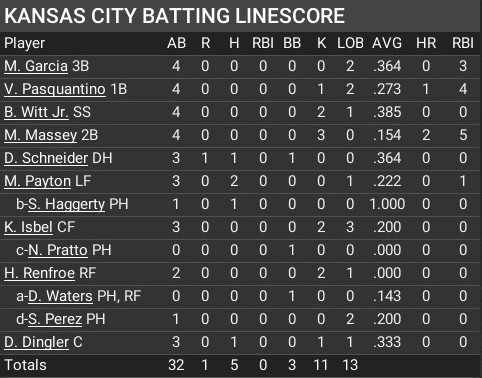 Ragans battled, but the margins stayed tight all afternoon, and Minnesota was sharper in the few moments that decided the game.
Code:
Kansas City Pitching Scoreline

Pitcher                IP    H   R  ER   BB   K  HR    PI   ERA
C. Ragans              5.1   4   3   3    2   6   1    88  5.06
K. Wright              2.0   0   1   1    2   5   0    43  4.50
C. Ferguson            0.2   2   1   1    1   1   0    18 13.50
S. Emanuels            1.0   0   0   0    0   1   0    18  0.00
As a manager, the message is clear: no free outs, no lazy innings, and no waiting for the ‘big hit’ to carry you. As GM, the message is more detailed: our roster has improved, but it’s not finished. The standard we set in camp is the same standard the standings will demand. If we meet it, this team will be tough to beat. If we don't, April will decide for us. This is the kind of game that keeps me honest. We're 2–1 now—fine—but the way we lose matters: when we face a starter with real command and a bat-missing profile, our margin shrinks quickly.
Series Takeaways
I'm not going to sugarcoat it: losing a series finale at home stings. But the sting is useful if you listen to it. We learn what holds up and what falls apart when the game speeds up—who stays focused after a bad at-bat, who resets after a defensive mistake, and who looks like they're still in spring training in their head.
We’ll review how Paddack challenged us—identifying where we expanded and where we became passive—and I’ll also keep an eye on the organizational pipeline note McLeod brought back. Because the only remedy to days like this is depth: more bats that don't give away strike zones and more arms capable of dominating when the opponent's lineup starts hunting for mistakes.
Now we turn the page and head to Baltimore. The schedule doesn't care what we want; it only cares what we are. And we're going to find out quickly.
Around the League – April 6
No real league noise this morning—just the quiet kind of day where you can hear your own standards.
________________________________________
👑 FOR THE CROWN — ALWAYS 👑
Kansas City Royals | Regular Season 2025 - Game 3
 (OOTP25 Royals Journey — GM/Manager's Dual Log)
Last edited by Biggp07; 01-17-2026 at 07:17 PM.
|