A National League Divided: The National Association
“...The gentlemen assembled in Chicago have done wisely to divide the nation’s clubs into Eastern and Western associations. The folly of dispatching ball clubs from Boston to St. Louis and back again shall no longer ruin the sport. Henceforth, the National Game shall be played within sensible distance, and prosperity shall follow...” - Chicago Times, December 18, 1875.
1875 saw the Association of Professional Base Ball Players (NAPBBP) unceremoniously collapse. A lack of a central authority, clubs unfulfilling schedules that were poorly organised and travel plans that were costly to implement, all were major factors in the inevitable failure of the first fully-professional sports league in baseball.
Out of the ashes a phoenix was to rise. William Hulbert of the Chicago club was not shy about the failings of the NAPBBP and had long been drawing up plans for a future association of professional baseball clubs. Joined by Morgan Bulkeley of the Hartford club and Arthur Soden of Boston, Hulbert coordinated a series of meetings with business magnates and club owners throughout the fall and winter months, he sold them on his vision for a new league founded on the principles of honest dealings, and business integrity. He also proposed a more orderly game on the field through prohibitions on drinking, gambling, and Sunday baseball, and more definite organization off it through limiting membership to cities of 75,000 inhabitants or more, and mandating teams to complete a predetermined schedule. Bulkeley, with concern for his own interests in Hartford, is credited with proposing two leagues, equal and aligned, but geographically seperate, a Western League and Eastern League. Bulkeley was able to convince the prospective members that two geographical leagues were essential to reducing travel costs, ensuring financial security for owners and a reduction in the risk of the schedules collapsing.
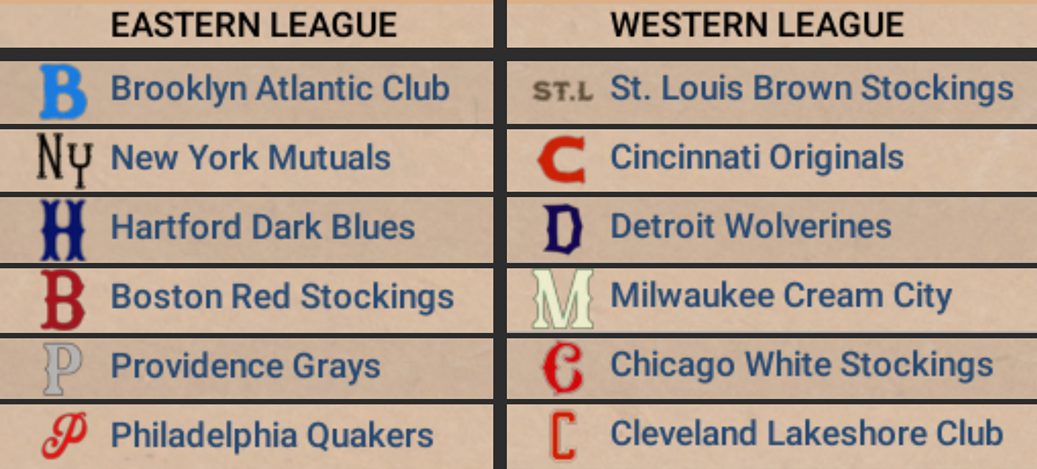
The founding of the National Association of Professional Base Ball Clubs was announced to the world, December 18, 1875 in Chicago. The charter clubs unanimously agreed to a 70 game schedule, starting in early May and concluding in early October. Each team plays one another 14 times, the season will culminate in a 9 game National Championship series, where the winner of each league face off to be crowned champions of the nation.
1876 Charter Clubs
A note: I want to acknowledge and thank the world builders and contributors of
https://legacy-baseball.com/ - it is their Eastern and Western League structure that acted as inspiration in creating this fictional league.