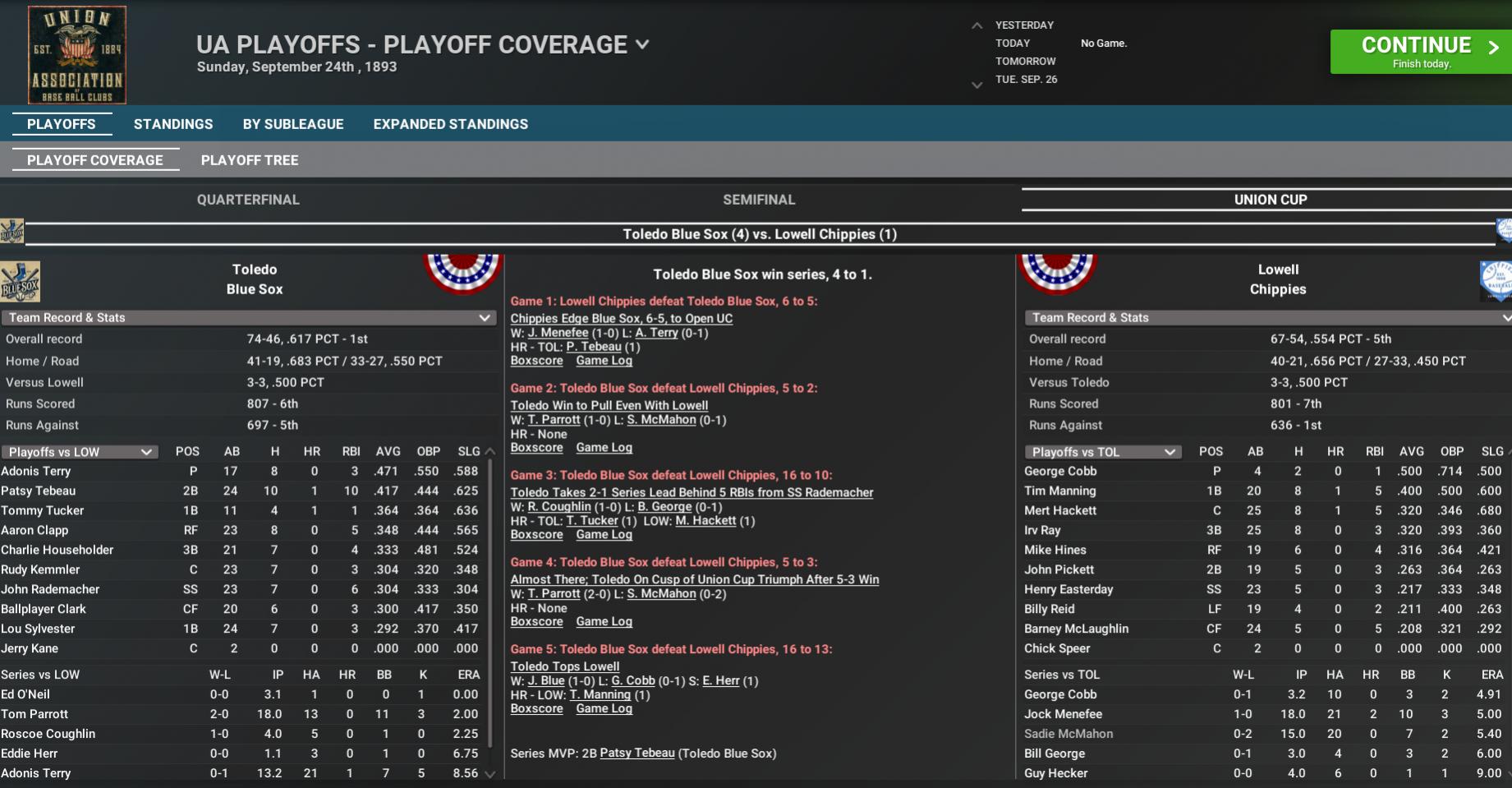
The Union Cup Finals saw the Lowell Chippies take the opener, 6-5, erasing a five-run deficit in front of an unhappy crowd at Maumee Park in Toledo. But the Blue Sox weren't going to let the fans of Cleveland and Cincinnati have all the fun; they wanted
their Ohio city to win a Cup, too! The Sox evened up the series as hurler Tom Parrott squawked his way to a seven-hitter in a 5-2 victory.
Then the series went to Lowell, Mass., and the third game was a slugfest with the lead changing hands no less than six times; after nine full, it was a 10-10 deadlock, with a double and a triple (and four RBI) by Chips catcher Mert Hackett. Then in the eleventh, Toledo scored six runs -- all unearned, thanks to three Lowell errors -- to take a 16-10 win and a 2-1 series lead.
As it turned out, the Cup Final would never leave Massachusetts. In Game 4, Parrott gave the Chippies the bird by holding them to six hits in a 5-3 decision. Toledo's big bats were truly unleashed in the fifth contest, a game that featured 29 runs, 34 hits and a painful-to-watch thirteen errors. The Blue Sox rolled up 14 runs in the first seven innings, but the Chips made it interesting by scoring six times in the eighth to make it 14-13. But the Sox -- who had at least one run and one hit by every man in the lineup, including last-minute pitcher John Blue -- scored twice more in the ninth and held on for a 16-13 win and the Union Cup!
Henry Eckford was a famous shipbuilder and entrepreneur in the early part of the 19th century, building ships that were used in the War of 1812. Such was his fame that many things were named for Eckford, including boats, streets, buildings...and baseball teams, the best-known being the Eckford Club of Brooklyn, founded in 1855, which was one of the founding members of the then-Amateur Association in 1871.
In 1893, Eckford was battling for its second American Cup (winning its first in '82), against Henry Lucas and his St. Louis Maroons -- who had never won any trophy in its existence. The series was a corker, as the teams split the first two games in Brooklyn: St. Louis holding off Eckford, 3-2, on the Maroons' Bob Emslie's four-hitter in Game 1, and Brooklyn pounding out fourteen hits (including four by AA batting champ Jack Clements) in a 9-2 slaughter.
The Cup Final headed for the Mound City and Brooklyn took the advantage in Game 3 as their bats continued to boom: Clements had four more hits, Eckford had nineteen in a 14-3 victory. But the Maroons were not going to lie down in front of their home fans. St. Louis starter Edgar "EE" Smith (a nickname that no one, including Smith himself, has any idea as to its origin) shut out the Brooklyn batters through seven as the Maroons built a 4-0 lead. Brooklyn scored thrice in the eighth...but so did St. Louis, and the Maroons held on a 7-4 win to knot up the Cup Final again. The next day at Lucas Park, St. Louis took a 3-2 series lead as Charlie Berry socked a three-run homer among his three hits as the Maroons took a 11-7 decision.
Back in Brooklyn, and Eckford was up against it: they needed not one win but
two against the red-hot Maroons. In Game 6, the two clubs battled to a 5-5 tied going into the last of the eighth, but Eckford put the game away with six runs, including a bases-clearing triple by Clements...so, there would be a Game 7.
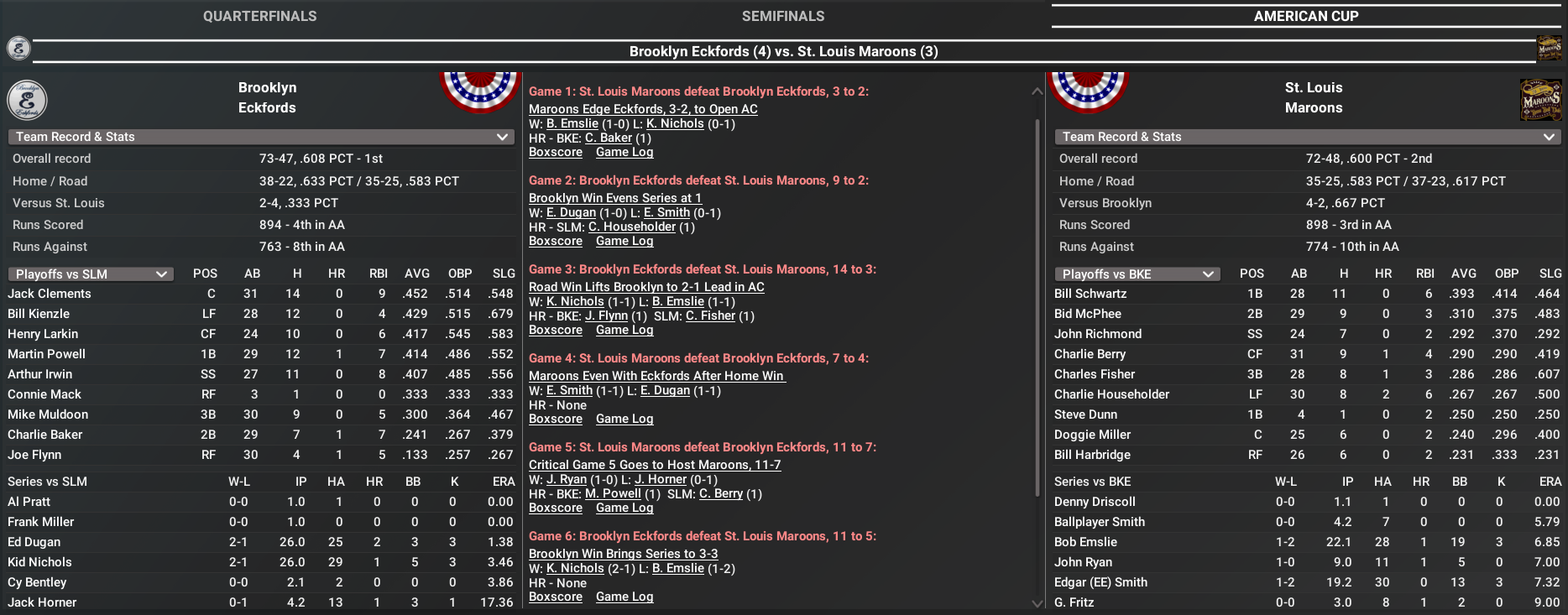
Win or lose, the finale would be the last-ever game at Manor House Grounds: the Eckfords would move into their new, all-concrete park in Flatbush in 1894. The Brooklyn ballclub ensured it would be a fond farewell for their fans: they scored five times in the opening frame, and pitcher Ed Dugan did the rest, holding the Maroons to two runs on eight hits in a 11-2 beating, giving the Eckford club the American Cup.

It was an unhappy day for Henry Lucas in more than one way: after the game, the now-former millionaire announced he was broke, and was selling the club to St. Louis investors. Subsequent news reports indicated that Lucas had purchased the Vandalia Railroad in rural Illinois, but in fact he was working as a lowly rail clerk just to make ends meet. He died of blood poisoning, penniless, in 1910.