Best Curveball in the WPK (WPK Tools Report, Vol. 2)
My apologies for the long delay, but here at long last is the second in a series of WPK tools reports (thanks Palaaemon, for the reminder.)
So, to remind us all, here is what I wrote to preface the first volume in this series:
"A feature I have been meaning to roll out for some time is periodic tools reports for the WPK. Today I am publishing the first of these, which looks at which players in the WPK have the best batting eye.
Just to explain the methodology a bit:
1) This is not a reporting of scouting ratings...
2) Nor is it just a stats based ranking.
3) The idea is to identify a subjective, but evidence-based, top 10 list for a specific baseball tool.
4) Some weight will be given to career stats but even more weight will be given to current stats and scouting perceptions. In other words, what have you done for me lately?"
This time we will be looking at pitchers and determining which pitchers possess the best curveballs in the game.
There are of course complications in making these types of distinctions, and in this case a big one is that there are different types of curves. For the purpose of this report it should first be noted that we are not discussing knuckle curves at all- they will likely eventually get their own report.
But the list does include both the over the top, 12 to 6 curve, as well as the more roundhouse variety, thrown generally from a 3/4 arm angle (or sidearm, but as it turns out none of these were in the discussion.)
While both general types can be strikeout pitches the overhand, 12 to 6 curve, which breaks more or less straight down, is far more likely to lead to ground ball outs as well and thus a pitcher who throws this variety should be judged on his ability to get ground ball outs.
And of course, pretty much no big league pitcher throws only a single pitch. So how do you measure the importance of one pitch in the repertoire, particularly when there are other's of equal quality?
Well, you just do your best to isolate the facts from the noise.
And for us, it leads to this top 10 list of WPK curveballs:
10- Tony Reyes, Boston Berskerers, 29 year old left-handed relief pitcher.
Curveball rating: 9.
Reyes is on the list primarily because while he has a fine curveball he possesses no other quality pitch, with a changeup rated just a 5 (all ratings on the 1-10 scale) and a fastball rated a 4. And yet here he is in his 6th year as a big league pitcher who has twice as many wins as losses (he went 16-10 in his only year as a starting pitcher) and a respectable enough 3.73 career ERA. Without his (as our head scout calls it) wicked curve, he would almost surely have been forced to find an alternative career long ago.
9- Jim Murphy, Boston Berserkers, 30 year old right-handed relief pitcher.
Curveball rating: 10
Veteran reliever Jim Murphy pairs a well above average 94 to 96 mph fastball with a devastating curveball from the over the top angle. While he doesn't necessarily carry the label of groundball pitcher, his ground out percentage last year was .53 and this year is up to a fantastic .61. Although never considered one of the best relievers in the game, Murphy has used this two-pitch combination to fashion a fine six year career thus far. And, as you can see, he gives the Berserkers a fine left-right combination, with #10 on this list, of curveball specialists in their bullpen.
8- Dan Knauff, Oklahoma City Diamond Kings, 27 year old right-handed starting pitcher.
Curveball rating: 9
Dan Knauff pairs his excellent roundhouse curve with an almost equally good sinker to keep hitters off balance, getting a good number of ground ball outs (.57 GO% this season) as well as getting a good number of strikeouts. His third pitch is an average changeup which might eventually push him to the bullpen but at this point he rests comfortably in the middle of an increasingly talented Oklahoma City rotation.
7- Joe Hall, San Francisco Velocity, 24 year old right-handed closer.
Curveball rating: 9.
Young Joe Hall, a native of Golden, Colorado (Dan Knauff, above, is also a native Coloradan, from Ft. Collins- a bit odd that curveball specialists should come from a part of the nation where the thin air limits the pitch's effectiveness) combines his "wipeout curveball" (our head scout's description) with a moving fastball that seems to travel much faster than the low-90's mph range that is usually sits in. He is rapidly becoming one of the more dominant closers in the game.
6- Jason Gottula, Denver Brewers, 31 year old left-handed reliever.
Curveball rating: 10
After having missed the entire 1977 season with a torn back muscle, Gottula has returned this season to help lead the Brewers bullpen. With his off the charts roundhouse curve and a strong sinker he gets plenty of ground ball outs and a high number of strikeouts. He has elite-level stuff and excellent movement.
5- Jose Casillas, Washington Night Train, 31 year old right handed starting pitcher.
Curveball rating: 9
Casillas place on the list is maybe more of a career acknowledgment. After having been one of the most consistently valuable starters in the game for many years (and being adored by the fans for this and his overall approach to the game), Casillas is struggling thus far in the 1978 season. Still, his curveball is considered a plus-plus offering and while he combines it with three other strong pitches (particularly an excellent slider) it certainly has played a large role in his years of success.
 4- Joe Shetler
, Oklahoma City Diamond Kings, 24 year old left-handed starting pitcher.
Curveball rating: 9
Shetler, along with the next man on the list, represents the future. Although Shetler's changeup is his real out pitch, his curveball, in the words of the Brewers head scout, "falls off the table" and the two combined with a good, but not particularly hard, fastball help make Shetler one of the more promising young starters in the MGL.
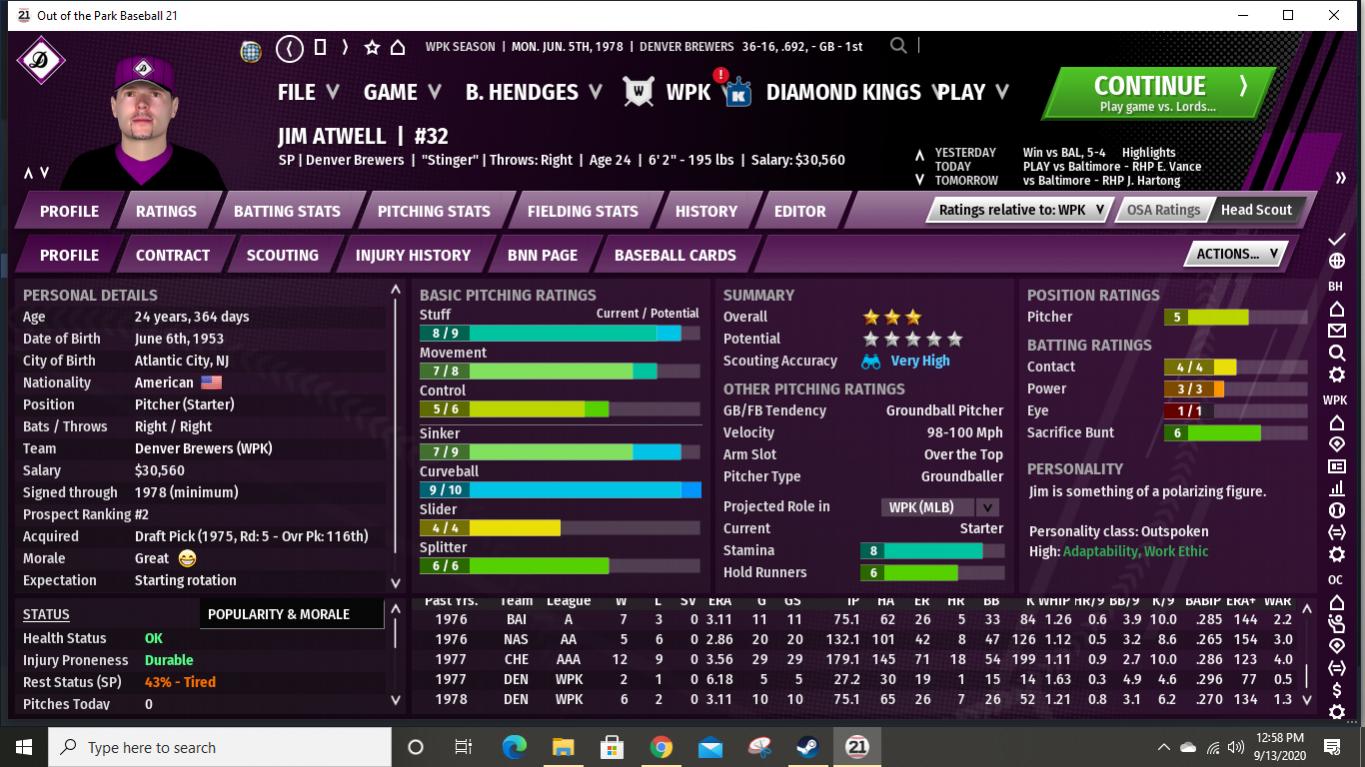
 3- Jim Atwell
, Denver Brewers, 24 year old right-handed starting pitcher.
Curveball rating: 9
But many around the WPK consider this man, the Brewers rookie phenom, to be the true heir to the title of best pitcher in the MGL. With his overhead curve already considered elite the thought is that it may even develop a bit more and that combined with a still improving sinker that can reach triple digits on the radar gun, Atwell's pure stuff has a chance to be the best in the game. The young man who turns 25 tomorrow looks to have a bright future in the WPK.
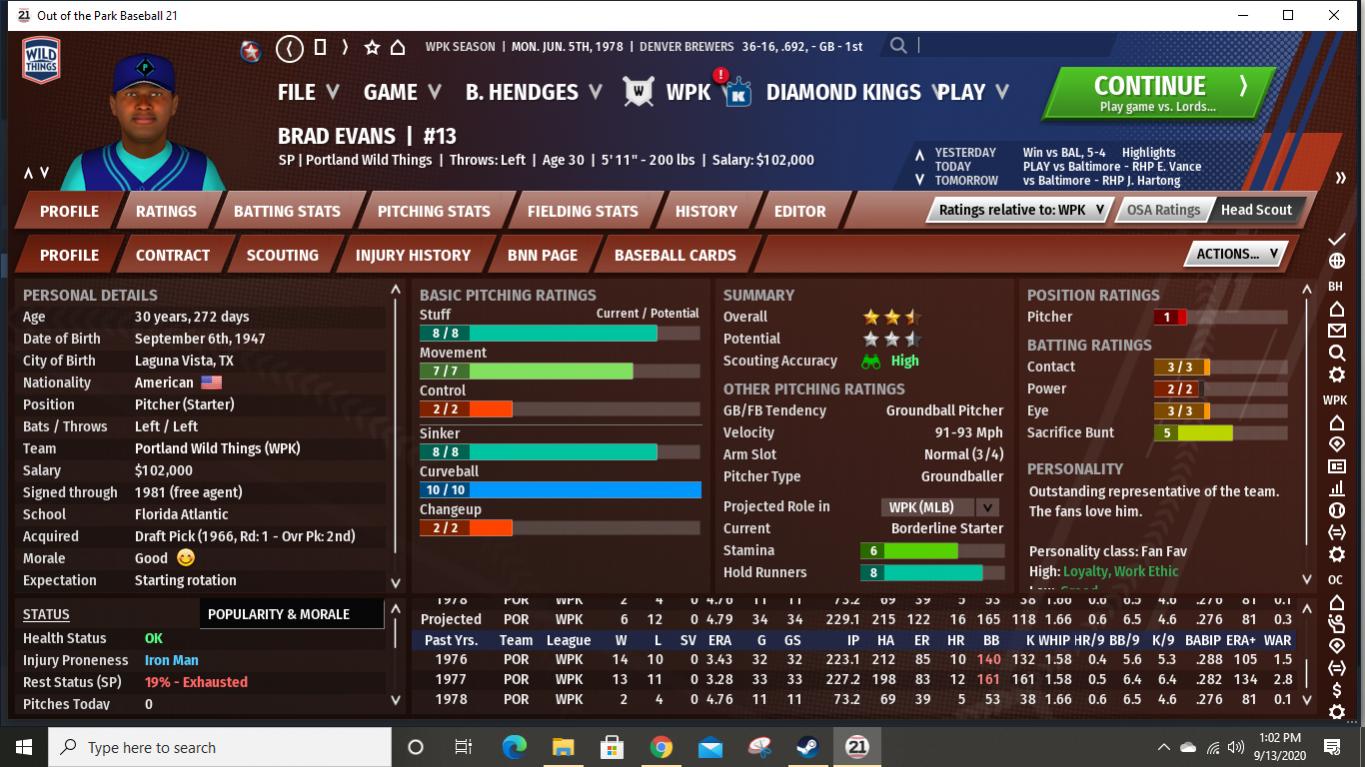
 2- Brad Evans
, Portland Wild Things, 30 year old left-handed starting pitcher.
Curveball rating: 10
Brad Evans is a conundrum wrapped in an enigma. Okay, maybe not. But he is an interesting case. Last season he set a new WPK record by walking 161 batters. He had led the league the previous year with a mere 140 bases on balls issued. And yet in both seasons he had winning records- on a less than stellar team- and ERA's in the low 3's. And while his tremendous sinker which he uses to great effect to induce ground ball outs is a big reason for his success, there can be little doubt that he has one of the finest roundhouse curves in the game. Now if he only he could catch the strike zone a bit more consistently.
 1- Joel Travino
, Brooklyn Aces, 29 year old left-handed starting pitcher.
Curveball rating: 9
Veteran Venezuelan lefty Joel Travino pairs maybe the best changeup in the game with one of the best curves to have almost surely the best stuff in the game, in spite of rarely even hitting 90 mph with any of his pitches. And it's a darn good thing since he has poor control and struggles with command issues, being prone to giving up home runs. He set a new single-season strikeout record in the WPK last season with 285 K's. It could be argued that this is the wrong list for him to top- and let's face it, if this was a list of the best changeups in the game he would probably also be at #1. But for his performance last year he gets this top spot. For now. Likely before long either Atwell or Shetler will replace him here.
