Quote:
Originally Posted by Matt Arnold

To be accurate, you need to look at both the gate revenue AND season ticket revenue to get the full picture for teams. So in your example, Bristol had overly high season ticket sales (2000+) so they only had a handful of fans extra each game, that's why they only cleared 82 pounds in gate receipts during the season. But they're at or near the top in season tickets, so those sales are dominating for you.
|
OK, then that being the case, can you consider combining gate revenue with season ticket revenue to reflect a total ticket revenue figure within
the Financial Report? Because when the Financial Report was developed, there was only gate revenue reflected. But now that you have improved this area by splitting gate and season ticket revenue into separate line items, the ticket revenue part of the Financial Report is an iteration behind and doesn't properly reflect this important change. Would you consider fixing this?
Quote:
Originally Posted by Matt Arnold
The next issue deals with actual attendance figures being off from your expected values. I think the problem there is mostly with teams' ticket prices. I've added extra "protection" so that setting your ticket prices too high would have a larger effect on your attendance - ie. if your team's settings currently support a 25$ ticket price, and you set them to 50$, your attendance will drop by more than half. It works great when you have leeway, but since your team's ticket prices are all in the 2-4 cent mark, if a team has an expected ticket price of 2 cents, and they set their ticket price to 3 cents, the game sees that as them trying to gouge their fans by 50%, so it ends up dropping their attendance to nearly half of what is expected. And since we generally round values to the penny, it can really throw things out of whack.
So that I think is likely why your minors attendance has cratered. A few teams have ticket prices set "too high", and it's blowing everything out of proportion. Also, I noticed a lot of teams have market sizes that are non-existant in the minors, and a lot of our attendance calculations are based on the league having an average market size that's, you know, average. Market sizes in-game are always used relative to the league the team is in, so having leagues that deviate from that can cause the numbers to vary.
|
I don't set the ticket prices in my fictional league. They all set their own ticket prices. But here is the thing: not one team changed its ticket price from 1931 to 1932. Not a single one, even though I lowered the suggested ticket price by -17%. It is not unusual for teams to change their ticket prices en masse. Since the war there have been four seasons in which every team changed their ticket prices (1922, 1923, 1928, 1931). But in most seasons the majority of teams do NOT change ticket prices: on average only, between 27% and 41% of teams change ticket prices. 1932 was the first season in which none of them changed ticket prices. That's unusual, but then, I moved the game from 14 to 16 for the 1932 season. but bottom line: ticket price changes had exactly zero effect, because there were none.
I also did an analysis on how changes in other attributes might have affected attendance change. The change in how a team finished in the table had a correlation of +0.04 to attendance change. Correlation to fan interest: +0.05. Correlation to fan loyalty: -0.15. (That's minus zero point one five.) So across the league, there is no correlation between ticket prices, fan loyalty, fan interest or finish to attendance change. When you look division by division there is a touch more correlation: in Divisions 1 and 2 there is a slightly better correlation between fan interest and attendance change, and a negative correlation between finish and attendance change (which there should be: the better the finish, the lower the number). But in Division 3 it's the opposite: slightly worse finish equaled better attendance gains, and slightly less fan loyalty equaled better attendance gains. It's backward.
I have attached the analysis in .xls form, if you (or anyone else) is interested.
Quote:
Originally Posted by Matt Arnold
Otherwise, I do notice in your D3 league that most teams have sold way more season tickets than expected. When did you change your league financial settings? They should be changed at the start of the off-season, either the day after the WS or at the latest when FAs file.
|
I didn't change any financial settings in relation to season tickets, since I was not exactly aware it was even there (it wasn't in 14). I makes changes to the league's financial setting once a year, at the beginning of the offseason. Here is a screenshot of the changes I made in these attributes from 1931 to 1932:
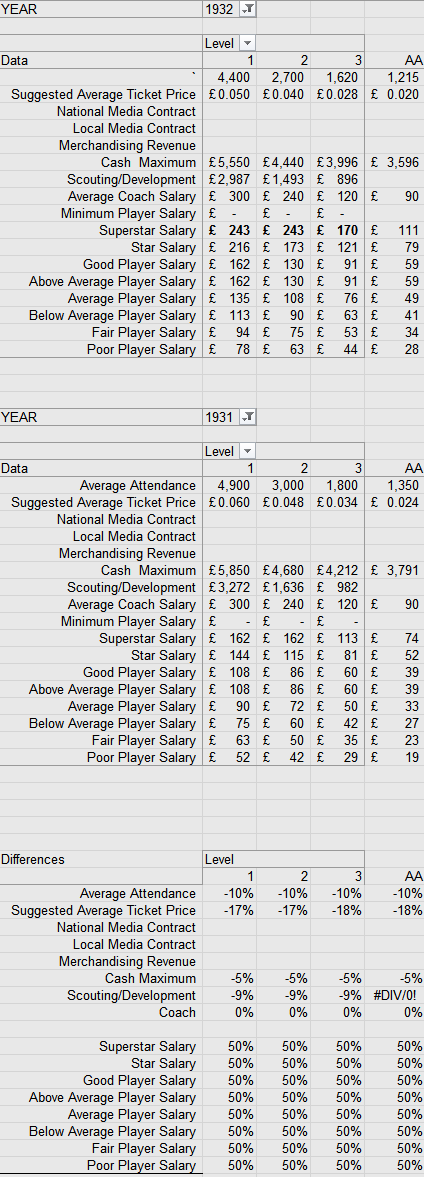
The real dramatic one, player salaries, is a correction from the dramatic cut made between 1930 and 1931, which itself did not have any effect on attendance.
Quote:
Originally Posted by Matt Arnold
So a few potential recommendations for you:
-In the minor league, I would suggest setting the "fixed ticket price" flag, to have all teams charge the same. You could even do this for the other leagues as well, but the higher the baseline, the less crazy the problem would be (ie. with a baseline of 5 cents, then teams will almost always stay in the 4-6 cent range, and even if they "pick wrong", they should still be close enough to not cause attendance to crater)
-All financial changes and team moves need to be done before free agents file. This will also help ensure that you don't have "last year"'s financials affect this season's season ticket sales.
|
I can try the change in the minor league, since I don't care nearly as much about what happens there as I do in the major league.
As for when to make the changes, I have no free agency, so free agents don't file. I have a reserve clause. I also have no farm systems or draft, so all new players are signed as free agents off the open market (not to be confused with major league free agents which, again, my league does not have).
Quote:
Originally Posted by Matt Arnold
Such small financial numbers the game will always have a bit of trouble handling, and especially when you add in relegation and other financial changes year to year, we do our best, but you run into troubles.
Let me know if you have other questions or if I missed something while looking at this, but if you do the above before next season, I would expect the results to be closer to what you expect.
|
OOTP 14 had no trouble handling any of this. That said, I do realize you made changes and that we're not in OOTP 14 anymore, Dorothy.

I will do a test run between 1932 and 1933 and see whether there is stability or not, and let you know. But the main thing to remember is this: Not all of my leagues experienced this problem equally. The First Division was fine, going down -16%. The Second Division was a bit goofy, up some +12% for average attendance. But the Third Division went absolutely bonkers, up almost +100%. And dward posted in this same thread that he experienced the same problem. That's why I wondered whether something in the coding might have been "off".