I'm a fictional guy and I'm gonna get started with a fictional history using all the historical progression from 1901 through modern times. I'm running a test league and I've noticed that I have a hard time discerning the quality of deadball era hitters. Unlike in modern baseball, the players just don't stand out to me. I can't tell who's great, good, average, etc. Also, I don't know what qualities to look for in building a roster or how to pick my batting order.
I simmed from 1901-1930 just to make sure things looked good before I start a new league with the same settings but controlling a team. So I'm looking in the history index and discussing a team at random, the fictional 1912 Red Sox. For reference, they finished 81-73 in 4th place in the 8-team league.

I sorted these guys by VORP, a stat I don't ever use but I figured would work well for this. All guys with at least 100 AB are shown. I'll try to explain what I'm seeing, then I ask for you guys who are better informed to tell me where I'm wrong/right.
So the top two guys appear to be far and away the best...highest AVG, OPS, 3B, SB, BB, and low K. I'm guessing based on R and RBI totals, George batted 1st and Soalhes batted 3rd. But the next five guys seem quite interchangeable to me.
The thing that sticks out next is Sherrill. He smoked everyone with 137 RBI, but had only 30 XB
with 1 HR. His OPS is 2nd lowest among the 8 starting position guys. So how in the world was he able to drive in so many runs? Is it purely because he had the 3rd highest AVG despite it not being considerably higher than the rest?
Also, since I just simmed straight through to 1930 in this test, I didn't watch any games. But I see that Hit & Run is "very high" in this era. That said, would it be prudent to have a guy like Rose (.297, 0 HR, but only 4 K) bat cleanup and push a guy like Arredondo down to 7th or 8th because of his 100 K, ignoring his 33 2B and 7 HR? Where and why would you slot the rest of the guys?
Also, I have to mention the SB/CS. I wonder why there were so many attempts when they're thrown out half the time. Does this have something to do with missed swings on hit & run plays? If so, is that truly a viable strategy? Also, at what point is a guy considered to have exceptional lead off speed or not? Should I cut back on the stealing sliders to avoid losing so many base runners throughout the year?
While on the subject of speed, are triples hitters to be viewed as if they're modern-day home run hitters? Who gets preferential treatment in slotting higher in the order...a triples hitter like O'Brien or an avoids K guy (for hit & run) like Rose?
Lastly, is defense more/less/equally important as it is modern-day? Are any positions to be considered differently like Turn DP for middle infielders? Perhaps more emphasis on infield defense over outfield defense considering the lack of power? Or more speed and better arms in the outfield to cut down on opposing triples? Strong catcher arm with so many steal attempts or will they likely get thrown out anyway?
I'm sure I'm missing some more key points. It's tough seeing a rhyme and reason to building a team and then properly utilizing the players.
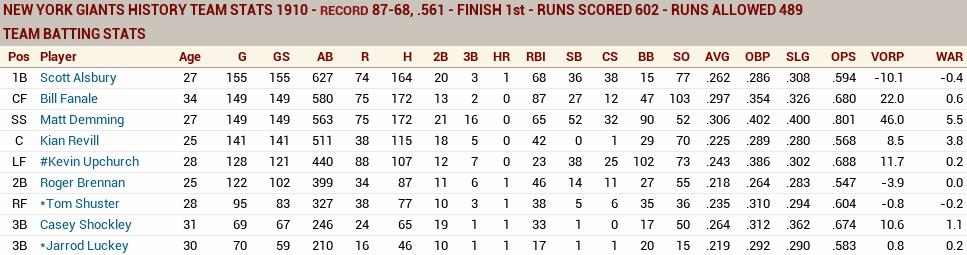
Below I've also included the fictional 1910 Giants, an 87-68 1st place team in a year when hitting was far less ubiquitous. They are sorted by AB. Feel free to analyze them as well, particularly why Matt Demming had so few R and RBI considering ALL of his other stats were significantly better than anyone else on the team. How would I be able to get more from this guy if I were the manager?
I can't wait to hear back from you deadball aficionados looking to school me a bit on this fascinating era. Have some fun with this and thanks a bunch for helping!